
By Saloni Nagar, Medically Reviewed by Dr. Jimisha Shah, B.V.Sc & A.H., PGDAW
Searching for the calcium phosphorus ratio in cats often starts with a simple question: What is the Ca:P ratio in cat food, and what do those two mineral numbers on a food label actually mean together?
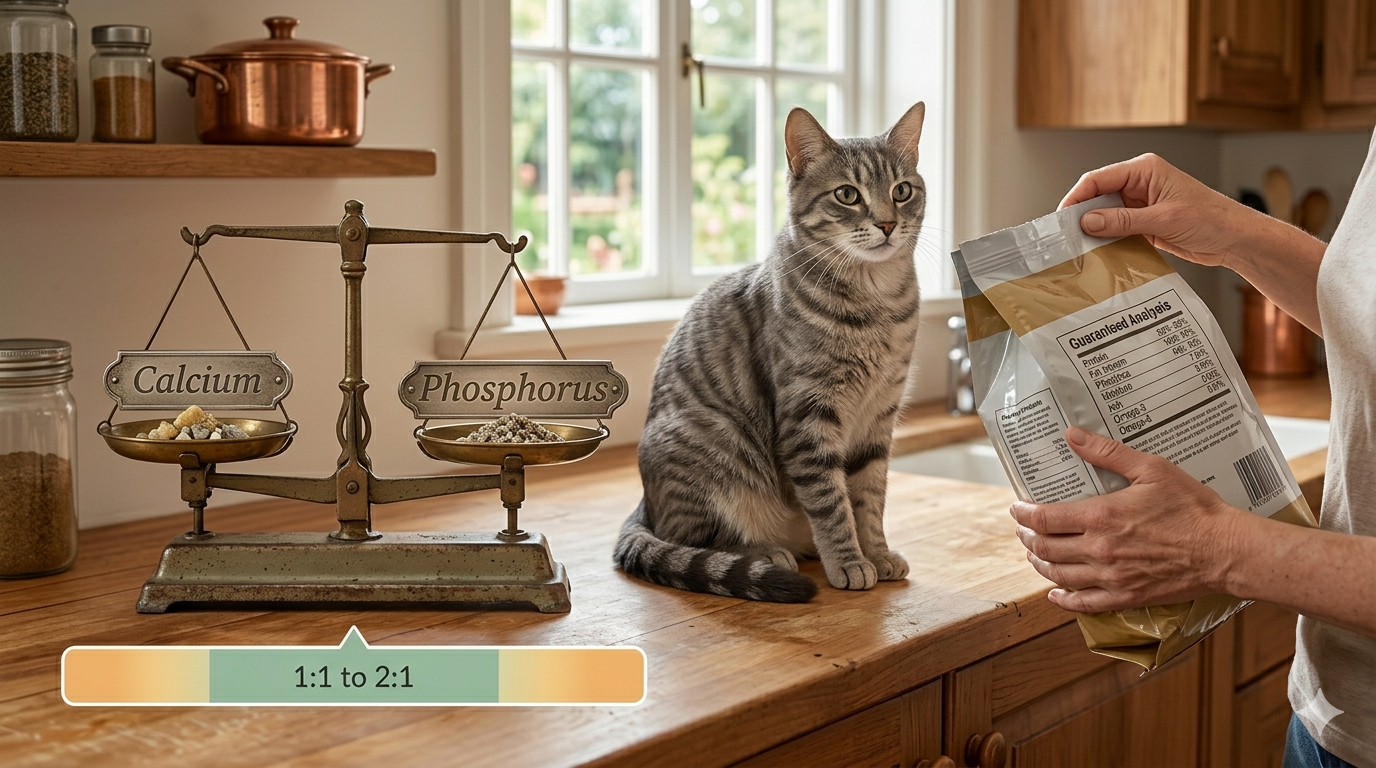
The calcium-to-phosphorus ratio, often written as Ca:P, describes the relationship between calcium and phosphorus in a cat’s diet. The recommended Ca:P ratio for cats generally falls between 1:1 and 2:1 for adult cats. In simple terms, for every one part phosphorus, there should be at least one part calcium and no more than two parts calcium.
This ratio matters because the calcium-phosphorus interaction in cats affects how both minerals are absorbed. Calcium and phosphorus share absorption pathways in the digestive tract. When one mineral becomes excessive, it can reduce how much of the other the body absorbs. Over time, poor calcium-phosphorus balance cats can affect bone strength, muscle function, and overall mineral status.
Unlike many nutrients, where the total amount is the main concern, the relationship between calcium and phosphorus in the food, not just how much of each is present, determines how your cat’s body handles them. A food may contain enough calcium on paper, but still provide less usable calcium if phosphorus levels are too high.
Most cat food labels list calcium and phosphorus as separate percentages. However, they rarely explain whether those values fall within a safe calcium phosphorus ratio that cats should receive. Maybe a friend mentioned the calcium phosphorus ratio, and I realized I had never heard of it before, or perhaps you noticed the calcium and phosphorus numbers on the bag but had no idea what they meant when you first looked closely at a label.
Many cat owners find themselves in the same situation. They know the ratio matters, but they are not sure what a healthy ratio looks like in real life. Some owners say their vet mentioned the “ratio” but never really explained what it was, while others feel they picked up the bag, and the guaranteed analysis panel was completely unclear.
This article builds that understanding step by step. It explains what calcium does for cats, what phosphorus does for cats, and why their balance matters. It also covers AAFCO calcium phosphorus cats guidelines, FEDIAF calcium phosphorus cats recommendations, how cats absorb these minerals, and why the source of phosphorus can matter just as much as the amount.
No background in feline nutrition is required. Every concept is explained in plain language while remaining accurate to the science behind it.
Calcium and Phosphorus in Cats: What They Do
Before the ratio between calcium and phosphorus makes sense, it helps to understand what each mineral does inside a cat’s body.
My vet mentioned the “ratio” but never really explained what it was, and my cat seems totally fine, which made it harder to see why the numbers matter at all. Both reactions are completely understandable. Neither mineral usually causes obvious day-to-day symptoms when everything is working normally.
The next two sections look at calcium and phosphorus separately. The third section then brings them together to explain why their relationship deserves the most attention.
What Does Calcium Do for Cats?
Calcium gives a cat’s bones and teeth their hardness, and it also enables nerve signaling and muscle contraction throughout the body. This is why calcium needs aren’t a simple “more is better” equation. The mineral has to be available for moment-to-moment nervous and muscular function, not just long-term skeletal structure.
Bone and teeth structure: About 99% of the calcium in a cat’s body is stored in the skeleton and teeth. There, it provides the hardness that helps bones withstand everyday stress. This is the most familiar role of calcium for cat bones and teeth, and it is often the first answer people think of when asking what calcium does for cats.
Nerve signal transmission: The small amount of calcium circulating in the bloodstream is essential for the cat’s calcium nerve function. Without enough calcium, communication between the brain and the rest of the body becomes less reliable.
Muscle contraction: Does calcium affect cat muscles? Yes. Every muscle contraction depends on calcium. This includes voluntary movements, such as jumping onto a counter, and involuntary actions, such as the heartbeat.
Blood clotting: Calcium plays a necessary role in the chain of events that allows blood to clot after an injury.
Cellular signaling: Calcium also works as an internal messenger inside cells. It helps regulate hormone release, enzyme activity, and immune responses.
Many owners thought calcium was only about bones and did not know it affected nerves and muscles too. That assumption makes sense because most discussions about calcium focus on skeletal strength.
When people ask why do cats need calcium in diet, the answer comes down to how tightly the body controls blood calcium levels. Veterinary physiology shows that a cat’s parathyroid glands constantly regulate calcium in the bloodstream. If dietary intake falls short, the body pulls calcium from the bones to keep blood levels stable.
This also connects to the question of how much calcium does a cat need. As the next section explains, the answer depends not only on calcium intake but also on phosphorus levels.
Many people thought calcium was only about bones and did not know it affected nerves and muscles too. That assumption is understandable because most discussions about calcium focus on skeletal strength.
Why do cats need calcium in their diet comes down to how tightly the body controls blood calcium levels. Veterinary physiology shows that a cat’s parathyroid glands carefully regulate circulating calcium. If dietary calcium falls short, the body pulls calcium from the bones to keep blood levels stable.
This connects directly to the question of how much calcium a cat needs. As the next section explains, the answer depends as much on phosphorus as it does on calcium itself.
The roles listed above come from established veterinary physiology guidance. Here’s exactly where that foundation sits.
- Bone and skeletal development
- Muscle contraction and movement
- Nerve signal transmission
- Blood clotting mechanisms
- Hormone and enzyme release
- Cell-to-cell communication
While many cat owners associate calcium only with bones, veterinary physiology references consistently show that calcium influences nearly every major body system. This is why both calcium deficiency and calcium excess can have significant health consequences.
What Does Phosphorus Do for Cats?
Phosphorus works alongside calcium to build the mineral structure of bone. It also powers an entirely separate job at the cellular level by storing and transferring energy. Because phosphorus is naturally present in almost every animal-based ingredient cats eat, outright dietary shortage is uncommon, while excess relative to calcium is the more frequent practical concern.
Bone mineral component: In bone, calcium and phosphorus combine to form hydroxyapatite, the hard mineral structure inside your cat’s bones. Put simply, the crystalline mineral that makes bones hard is formed from both calcium and phosphorus together. It makes up most of a bone’s dry weight. Neither mineral can create that strength alone. This is a key part of the answer to whether phosphorus affects cat bones, alongside calcium’s structural role.
Energy metabolism: Phosphorus and energy in cats are closely connected. Phosphorus forms part of ATP, the molecule every cell uses to store and transfer energy.
DNA and RNA structure: Phosphate groups help build the structural backbone of DNA and RNA. This makes phosphorus essential when cells divide or produce new proteins.
Cell membrane integrity: Phospholipids contain phosphorus and form the outer membrane of every cell in a cat’s body.
Acid-base balance: Phosphate also helps maintain normal pH levels in the blood and inside cells. This supports healthy enzyme function throughout the body.
So, what does phosphorus do for cats? In short, it supports bone structure, energy production, cell function, and many other essential biological processes.
This leads to another common question: is phosphorus good or bad for cats? The answer is neither. Phosphorus is essential, and a cat’s body cannot function without it. Phosphorus in cat food what is it, practically speaking, is a naturally occurring mineral found in meat, organs, fish, and eggs. Most feline diets provide more than enough to meet minimum requirements.
Because of that, why do cats need phosphorus is often not the most useful question. The more important one is how much phosphorus a food contains compared with calcium. That relationship is where most real-world nutritional concerns begin.
🦴 Organic Phosphorus Sources in Common Cat Food Ingredients
| Ingredient | Approx. Phosphorus (mg/100 g) | Phosphorus Type |
|---|---|---|
| Chicken Breast | 210 mg | Organic |
| Turkey | 200 mg | Organic |
| Beef | 180 mg | Organic |
| Pork | 220 mg | Organic |
| Chicken Liver | 330 mg | Organic |
| Beef Liver | 470 mg | Organic |
| Sardines | 490 mg | Organic |
| Salmon | 250 mg | Organic |
| Egg Yolk | 390 mg | Organic |
| Bone Meal | 5,000+ mg | Organic |
📌 Note:
The phosphorus listed above occurs naturally (organic phosphorus) within animal tissues and ingredients. Organic phosphorus is generally absorbed more gradually than many inorganic phosphate additives. When evaluating a cat food, also review the ingredient list for added phosphate compounds such as sodium phosphate, potassium phosphate, dicalcium phosphate, tricalcium phosphate, and phosphoric acid, as these can contribute additional phosphorus to the diet.
Why the Ca:P Ratio Matters More Than Amounts?
Calcium and phosphorus are absorbed through linked pathways in a cat’s small intestine. The amount of one mineral affects how much of the other gets absorbed. This is why veterinary nutritionists focus on the ratio between these minerals rather than looking at either one as a standalone number.
Calcium and phosphorus compete for the same absorption pathways in the small intestine, and that competition is the main reason the ratio gets so much attention. Calcium phosphorus ratio cats explained in simple terms: it is a comparison, written as Ca:P, that shows how many parts calcium are present for every part phosphorus in a food.
Why does the ratio matter in cat food? Because these minerals interact during absorption. An imbalance in either direction can affect how the body handles both minerals, even when each percentage appears reasonable on its own. This concept is often described by the phrase what is the Ca:P ratio of cat food, and understanding it makes the science much easier to follow.
In real-world diets, excess phosphorus is the more common concern. Too much phosphorus affects calcium in cats in a specific way. When phosphorus is elevated, it can bind to calcium in the gut, so less calcium actually gets absorbed. As phosphorus levels rise, the parathyroid gland may release hormones that pull calcium from bone to help maintain normal blood calcium levels.
Over time, the body may rely on stored calcium from bone, even when the food appears complete and balanced on paper. This is one reason veterinarians pay close attention to calcium-phosphorus balance in cats rather than looking at calcium or phosphorus alone.
The opposite situation, where calcium is much higher than phosphorus, is less common. However, it can still reduce phosphorus absorption. In some cases, it may also interfere with the absorption of minerals such as zinc, magnesium, and iron. This two-way calcium-phosphorus interaction in cats explains why neither mineral should be evaluated by itself.
This is also why absolute numbers can be misleading without context. A food with 1.2% calcium and 1.5% phosphorus has a Ca:P ratio of about 0.8:1. That falls below the commonly recommended minimum, even though neither number looks unusually high.
Now consider a food with 1.8% calcium and 0.9% phosphorus. Its ratio is close to 2:1, which sits near the upper end of the commonly accepted range. At first glance, the calcium percentage may seem high, but the mineral balance is very different.
Many cat owners say they started reading labels more carefully after realizing the ratio matters more than the individual numbers. That shift is often helpful. In the end, the relationship between calcium and phosphorus in the food, not just how much of each is present, determines how your cat’s body handles them. That principle forms the foundation for everything that follows in this article.
Calcium-to-Phosphorus (Ca:P) Ratio Interpretation Guide
| Ca:P Ratio | Interpretation | What It May Mean |
|---|---|---|
| Less than 0.8 : 1 | Low Calcium Relative to Phosphorus | Calcium is substantially lower than phosphorus. Long-term feeding may not provide an appropriate mineral balance for healthy bone maintenance. |
| 0.8 : 1 to <1.0 : 1 | Slightly Low | Calcium is slightly lower than commonly recommended. Review the complete nutrient profile and verify the food is nutritionally complete and balanced. |
| 1.0 : 1 to 2.0 : 1 | Commonly Recommended Range | Calcium equals or moderately exceeds phosphorus, consistent with commonly referenced feline nutrition guidance for healthy adult cats. |
| >2.0 : 1 to 2.5 : 1 | Slightly High | Calcium is noticeably higher than phosphorus. Compare with the manufacturer’s nutrient analysis and feeding recommendations. |
| Greater than 2.5 : 1 | High Calcium Relative to Phosphorus | Calcium substantially exceeds phosphorus. The overall diet should be reviewed to ensure appropriate mineral balance. |
📌 Reference
Many feline nutrition references, including AAFCO and FEDIAF guidance, recommend maintaining a calcium-to-phosphorus ratio of approximately 1:1 to 2:1 for complete and balanced diets intended for healthy cats. The ratio should always be interpreted alongside the food’s complete nutrient profile, life-stage suitability, and overall nutritional adequacy rather than in isolation.
Now that each mineral’s role is clear and the reason behind the ratio makes sense, the next question is practical: what does a safe ratio actually look like? More importantly, what range do the regulatory organizations that oversee cat food consider acceptable? The next section explains the recommended calcium-to-phosphorus ratio and the standards used to define it.
Safe Calcium Phosphorus Ratio for Cats: The Guidelines
With each mineral’s role now clear, the next step is understanding what a “safe” ratio actually looks like in practice. The sections below explain what regulatory and industry organizations currently recommend for the Ca:P ratio.
You’ll also learn how to calculate the ratio from a cat food label and why the number you calculate may not always match the nutrients your cat ultimately receives from the food.
What AAFCO and FEDIAF Define as the Safe Ca:P Range for Cats?
The safe calcium phosphorus ratio for cats are generally fed within is a range between 1:1 and 2:1, a figure published by FEDIAF. This range is widely referenced across veterinary nutrition guidance. AAFCO, the body that sets US pet food standards, takes a different approach. It currently requires calcium and phosphorus to each meet a separate minimum amount rather than enforcing this ratio directly, so the two regulatory approaches describe similar territory from slightly different angles.
A bag of cat food certified as “complete and balanced” lists calcium and phosphorus minimums on the label. What it rarely shows is an actual ratio figure anywhere on the package. Many owners had always assumed “complete and balanced” on the label covered everything important. That’s a reasonable assumption, given how prominently the phrase appears compared to the mineral numbers themselves.
According to nutritional guidelines established by FEDIAF, the European pet food industry federation, a recommended Ca:P ratio for cats falls between 1:1 and 2:1 for adult maintenance. Kitten growth formulas lean toward roughly 1.5:1, to support faster bone mineralization. FEDIAF calcium phosphorus cats guidance treats this ratio as a defined target, rather than just a byproduct of two separate minimums.
AAFCO calcium phosphorus cats standards work differently. Current Cat Food Nutrient Profiles set a minimum calcium level of around 1% and a minimum phosphorus level of around 0.8% on a dry matter basis for adult maintenance. AAFCO does not currently enforce an upper limit on either mineral, or a maximum ratio between them.
| Life Stage | AAFCO Requirement | FEDIAF Recommended Ca:P Range |
|---|---|---|
| Adult maintenance | Minimum Calcium ~1%, Minimum Phosphorus ~0.8% (dry matter basis); no enforced maximum ratio currently set | 1:1 to 2:1 |
| Growth (kittens) | Higher minimum Ca and P than adult maintenance; no enforced maximum ratio currently set | ~1.5:1 preferred |
| All life stages | Must meet growth minimums; no enforced maximum ratio currently set | 1:1 to 2:1 |
This difference helps explain why normal calcium phosphorus ratio cat food discussions can become confusing. One source describes a regulatory minimum, while another recommends a target range. Both are useful, but they are not measuring exactly the same thing.
Industry reporting suggests that AAFCO members have discussed adding a phosphorus maximum and a specific calcium-to-phosphorus ratio requirement in future meetings. As of this writing, however, those changes have not been added to the official Cat Food Nutrient Profiles.
Life stage also matters. The calcium phosphorus range for kitten food usually falls closer to the upper half of the recommended range. Growing kittens build new bone much faster than adult cats, which increases their mineral needs during development.
In practical terms, looking for foods where the calcium value is at least equal to, and ideally a little higher than, the phosphorus value is a useful rule of thumb. It captures the basic goal of the 1:1 to 2:1 range without requiring a detailed calculation every time.
Many owners felt reassured when a food met standards but now understand that is just the starting line. Meeting a minimum standard provides a baseline, but it does not guarantee that a food sits in the most favorable part of the range for every cat.
Likewise, recognizing that “complete and balanced” means a food meets minimum standards, not that every option is equally ideal for mineral balance can help shift how you evaluate cat food labels. That understanding leads naturally into the next step: learning how to calculate the ratio yourself so you can see where a specific food falls.
For this reason, AAFCO values cited throughout this article were sourced from the individual calcium and phosphorus minimum requirements rather than a formal ratio recommendation.
Unlike AAFCO’s current profile structure, FEDIAF explicitly discusses maintaining an appropriate calcium-to-phosphorus balance and provides ratio guidance commonly referenced by veterinary nutritionists when evaluating diet formulation.
As a result, nutrient recommendations may appear different even when the underlying nutritional goals are broadly similar.
However, at the time of writing, these discussions and proposed revisions have not fully replaced the currently published Cat Food Nutrient Profiles that remain in active use by manufacturers.
Where ratio discussions appear in this article, they are primarily derived from published veterinary nutrition literature and FEDIAF guidance. Where individual nutrient minimums are referenced, they are based on the current official AAFCO Cat Food Nutrient Profiles.
With a clear understanding of the safe range and where those recommendations come from, the next step is applying that knowledge to a real food label. The following section shows you how to find the numbers, calculate the ratio, and interpret what the result actually means in practice.
How to Calculate the Ca:P Ratio From a Cat Food Label?
Calculating a food’s Ca:P ratio is a simple four-step process. It starts with the calcium and phosphorus percentages listed on the label and ends with a single number you can compare to the 1:1 to 2:1 range. In most cases, you’ll also need to adjust for moisture because wet and dry foods cannot be compared directly otherwise.
Many owners have picked up the bag and the guaranteed analysis panel was completely unclear. That reaction is understandable. The panel is dense, uses unfamiliar terms, and was not designed with ratio calculations in mind.
Cat food guaranteed analysis explained simply: the guaranteed analysis panel is the nutrition box on a pet food label. It lists minimum or maximum percentages for nutrients such as protein, fat, fiber, moisture, calcium, and phosphorus.
Many cat owners have never thought to look past the protein percentage on the label, which is understandable given how heavily protein content is marketed. Calcium and phosphorus appear in the same panel. Once you know where to look, they are just as easy to find.
The calculation itself follows four steps:
Find the values. Locate calcium (%) and phosphorus (%) on the guaranteed analysis panel. These are usually listed as minimums, such as “Calcium min 0.8%.”
Convert to dry matter basis. As-fed values include moisture, so you need to remove that variable. Dry matter % equals the as-fed % divided by (1 minus the moisture %). For example, if moisture is 78% and phosphorus is 0.3% as-fed, the dry matter phosphorus value is about 1.36%.
Calculate the ratio. Divide the calcium dry matter % by the phosphorus dry matter %. A food with 1.5% calcium and 1.0% phosphorus on a dry matter basis has a ratio of 1.5:1. That sits comfortably within the safe range.
Check against the safe range. A result below 1:1 suggests a phosphorus-heavy balance. A result above 2:1 suggests a calcium-heavy balance.
This step matters because converting nutrients to a dry matter basis removes the “water” variable so you can fairly compare one food to another. A wet food may appear to contain less calcium than a dry food on the label. Once moisture is removed, it may actually contain more.
Many owners did not realize how differently wet and dry foods look once you convert them to dry matter. That reaction is common when someone compares foods side by side for the first time. Dry matter basis cat food explained in simple terms means removing water from the equation so every food can be compared fairly, regardless of whether it is wet or dry.
How to read cat food label minerals ultimately comes down to checking both calcium and phosphorus together instead of judging either number on its own. Neither number tells the full story by itself.
A useful habit is converting the label values to dry matter before comparing two different foods instead of relying on as-fed numbers alone. This gives you a more meaningful comparison.
Think of using the ratio calculation as a quick screening tool rather than a precise medical measurement. As the next section explains, the numbers printed on the label do not always reflect the exact mineral content in the food.
For many pet owners, reading the label in the aisle and not knowing what I’m actually supposed to look for is the biggest challenge. This four-step process helps close that gap.
Knowing how to calculate the ratio is valuable. However, the result is only as reliable as the numbers printed on the label. Those numbers come with limitations that are worth understanding before treating any calculation as definitive.
Why Cat Food Labels Aren’t Always Accurate?
The calcium and phosphorus figures on a guaranteed analysis panel are declared minimums, not exact measured amounts. This means the actual mineral content of a bag or can may run higher than what’s printed. This gap exists because of how pet food labeling regulations work and because natural ingredients vary from batch to batch. It’s not a sign of any error on the part of the owner reading the label.
The numbers on the guaranteed analysis are declared minimums, not exact measured amounts, and that fact explains much of the confusion around as-fed vs. dry matter cat food comparisons and label interpretation in general.
A declared minimum of 0.8% calcium means the food contains at least that amount. The actual level may be higher and still comply with labeling rules. Research published in the Journal of Veterinary Internal Medicine found that measured calcium and phosphorus levels in commercial cat foods were often higher than the minimum values printed on the label. This pattern was statistically significant across the foods tested.
Part of this cat food nutrient analysis accuracy issue comes from a simple reality. Natural variation in meat and bone ingredients means the real mineral levels can sit above the declared minimums on the label. Differences in meat sources, organ content, and bone meal quality can change mineral levels from one production batch to another.
This variation is often called analytical variability, meaning the natural difference between what a label guarantees and what laboratory testing measures in real products. It is a normal part of pet food manufacturing and does not automatically indicate poor quality control.
Many owners have switched to a more expensive food, assuming the minerals would take care of themselves. In reality, price and mineral balance do not necessarily move together. A higher-priced food may contain better protein or fat sources, but price alone does not tell you where calcium and phosphorus fall on a dry matter basis.
Another common challenge occurs when phosphorus is missing from the label. A cat food label with phosphorus not listed is a real issue because phosphorus disclosure is not required in every market.
Some owners find that the food lists phosphorus but not calcium so I had no way to check the balance. Others encounter the opposite problem. In either case, calculating the ratio from the package alone becomes impossible.
Can I trust the cat food label nutrients completely in that situation? Not entirely. The issue is not dishonesty. The issue is that minimum values leave room for actual nutrient levels to be higher than what appears on the label.
Many pet owners have started second-guessing the food I’d been feeding for years once I heard about the ratio. That reaction is understandable. It does not necessarily mean there is a problem with a food that has worked well for years.
A more practical approach is to use the manufacturer’s full nutrient profile sheet as your main mineral reference instead of relying only on the package. These documents usually provide typical or average analyzed values rather than minimum guarantees. Manufacturers can often provide them upon request.
It can also help to get into the habit of saving a photo of the label and your ratio calculation to show your veterinarian at the next check-up. This gives you something concrete to discuss with a professional instead of trying to interpret the information entirely on your own.
While checking a food label one evening, Racheal, who shares her home with a young Birman named Mishka, realized she had never thought to look past the protein percentage on the label. After working through the dry matter calculation, she found the ratio sat comfortably within the recommended range. That experience made future label checks feel much less intimidating.
Understanding what a label can and cannot tell you is only part of the story. The ratio printed on a package and the ratio your cat’s body actually processes are not always the same. That is exactly where the next section begins.
Calcium and Phosphorus For Cats: How Absorption Works
Once the label side of things is clear, the next step is understanding how do cats absorb minerals. The number printed on a bag and the amount a cat’s body actually absorbs are not always the same.
The next three sections explain how cats absorb calcium from food, how cats absorb phosphorus, and what blocks calcium absorption in cats, even when a cat eats a well-balanced diet.
Together, these concepts help explain why the ratio a cat’s body ultimately uses does not always match the ratio printed on the label.
The Step-by-Step Process of How a Cat’s Gut Absorbs Calcium
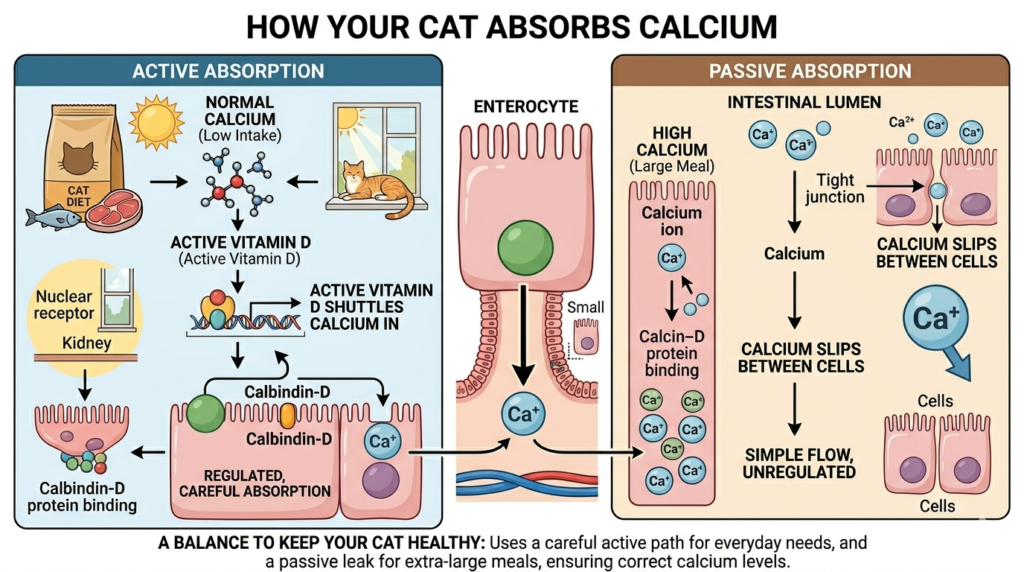
A cat’s intestine absorbs calcium through two pathways that work side by side. One pathway is actively regulated based on the body’s needs. The other allows calcium to pass through based on concentration alone.
Active calcium transport depends on the body switching on vitamin D into its usable form. The passive pathway works regardless of how much calcium the body needs at that moment.
How do cats absorb calcium from food? The process relies on these two absorption mechanisms. The first, active transport, takes place mainly in the upper small intestine. The body increases this pathway when it needs more calcium and reduces it when calcium levels are already adequate.
The second pathway, often called passive paracellular absorption (calcium moving between intestinal cells based on concentration rather than active regulation), occurs throughout the small intestine. It does not respond to the body’s calcium needs. As a result, very high dietary calcium levels can increase absorption through this route.
Does vitamin D help cats absorb calcium? Yes. The active transport pathway cannot function without it. According to the Merck Veterinary Manual, calcitriol (the active form of Vitamin D that switches on calcium absorption in the gut) plays a key role in increasing intestinal absorption of both calcium and phosphorus.
Once calcium enters intestinal cells through Vitamin D-regulated channels, it binds to calbindin-D (a carrier protein inside gut cells that helps move calcium into the bloodstream). This protein transports calcium across the cell before releasing it into the bloodstream.
Why does this matter when looking at mineral balance? The answer goes back to the relationship between calcium and phosphorus discussed earlier.
When phosphorus is elevated, it can bind to calcium in the gut, so less calcium actually gets absorbed. Some phosphorus attaches directly to calcium in the intestine before either mineral can be absorbed. These bound complexes are then excreted instead of entering the body.
This means the amount of calcium available to the body may be lower than the food’s declared calcium percentage suggests. Even when the calcium content stays the same, high phosphorus levels can reduce how much calcium the body actually uses.
Why Cats Absorb Phosphorus Differently Than Calcium
Phosphorus crosses into a cat’s bloodstream through a different, and much more efficient, route than calcium. This route does not slow down simply because the body already has enough. This efficiency explains why _why is phosphorus hard to limit in cats through diet alone, compared with calcium, which the body can increase or decrease according to need.
How cats absorb phosphorus centers on transport proteins in the small intestine. Research published in the Journal of Feline Medicine and Surgery describes phosphorus absorption as occurring mainly through sodium-phosphate cotransporters (a highly efficient transport system that pulls phosphorus across the gut wall).
Phosphorus is absorbed through very efficient transport mechanisms that do not switch off easily. Once phosphorus reaches the gut, a large portion is usually absorbed. This happens whether or not the body needs that amount at the time.
This highlights a broader pattern in feline mineral metabolism. Cats process minerals differently from omnivores because they evolved on animal-based diets. The body has tighter control over how much calcium it pulls in than how much phosphorus it absorbs.
Calcium absorption adjusts based on the body’s needs. Phosphorus absorption stays relatively steady and efficient under most conditions. As a result, when excess phosphorus enters the bloodstream, the body must deal with it after absorption.
The kidneys handle most of that work. They filter and excrete phosphorus that the body does not use, rather than relying on the intestine to absorb less of it in the first place.
The difference between calcium and phosphorus absorption becomes easier to understand when viewed side by side. The table below compares the two systems across the factors that matter most when evaluating mineral balance and reading pet food labels.
⚖️ Calcium vs. Phosphorus Absorption Comparison
| Parameter | Calcium | Phosphorus |
|---|---|---|
| Primary Site of Absorption | Mainly absorbed in the small intestine, particularly the upper small intestine where vitamin D enhances uptake. | Mainly absorbed throughout the small intestine with generally high efficiency. |
| Dominant Absorption Mechanism | Actively regulated according to the body’s calcium needs. | More passive absorption, with a substantial amount absorbed regardless of immediate body requirements. |
| Regulatory Control | Highly regulated by vitamin D, parathyroid hormone (PTH), and calcitonin. | Moderately regulated, although absorption is generally more efficient than calcium. |
| Response to Excess Intake | The body can reduce calcium absorption when dietary intake is high. | Excess dietary phosphorus is often readily absorbed, increasing the body’s phosphorus load. |
| Kidney Involvement | Kidneys help fine-tune calcium balance after absorption. | Kidneys play the primary role in excreting excess phosphorus and maintaining phosphorus balance. |
| Effect of Food Source | Bioavailability varies depending on whether calcium comes from bone, supplements, or other ingredients. | Bioavailability is highly influenced by the source. Inorganic phosphate additives are typically absorbed more efficiently than naturally occurring organic phosphorus. |
📌 Practical Takeaway
Calcium absorption is tightly regulated by the body, whereas phosphorus is generally absorbed more readily, particularly when it comes from inorganic phosphate additives. This difference helps explain why diets high in added phosphates may increase phosphorus exposure even when calcium intake appears adequate.
It’s a detail that surprises many people the first time they hear it.
Many owners have said they did not realize phosphorus absorption was something that even varied. They often assumed minerals were absorbed in fixed amounts, regardless of where they came from. In reality, absorption can vary significantly based on the form of phosphorus in the food.
That variability, and the factors behind it, help explain why the number on a food label does not always match what a cat’s body actually absorbs. The next section explores those differences in more detail.
What Dietary Factors Disrupt Calcium Absorption In Cats?
Several everyday dietary factors can reduce how much calcium a cat actually absorbs, even from a food that looks complete and well-formulated on paper. Most of these factors bind calcium in the gut before it reaches the bloodstream. Others reduce the Vitamin D activity that calcium absorption depends on.
What blocks calcium absorption in cats starts with the mechanism already discussed. Excess dietary phosphorus can bind to calcium in the intestine, forming insoluble complexes that pass out of the body rather than being absorbed. Vitamin D inadequacy is another major factor. Without enough active Vitamin D, the regulated absorption pathway described earlier can slow down significantly.
In practical terms, a cat may consume enough calcium on paper but still absorb very little of it.
Plant ingredients add another layer to the picture. Phytate compounds found in some plant ingredients can latch onto calcium before it has a chance to cross the gut wall, carrying it out in the feces instead of allowing it to enter the bloodstream.
This connects directly to a common misconception. Grain-free food, calcium absorption, and cats’ discussions often assume that removing grains automatically improves mineral absorption. However, many grain-free formulas replace grains with legumes such as peas, lentils, or chickpeas. These ingredients can also contain meaningful amounts of phytates.
Many owners have assumed grain-free meant fewer additives and a cleaner mineral profile. In reality, calcium absorption depends more on the specific ingredients in the formula than on whether grains are present.
Taken together, these factors rarely act alone. A food may contain adequate calcium on paper but also be high in phosphorus, include phytate-containing legumes, and sit at the lower end of Vitamin D adequacy. When several of these factors occur together, they can create multiple barriers to calcium absorption.
This is exactly why the ratio printed on a label can become increasingly disconnected from what a cat’s body actually receives.
These factors rarely cause concern on their own; it’s when several appear together in the same food that the gap between label ratio and absorbed ratio can widen.
🔍 Calcium & Phosphorus Absorption Disruptor Checklist
Review your cat’s food label and check any factors that apply. The more boxes you check, the more topics you may want to discuss with your veterinarian when evaluating your cat’s diet.
☐ High-phosphorus ingredients or phosphate additives appear near the top of the ingredient list.
☐ Vitamin D adequacy is unknown or not declared by the manufacturer.
☐ The food contains significant amounts of peas, lentils, chickpeas, or other phytate-containing legumes.
☐ The recipe includes spinach, beet greens, or other oxalate-containing plant ingredients.
☐ The diet is unusually high in fat compared with typical commercial cat foods.
☐ A grain-free formula relies heavily on legumes as replacement ingredients.
✅ Interpreting Your Checklist
| Boxes Checked | Interpretation |
|---|---|
| 0–1 | Low disruptor count. Few obvious dietary factors that may influence calcium or phosphorus utilization were identified. |
| 2–3 | Moderate disruptor count. Several ingredients or formulation factors may be worth reviewing more closely. |
| 4–6 | Higher disruptor count. Multiple dietary characteristics may influence mineral utilization and deserve further evaluation, particularly if your cat has specific nutritional or health concerns |
📌 How to Use This Checklist
This checklist is not a diagnostic tool. It simply highlights dietary characteristics that may influence calcium and phosphorus utilization. The results should be considered alongside the food’s complete nutrient profile, life-stage suitability, and your veterinarian’s recommendations.
With a clear understanding of how mineral absorption works, one final layer becomes important. Not all phosphorus in cat food behaves the same way once it reaches the gut. The source of the phosphorus can strongly influence how much the body absorbs. That’s exactly what the next section explores. It looks at why phosphorus from meat and phosphorus from additives can behave differently, and why that difference matters when evaluating a food’s mineral profile.
Phosphorus in Cat Food: Why Type Matters
Now that you know how to calculate the calcium-to-phosphorus ratio in cat food values from a label and understand where that calculation has limits, the next step is to look at something the numbers alone cannot show. Not all phosphorus behaves the same way once it reaches a cat’s gut. The previous section explained how absorption can create a gap between the ratio printed on a label and the ratio a cat’s body actually uses.
This section looks at one of the biggest reasons for that difference: the source of the phosphorus itself. The next three sections explore the organic-versus-inorganic distinction, the specific additives involved, and how to spot phosphorus additives in cat food ingredients on a label.
The Difference Between Organic and Inorganic Phosphorus in Cat Food
Phosphorus in cat food comes from two distinct sources: naturally occurring phosphorus found in whole-food ingredients and mineral-salt phosphorus added during manufacturing. A cat’s digestive system handles each type differently. Because the guaranteed analysis reports only one total phosphorus value, two foods with the same phosphorus percentage can deliver very different amounts of absorbed phosphorus.
Organic vs inorganic phosphorus cat food comparisons begin with where the phosphorus comes from. Organic phosphorus bound inside meat protein is released more slowly as the protein is digested. Chicken, beef, fish, eggs, and organ meats all contain phosphorus that is tied to protein structures. The body must digest those proteins before it can release and absorb the phosphorus. This process naturally slows absorption and helps moderate how much phosphorus enters the bloodstream at one time.
What is inorganic phosphorus in cat food, by contrast, refers to phosphorus added as a mineral salt rather than being naturally bound to protein. Inorganic phosphorus from additives is absorbed almost completely, with very little left behind in the gut, because it reaches the intestine in a free form that is ready for absorption. It does not require the digestion step that organic phosphorus does.
This difference is invisible on most cat food labels. The guaranteed analysis lists total phosphorus as a single value and does not separate organic and inorganic sources. As a result, a food that relies heavily on phosphorus additives in cat food can deliver more absorbed phosphorus than a food with a higher total phosphorus level that comes mainly from meat ingredients.
Many owners have had no idea that the type of phosphorus in the food made a difference because the label does not show this distinction. This ties directly to the concept of bioavailability. Bioavailability refers to how much phosphorus a cat actually absorbs compared with how much passes through the digestive tract. In practice, absorption matters more than the printed phosphorus percentage alone.
One owner working through a label calculation found a ratio that looked reassuring on paper. However, a closer review of the ingredient list revealed several phosphate additives near the top. The experience highlighted that the food looked balanced on paper but turned out to depend on where the phosphorus came from.
Research published in the Journal of Feline Medicine and Surgery has reported that diets containing large amounts of highly soluble inorganic phosphorus sources tend to cause a faster and larger rise in blood phosphorus after a meal than diets where phosphorus comes mainly from whole-food ingredients. This finding helps explain why the safe Ca:P range was developed using whole-food-based diets as the reference. It also shows why a food that relies heavily on additives may function differently, even when its label ratio appears acceptable.
🦴 Phosphorus Source Type Decoder
Use this quick reference when reading your cat food’s ingredient list. It can help you distinguish between naturally occurring (organic) phosphorus and added inorganic phosphate ingredients.
| Feature | Organic Phosphorus Sources | Inorganic Phosphorus Sources |
|---|---|---|
| Usually Found In | Chicken, turkey, beef, duck, lamb, fish, eggs, liver, other organ meats, and bone-containing ingredients | Sodium phosphate, potassium phosphate, dicalcium phosphate, monocalcium phosphate, tricalcium phosphate, phosphoric acid, sodium acid pyrophosphate |
| Typical Purpose | Naturally present within animal tissues as part of whole-food ingredients | Added during manufacturing for preservation, texture, acidity control, moisture retention, or mineral supplementation |
| Absorption Pattern | Generally absorbed more gradually as part of whole-food nutrients | Often absorbed more efficiently than naturally occurring phosphorus |
| Example Ingredient List | Chicken, Turkey Liver, Salmon, Egg Product | Chicken, Chicken Broth, Sodium Phosphate, Potassium Phosphate |
📌 Quick Rule
- If the ingredient is a meat, fish, egg, liver, or another organ meat, it is usually a naturally occurring (organic) phosphorus source.
- If the ingredient contains words such as “phosphate” or “phosphoric,” it is usually an added inorganic phosphorus source.
Important: Both organic and inorganic phosphorus contribute to a cat’s total phosphorus intake. However, inorganic phosphate additives are generally more readily absorbed than naturally occurring phosphorus, which is why ingredient lists deserve careful review when comparing foods.
Which Specific Additives Contribute Inorganic Phosphorus to Cat Food
A handful of specific mineral compounds account for most of the phosphorus additives in cat food. Once you know what to look for, you’ll start seeing them regularly on ingredient lists. Manufacturers use these compounds because they are inexpensive, shelf-stable, and easy to measure accurately. They are not added to hide anything from the label.
| Additive Name | What It Is | Why It’s Used | Absorption Pattern |
|---|---|---|---|
| Dicalcium phosphate in cat food | A calcium-and-phosphorus mineral salt | Adds both minerals in a single inexpensive ingredient | Inorganic source; no digestion step needed before absorption |
| Monocalcium phosphate | A more acidic calcium-phosphorus salt | Mineral fortification | Inorganic source; no digestion step needed before absorption |
| Sodium phosphate in cat food | A sodium-and-phosphorus mineral salt | Doubles as a preservative, texture aid, and mineral source | Inorganic source; among the more soluble forms studied in feeding research |
| Potassium phosphate | A potassium-and-phosphorus mineral salt | Mineral supplementation plus pH control | Inorganic source; no digestion step needed before absorption |
| Phosphoric acid in cat food | A liquid acidic phosphorus compound | Used as a preservative and acidity adjuster | Inorganic source; enters the gut already in fully soluble, free form |
| Calcium phosphate (tribasic) | A high-calcium phosphate compound | Mineral supplementation | Inorganic source; no digestion step needed before absorption |
Manufacturers choose these compounds because they deliver consistent mineral levels from batch to batch. They are also less expensive than many natural mineral sources. In many formulas, they serve more than one purpose, such as helping preserve texture or adjust acidity while also supplying phosphorus.
The trade-off is that these additives provide phosphorus in a highly absorbable form. Nothing slows the absorption process down. This differs from phosphorus naturally found in meat, which must first be released from protein during digestion.
These additives appear most often in heavily processed dry kibble, pâté-style wet foods, and formulas that rely on plant-based protein sources. In these products, natural phosphorus from meat may be lower, so manufacturers often add phosphorus to meet minimum nutritional requirements.
Many owners are surprised when they examine an ingredient list more closely. The ingredient list had three different phosphate compounds and I had no idea what that meant for my cat is a common reaction. Most cat owners have never had a reason to look for this pattern before.
How to Identify High-Absorption Phosphorus Ingredients on a Cat Food Label
How to spot phosphorus additives in cat food comes down to checking the ingredients list rather than the guaranteed analysis panel. The ingredients list is where individual compounds are named. The position of an ingredient also gives a rough idea of how much it contributes because ingredients are listed in descending order by weight.
The ingredients list in phosphate cat food entries is usually easy to identify once you know what to look for. Common examples include anything ending in “phosphate,” such as dicalcium phosphate, sodium phosphate, potassium phosphate, and monocalcium phosphate. Phosphoric acid is another ingredient to watch for, even when it appears simply as an acid on the label.
The position of a phosphate ingredient on the label shows how much of the formula it makes up. A phosphate listed among the first several ingredients may contribute more phosphorus than one found near the end of a long ingredients list. This is especially worth noting when it appears before or alongside the main protein source.
A useful habit is scanning the ingredients list for any item that ends in “phosphate”. Count how many phosphate-containing ingredients appear and note where they are located in the list. Treating multiple phosphate additives high in the ingredient list as a sign to ask more questions before choosing that food is a reasonable approach.
This does not automatically mean the food is unsuitable. It simply means the ingredient list may deserve a closer look before assuming the label ratio tells the whole story. Some owners specifically compare cat food with fewer phosphorus additives when narrowing down their options. This can be a practical way to compare foods without needing exact bioavailability data.
As a simple shortcut, if you find two or more phosphate-containing additives anywhere in the ingredients list, it is reasonable to view the food’s effective phosphorus load as somewhat higher than the calculated label ratio alone suggests. Think of it as a useful mental adjustment rather than a reason for alarm.
After researching a few unfamiliar ingredients online, James brought his questions to his veterinarian during Otis’s next checkup. The food he fed his middle-aged Russian Blue contained three phosphate-sounding additives near the top of the ingredients list. After reviewing the label, the veterinarian felt the overall mineral balance looked appropriate. That conversation helped James feel more confident when reading future cat food labels.
With the foundation now in place, we can move to the next important question: what happens inside a cat’s body when the calcium-to-phosphorus ratio stays out of balance for a long time?
So far, we’ve covered what each mineral does, what a safe ratio looks like, how absorption works, and why the source of phosphorus affects how much the body absorbs. The next step is understanding the biological effects of an ongoing imbalance.
The following section explains the hormonal changes involved, the specific conditions linked to an improper ratio, and how skeletal changes can develop before any obvious signs appear.
For the full biological explanation of the hormonal cascade, the named conditions involved, and how skeletal changes can progress before any outward signs appear, the next article in this series continues with: Article 2: What Happens Inside a Cat’s Body When the Calcium-Phosphorus Ratio Goes Wrong — The Full Biological Explanation.
Conclusion
The calcium-to-phosphorus ratio is not a complicated concept once you understand what each mineral does. More importantly, you need to understand why their relationship matters more than either mineral amount on its own. The 1:1 to 2:1 range discussed throughout this article provides a practical benchmark for cat owners. However, finding a meaningful answer for a specific food requires looking beyond the label and understanding how cats absorb these minerals, as well as where the phosphorus comes from.
By this point, you have a foundation built around several connected ideas. You now understand what calcium and phosphorus do in a cat’s body and why neither should be judged alone. You have also learned what the recommended range looks like, how to calculate it from a food label, and why absorption can make the ratio inside the body different from the ratio printed on the package.
You have also seen why phosphorus sources matter. Organic vs inorganic phosphorus cat food comparisons are important because phosphorus from whole meat and phosphorus from additives do not behave the same way. What is inorganic phosphorus in cat food becomes especially relevant when you consider how much of it may actually be absorbed.
If your cat’s food falls outside the 1:1 to 2:1 range, or if you notice several phosphorus additives in cat food listed near the top of the ingredients panel, it may be worth discussing the food with your veterinarian. That conversation can help determine whether the food fits your cat’s life stage and overall health needs.
No diet decision should rely on label analysis alone. However, an owner who has reviewed the numbers and ingredients is often better prepared to ask informed questions than someone who has never looked at them.
Questions to Ask Your Vet
- Whether your cat’s current food lists both calcium and phosphorus on the guaranteed analysis panel, and if not, how to get that information from the manufacturer
- Whether the dry-matter Ca:P ratio you’ve calculated for your cat’s food falls within the range your vet considers appropriate for your cat’s life stage
- How many ingredients ending in “phosphate” appear in your cat’s food, and roughly how high up the ingredients list they sit
- Whether your cat’s current life stage or health history calls for a different point within the safe range than a general adult guideline would suggest
- Bringing a photo of your cat’s food label and your own ratio calculation to your next check-up as a starting point for discussion
FAQ — Calcium Phosphorus Ratio For Cats
Q1: What is the normal calcium-to-phosphorus ratio for adult cats?
Veterinary nutrition guidance commonly references a Ca:P ratio between 1:1 and 2:1 for adult cats, a range explicitly recommended by FEDIAF, the European pet food industry body. US standards set by AAFCO currently establish separate minimum levels for calcium and phosphorus rather than enforcing this exact ratio as a rule, though the two approaches describe similar territory. If you want to know exactly where your cat’s current food falls, your veterinarian can help interpret the numbers alongside your cat’s individual situation.
Q2: Why does the ratio matter more than just the phosphorus amount?
Because calcium and phosphorus compete for the same absorption pathways, a phosphorus level that looks unremarkable on its own can still create an imbalance if there isn’t enough calcium relative to it. The ratio captures that relationship in a way that looking at either number by itself cannot. This is part of why nutrition guidance tend to focus on the ratio rather than either mineral in isolation.
Q3: Can I trust the Ca:P ratio shown on a cat food label?
Not entirely, labels show declared minimums rather than the actual analyzed content, and research on commercial cat foods has found that real mineral levels often run higher than what’s printed. Treat a label-based ratio calculation as a useful screening estimate rather than a precise figure, and check the manufacturer’s detailed nutrient data where it’s available. If you have specific concerns about a particular food, your vet can help you weigh that alongside your cat’s needs.
Q4: What is the difference between organic and inorganic phosphorus in cat food?
Organic phosphorus comes from whole-food ingredients like meat and organs and has to be released through digestion before it’s absorbed, which moderates the amount and pace of absorption. Inorganic phosphorus comes from additives such as sodium phosphate or phosphoric acid and enters the gut already in a free, readily absorbable form. Two foods with identical phosphorus percentages on the label can behave differently in the body depending on which type makes up most of that total.
Q5: Does the safe ratio range change for kittens and senior cats?
FEDIAF guidance suggests growing kittens benefit from a ratio closer to the calcium-dominant end of the range, around 1.5:1, to support faster bone mineralization during growth. The general 1:1 to 2:1 range is the commonly cited benchmark across life stages, though how much an imbalance matters in practice can shift with age and kidney function. A topic covered in more depth later in this series. Your veterinarian is best placed to advise on what’s appropriate for your cat’s specific life stage.
Q6: How do I find the phosphorus content of my cat’s food if the label doesn’t show it?
Phosphorus isn’t legally required on pet food labels in every market, so if it’s missing, contacting the manufacturer directly and asking for the typical analyzed phosphorus content on a dry matter basis (after removing the water so you can compare foods fairly) is a reasonable next step. Many brands publish detailed nutrient spreadsheets on their websites or will provide them on request, and some third-party pet food databases compile analyzed values for various commercial brands. If you’re unable to find this information and have concerns, your veterinarian or a veterinary nutritionist can help you evaluate the food another way.
Disclaimer: This article is written for educational purposes only and does not replace professional veterinary advice. Always consult a licensed veterinarian before making changes to your cat’s diet or health management.
References and Sources
Peer-Reviewed Research
- Summers, S.C., Quimby, J.M., Phillips, R.K., Stockman, J., and Bhaleroa, S.K. (2020). Evaluation of phosphorus, calcium, and magnesium content in commercially available foods formulated for healthy cats. Journal of Veterinary Internal Medicine. https://onlinelibrary.wiley.com/doi/10.1111/jvim.15689
- Coltherd, J.C., Staunton, R., Colyer, A., Thomas, G., Gilham, M., Gilham, M., Butterwick, R.F., and Watson, P. (2021/2022). The form of dietary phosphorus affects its absorption and influences calcium and phosphorus homeostasis in adult cats. British Journal of Nutrition. https://pmc.ncbi.nlm.nih.gov/articles/PMC9592954/
- Stockman, J. (2024). Dietary phosphorus and the feline kidney: what do we know and what do we need to find out? Journal of Feline Medicine and Surgery. https://pmc.ncbi.nlm.nih.gov/articles/PMC11529143/
- Bartges, J.W. (2016). Calcium oxalate urolithiasis in cats. Journal of Feline Medicine and Surgery. https://journals.sagepub.com/doi/10.1177/1098612X16660442
- Parker, V.J., Gilor, C., and Chew, D.J. (2015). Feline hyperparathyroidism: pathophysiology, diagnosis and treatment of primary and secondary disease. Journal of Feline Medicine and Surgery. https://pmc.ncbi.nlm.nih.gov/articles/PMC10816244/
Veterinary and Institutional Guidelines
- FEDIAF (European Pet Food Industry Federation). Nutritional Guidelines for Complete and Complementary Pet Food for Cats and Dogs. Referenced via Coltherd et al. (2021/2022), citing FEDIAF 2019 and 2021 editions. https://pmc.ncbi.nlm.nih.gov/articles/PMC9592954/
- AAFCO (Association of American Feed Control Officials). Cat Food Nutrient Profiles — Adult Maintenance and Growth and Reproduction. Current profiles referenced via Cat Food Central nutritional guidelines summary and AAFCO official meeting documentation. https://catfoodcentral.co/kb-article/aafco-nutritional-guidelines/
- National Research Council (NRC). (2006). Nutrient Requirements of Dogs and Cats. Referenced via Summers et al. (2020) for phosphorus and calcium safe upper limit context. https://onlinelibrary.wiley.com/doi/10.1111/jvim.15689
- University of Minnesota Veterinary Urolith Center. Step-by-Step Risk Management for Calcium Oxalate (CaOx). Referencing Ehrlich et al. (2024) guidance on Ca:P ratio management in cats with concurrent CKD and idiopathic hypercalcemia. https://vetmed.umn.edu/urolith-center/advice-and-facts/step-step-risk-management-calcium-oxalate-caox
Market and Trend Context
- Mordor Intelligence. (2024–2025). United States Cat Food Market Report. Referenced for freeze-dried, raw-frozen, and fresh/refrigerated cat food format household penetration estimates. https://www.mordorintelligence.com/industry-reports/us-cat-food-market

Saloni Nagar is the founder and lead content creator of Bark & Meow Tales. As a dedicated cat parent and researcher, she transitioned from personal loss to pet health advocacy, focusing on early warning signs and preventive care. Saloni specializes in translating complex veterinary concepts into actionable guidance for pet parents. Her work is driven by a commitment to helping others interpret subtle feline health signals before they escalate, ensuring that every cat has a voice through informed, compassionate care.