
By Saloni Nagar, Medically Reviewed by Dr. Jimisha Shah, B.V.Sc & A.H., PGDAW
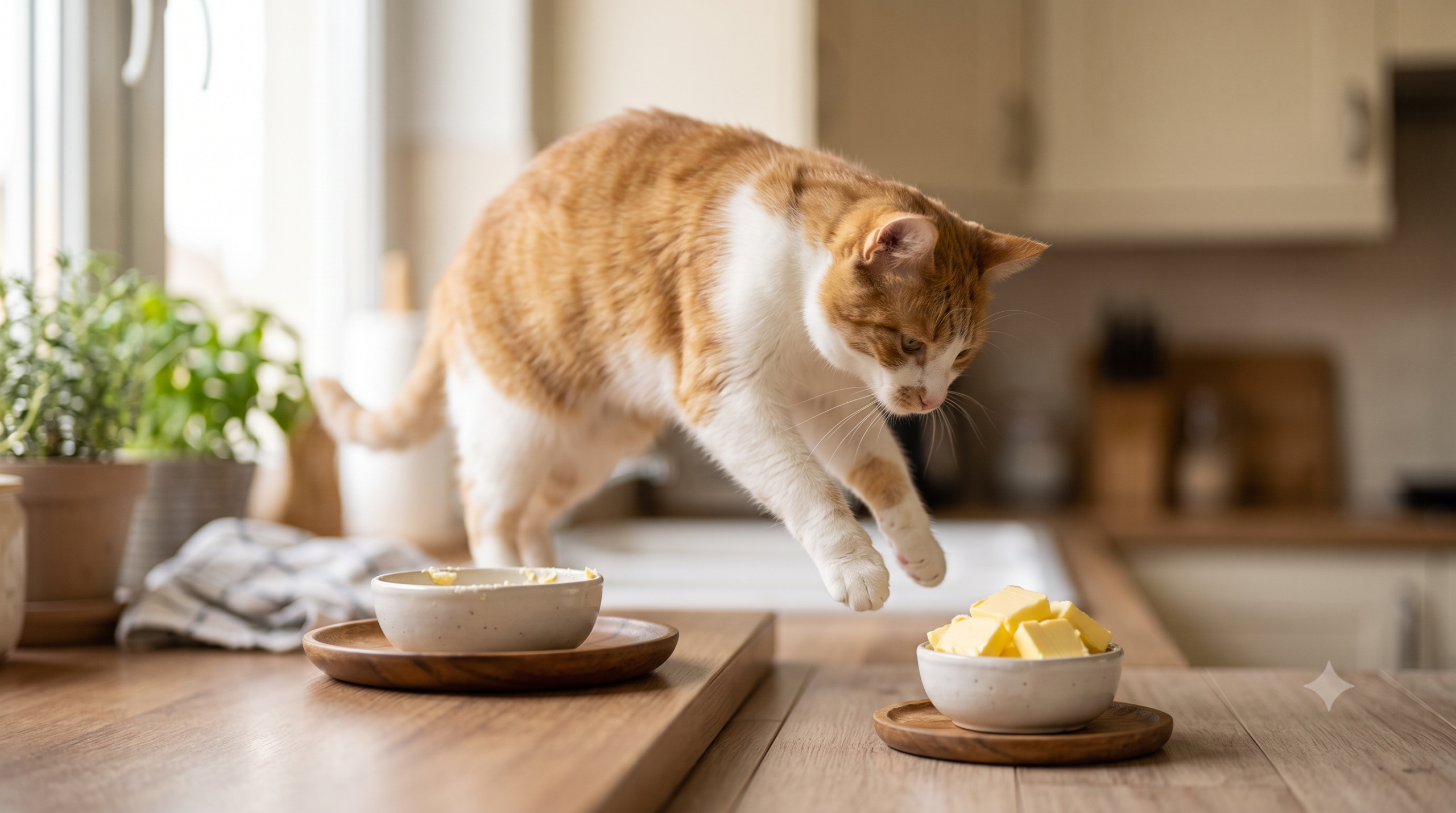
Cats are famous for turning away from foods that humans find irresistible. Offer a lick of frosting, a spoonful of ice cream, or a taste of birthday cake. Most cats will sniff it once and walk away. Dogs, by contrast, may go to great lengths for the same sugary snacks. This difference isn’t a coincidence, and it isn’t simply about personality.
Cats can’t taste sweet things because they lack a functional version of the Tas1r2 gene. This gene is needed to build sweet taste receptors. At some point in feline evolution, it became a non-functional pseudogene, meaning it lost its original function. As a result, cats’ taste buds cannot detect sugar. Unlike dogs, which retain the ability, this trait is found in domestic cats.
If you’ve seen your cat walk away from ice cream, ignore cake batter, or show no interest in sugary snacks, it isn’t just picky behavior. It’s a hardwired biological trait. Understanding this can explain some confusing reactions to human food. It also clears up a common misconception: sugar in cat treats isn’t there because cats crave sweetness. They cannot perceive sweetness in the first place.
This matters if you want to understand your cat’s food preferences more closely. It also helps explain what makes cats such specialized carnivores. Below, we’ll look at the signs of this trait, the science and genetics behind it, and what it means for treats and sugar in your cat’s diet.
Cats Show No Interest in Sweet Food
This section looks at what this indifference looks like in everyday life. Most owners notice these patterns before they understand why they happen.
We’ll cover common moments when the trait shows up. Then, we’ll compare them with the very different way dogs react to the same foods. Together, these examples set the stage for the science explained in the next section.
Why Does My Cat Ignore Ice Cream?
Cats routinely show no interest in sugary human foods, often sniffing them briefly before losing interest entirely. This is a normal and expected pattern across the species, not a sign of pickiness or a health concern.
Your cat gives that cake one sniff and turns away, and that reaction tends to repeat no matter how many times the same treat is offered. You offer a lick of ice cream and get total disinterest, just as a bowl of frosting or whipped cream often goes untouched. It can feel almost personal when your cat snubs your favorite dessert, especially if you’re used to sharing it with other pets or family members who react enthusiastically to it.
Watching your cat walk away from something sweet without a second glance is one of the most consistent behaviors owners report. It’s also easy to misread. Theodore, a Ragdoll owner, noticed his cat sniffed a dropped bite of birthday cake at a family gathering and walked away without touching it. He mentioned it to his vet during a routine weigh-in, and the vet confirmed this was expected feline behavior.
Your cat’s nose does all the investigating before any decision is made, and that instinct to sniff first and decide later never really goes away. A cat sniffing then rejecting food is simply gathering information, not judging whether the food is “good” in the way a dog might.
Most owners never even notice this trait until dessert is on the table, and that’s often when the question comes up: Is it normal for a cat to have zero interest in ice cream or cake? The short answer is yes. A cat not eating ice cream or cake is not, by itself, a sign of a problem.
Common Sweet-Food Reactions Checklist
Cats generally show little interest in sweet-tasting foods because they lack a functional sweet-taste receptor. This checklist is for observation only. Sweet human foods should not be offered as treats, especially foods containing chocolate, xylitol, raisins/grapes, or other potentially harmful ingredients.
| ✓ | Sweet Food Example | Common Observable Reaction |
|---|---|---|
| ☐ | Banana | Sniffs it, may give a brief lick, then walks away |
| ☐ | Plain cooked pumpkin | Sniffs, investigates briefly, and may show little further interest |
| ☐ | Plain cooked sweet potato | May sniff or take a small lick, then lose interest |
| ☐ | Plain cooked carrot | Often sniffs and walks away or gives only a brief exploratory lick |
| ☐ | Watermelon | May sniff, lick once or twice, then stop |
| ☐ | Plain apple flesh | May investigate the smell but show complete disinterest |
| ☐ | Plain pear flesh | May sniff and walk away without eating |
| ☐ | Plain cooked peas | May briefly investigate or lick, with little sustained interest |
What this tells you: A cat’s lack of interest in these foods does not mean the cat is “picky about sweetness.” Cats have a fundamentally different taste system from humans and generally do not experience sweetness the way we do.
Safety note: Do not use chocolate, candy, desserts, sugar-free products, or
Why Do Dogs Like Sweets But Not Cats?
Dogs typically show strong interest in sugary human food, while cats show the opposite pattern almost universally. This difference comes down to a genetic difference between the two species, which the next section explains in detail.
Your dog would practically climb the counter for that same treat your cat just ignored, and this contrast is one of the clearest ways owners first notice the trait. There’s a reason your cat never begs at the dinner table for cake, even when dogs and cats live together and share the same foods. A cat never begs for sweet snacks is not a training difference or a matter of manners. It reflects a basic difference in how each species experiences flavor.
The difference between your cat’s and dog’s reactions says a lot about why comparing the two species around sweets can be misleading. Dogs love sweets, but cats don’t, and that isn’t because cats are more disciplined or less motivated by food. Many cats are highly motivated by savory, meaty foods. The difference points to biology rather than behavior, which is what the next section explains.
Understanding what cats notice and ignore around sweet food naturally raises another question. Why does this happen at the sensory level? That’s what the next section explores.
Cat vs. Dog Sweet-Food Response Comparison
Dogs and cats can both investigate human foods, but their response to sweet-tasting foods is different. Dogs have functional sweet-taste receptors and may actively seek foods such as cake or ice cream. Cats, by contrast, lack a functional sweet-taste receptor, so their interest in these foods is generally driven by other features such as fat, protein, smell, texture, or moisture rather than sweetness itself.
| Food Type | Typical Dog Response | Typical Cat Response |
|---|---|---|
| Cake | May show strong interest because of sweetness, aroma, fat, and texture | Often sniffs or investigates briefly, then loses interest; may be attracted to the fat or dairy components rather than the sweetness |
| Ice cream | May eagerly lick or eat it because of its sweet, fatty, and creamy characteristics | May lick briefly or show little interest; attraction is more likely related to fat, dairy aroma, or texture than sweetness |
| Candy | May readily investigate or eat sweet candy | Often shows little interest or complete disinterest in the sweet taste itself |
| Fruit | May readily eat many sweet fruits because dogs can detect sweetness | May sniff, give a brief lick, or walk away; individual interest varies and is not driven by sweetness in the same way |
Important: “Typical” does not mean every animal will respond this way. Individual preferences vary, and a cat eating a sweet food does not mean the cat can taste sweetness like a dog. Also, human sweets are not appropriate treats for cats, particularly products containing chocolate, xylitol, raisins/grapes, or excessive fat.
Understanding what cats notice and ignore around sweet food naturally raises the question of why this happens at the sensory level, which is what the next section explores.
Cats Lack the Ability to Taste Sweetness
This section moves from what owners observe to the underlying sensory science, starting with the basics of how taste receptors work at all.
From there, we’ll clear up a common misconception about preference versus physical ability, compare cat taste biology to that of dogs and humans, and look at what cats can taste instead. By the end, the behavior patterns from the previous section will make complete sense.
Why Can’t Cats Taste Sugar?
Cats can’t taste sweet things because they lack the functional receptor protein needed to detect sugar molecules on the tongue. This applies to every domestic cat, not just certain individuals or breeds, and it’s a permanent feature of feline biology rather than a preference.
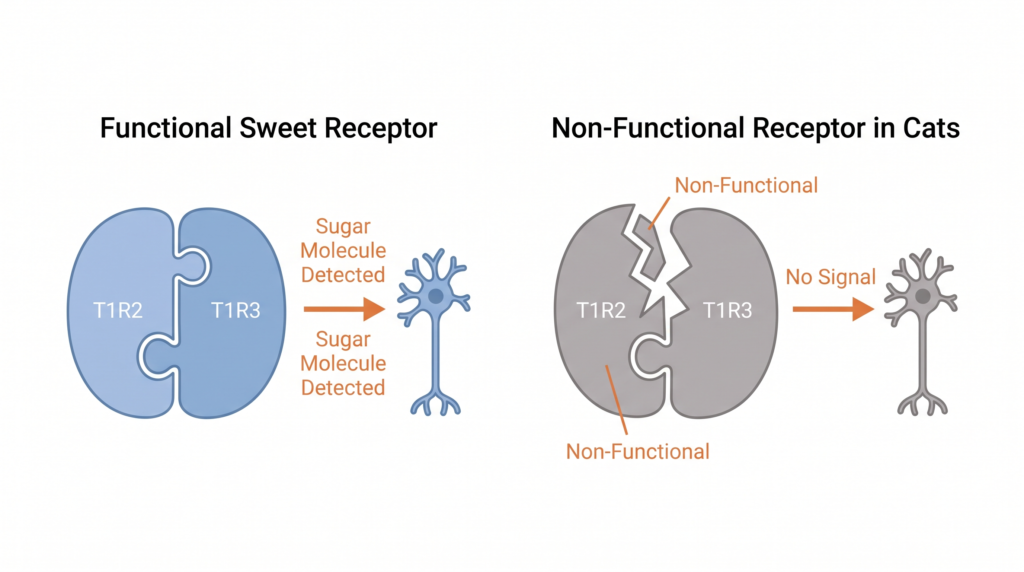
In simple terms, taste receptors are specialized proteins that detect specific flavor molecules, including those linked to sweet, bitter, salty, sour, and umami (savory) tastes. A functional receptor protein is needed before sweetness can be detected at all. Without it, the brain gets no signal that it can interpret as “sweet,” no matter how much sugar is present. Veterinary guidance from academic veterinary institutions confirms that cats are unable to taste sugar in the same physical way humans or dogs do. This trait appears consistently across the species.
You might assume your cat is just picky, but there’s more going on beneath the surface. Your cat’s disinterest isn’t a mood; it’s built into how it experiences flavor, and that distinction helps explain other sections of this article. Cats are unable to taste sugar in much the same physical sense that a colorblind person cannot see a particular shade. The equipment needed to register it isn’t there. Your cat isn’t snubbing you, it genuinely can’t tell the sugar is there, which is worth remembering the next time a treat gets an unenthusiastic sniff and nothing more.
A simple visual can make this pairing process easier to follow than a written explanation alone.
Is My Cat’s Dislike of Sweets a Preference?
Cats don’t dislike sweet things in the way that the word usually implies, since disliking something requires tasting it first. Their lack of interest in sugar reflects a total sensory absence rather than a rejected preference, meaning cats aren’t choosing to ignore sweetness. They simply cannot perceive it.
It’s easy to assume this is just a personality quirk, especially since “picky eater” is a familiar way to explain pet behavior. But a cat’s dislike of sweets is not a preference in the traditional sense. Preference implies that the cat tasted something and then rejected it. This isn’t a matter of taste in the way we usually mean it. It’s closer to an absence of a sensory channel altogether.
It’s not that your cat is being fussy about dessert. Your cat’s indifference to sugar has nothing to do with stubbornness, willfulness, or an aversion to a bad experience. The idea that cats can taste sweetness is a myth worth retiring. It can lead owners to expect a “no” response to sugar instead of the more accurate reality: there is no response because nothing is being detected.
Cat, Dog, and Human Taste Receptor Comparison
Cats, dogs, and humans do not experience food in exactly the same way. One of the clearest differences is the sweet-taste system: humans and dogs have functional sweet receptors, while cats lack functional sweet receptors. The three species can still detect other basic taste categories, although the strength and biological role of each taste can differ.
| Taste | Cat | Dog | Human |
|---|---|---|---|
| Sweet | ❌ No functional sweet receptor | ✅ Functional | ✅ Functional |
| Bitter | ✅ Functional bitter receptors | ✅ Functional bitter receptors | ✅ Functional bitter receptors |
| Sour | ✅ Can detect sour/acidic tastes | ✅ Can detect sour/acidic tastes | ✅ Can detect sour/acidic tastes |
| Salty | ✅ Can detect salty taste | ✅ Can detect salty taste | ✅ Functional salt taste system |
| Umami | ✅ Strongly relevant; detects amino-acid-rich tastes | ✅ Functional | ✅ Functional |
Key takeaway: For cats, the absence of a functional sweet receptor means that sweetness itself is not a major driver of food preference. Cats are much more biologically tuned toward detecting amino-acid-rich, meat-associated flavors, which fits their obligate-carnivore biology.
How Are Cat Taste Buds Different From Dogs?
Dogs and humans both retain functional sweet taste receptor genes and can taste sugar normally, unlike cats. This makes cats biologically unusual among mammals in this specific way, since most mammals studied to date can detect sweetness to some degree.
Cat taste buds are different from dog taste buds in this specific and striking way. Dogs kept the genetic machinery needed for sweet detection, while cats did not. Research in comparative genetics shows that this gap places cats among a small group of mammals with a broken sweet-taste pathway. Many of these species also have strict meat-based diets.
Cat treats taste sweet to humans, not cats, which helps explain why a product marketed with “sweet flavor” on the package can be misleading. That wording describes how the recipe may taste to humans, not how a cat experiences it.
Why a cat’s taste differs from human taste comes down to this same genetic gap. Humans process sweetness as one of five, or possibly six, recognized basic tastes. Cats did not retain this taste pathway as a functional system.
Why dogs taste sweet but cats can’t, is really a question of genetics. It comes down to which species kept a working copy of a specific gene. The next major section explores this difference in more detail.
How Many Taste Buds Do Cats Have?
Humans have roughly 9,000 taste buds, while cats have far fewer, often cited at around 470. This difference in total taste bud count is separate from the missing sweet receptor gene. However, it also adds to the difference in how varied a cat’s flavor experience is compared with a human’s.
Cats have fewer taste buds than humans overall, not just for sweetness. A cat’s fewer taste buds are concentrated toward detecting protein and fat, which fits what a meat-based diet would require an animal to notice. This does not mean cats have a poor sense of taste. Their system is simply streamlined toward flavors that matter most for an all-meat diet.
Do cats have taste receptors for sugar? No. This comes back to the specific gene discussed in the next section, not simply the fact that cats have fewer taste buds. The difference in taste bud count and the missing sweet receptor are two separate biological facts. Together, they show that cats are not built to register sweetness the way humans are.
Taste Bud Count by Species
Taste-bud numbers vary considerably across species, and the count alone does not determine how well an animal experiences taste. Receptor types, receptor sensitivity, and the animal’s sense of smell also influence food perception. For reference, cats have far fewer taste buds than humans or dogs.
| Species | Approximate Taste Bud Count |
|---|---|
| Human | ~9,000–10,000 |
| Cat | ~470 |
| Dog | ~1,700 |
| Cow | ~20,000 |
| Pig | ~15,000 |
The commonly cited figures are approximate rather than fixed biological counts. A comparative review reports approximately 470 in cats, 1,700 in dogs, 10,000 in humans, and 20,000 in cattle.
Important for cats: Having fewer taste buds does not simply mean cats have a proportionally “weaker” sense of taste. Cats have specialized taste-receptor biology, including the absence of a functional sweet receptor, and their strong sense of smell plays an important role in how they evaluate food.
What Can Cats Taste Instead of Sweet?
Cats retain the ability to taste bitter, sour, salty (to a limited degree), and especially umami, the savory taste linked to meat and protein-rich foods. This makes evolutionary sense because a strict meat-eater benefits more from detecting amino acids and protein-related flavors than sugar.
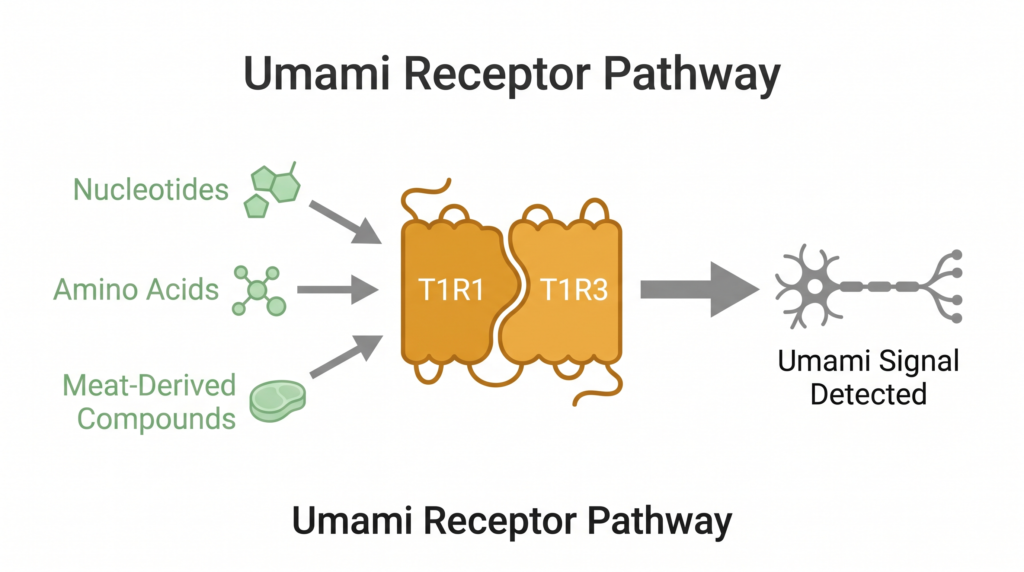
Cats can taste umami flavors through a receptor pathway that responds to compounds naturally found in meat. These include certain nucleotides and amino acids. That surviving subunit pairs up differently to detect savory flavors instead of sweet ones. This is a detail that many general explainers skip.
You’ve probably noticed your cat gravitates toward savory, meaty smells instead of anything that resembles dessert. That preference fits with what current taste research shows about feline sensory biology.
This means cats have a fairly sophisticated system for detecting protein quality. It is not a simplified or “lesser” version of human taste. It is simply specialized in a different way.
This umami-focused system is the evolutionary counterpart to the sweet-detection system found in omnivores and herbivores. It also connects taste biology to the genetic explanation covered next.
A visual of how this repurposed pathway works can make the savory-taste explanation click faster than text alone.
Can Kittens Taste Sweetness?
Kittens are born with the same inability to taste sweetness as adult cats because the trait is genetic, not age-related. This fixed characteristic is present from birth. It does not fade over time or change as a cat matures.
The honest answer is that kittens taste sweetness before adulthood is not supported by this explanation. Kittens do not develop a sweet taste that later disappears. Your kitten showed the same disinterest in sweets from very early on, likely before you had any reason to test the idea with sugary food.
Because this trait is genetic rather than developmental, there is no stage of life when cats have a functional sweet taste. The trait remains consistent as they grow.
Once we understand which flavors cats can and cannot detect, the next question is why this gap exists. The genetic and evolutionary explanation in the next section covers that question.
Kitten Feeding Observation Prompt
If your kitten happens to encounter a sweet-tasting food, use the moment only as an observation—not as a taste test. Do not deliberately offer sweets to see how your kitten reacts.
Observe and note:
- What was the food? __________________________
- Did your kitten approach it? ☐ Yes ☐ No
- First reaction: ☐ Sniffed ☐ Licked ☐ Tried to eat ☐ Walked away
- How long was the interest? ☐ A few seconds ☐ Less than a minute ☐ Longer
- Did your kitten return to it? ☐ Yes ☐ No
- What happened afterward? __________________________
- Was the food actually eaten? ☐ No ☐ A tiny amount ☐ More than intended
- Any unusual reaction afterward? __________________________
What to remember
A kitten showing interest in a sweet food does not demonstrate that it can taste sweetness like a human or dog. Smell, fat, protein, texture, moisture, and novelty can all influence the response.
Safety first: Never intentionally test a kitten with chocolate, candy, sugar-free products, grapes/raisins, or other potentially harmful human foods.
Once we understand which flavors cats can and can’t detect, it makes sense to ask why this specific gap exists in the first place, which is exactly what the genetic and evolutionary explanation in the next section covers.
A Genetic Mutation Explains This Trait
This section moves from what cats can and cannot taste to the genetic reason behind it. We start with a plain-language look at the specific gene involved.
From there, we’ll explain why one half of the receptor pair still works while the other does not. We’ll also connect this trait to what it means to be an obligate carnivore and explore how widespread this mutation is among other meat-eating species.
Finally, we’ll briefly explain how scientists discovered this difference in the first place.
What Is the Tas1r2 Gene Mutation in Cats?
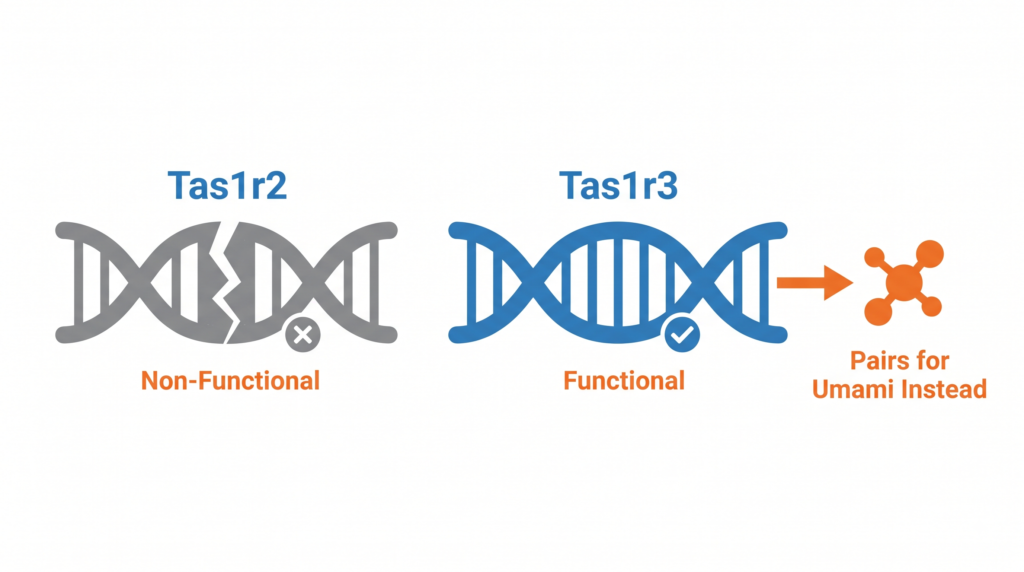
Cats have a broken sweet taste gene called Tas1r2, and this mutation is present in every domestic cat, not just some individuals. This gene mutation means the receptor simply never gets built, which is why no amount of exposure or repetition changes the outcome.
A pseudogene is a gene that stopped working over time, usually because it accumulated mutations that prevent it from producing a functional protein. Research in genetics journals indicates that the cat version of Tas1r2 carries a specific deletion and other changes. These changes stop the gene from being read correctly by the body.
This is not a case of a “missing” gene that was deleted entirely. The gene is still physically present but permanently disabled. Think of it like a light switch that is still there but wired to nothing.
Is the sweet taste gene missing in all cats, or only some? It is present as a non-functional pseudogene in all domestic cats (Felis catus). This mutation is fixed across the species, not something individual cats vary in.
What does the sweet taste receptor mutation mean for cat nutrition? Mostly, it means sweetness does not affect what draws a cat toward or away from a particular food. This detail becomes especially relevant later when the article discusses treats and sugar content.
Why Do Cats Still Taste Savory Food?
Sweet taste receptors are normally built from two paired protein subunits, and cats still have one of those two working normally. This partial preservation explains why cats are not “taste-blind” altogether. They have simply lost the part that detects sweetness.
The Tas1r3 gene still works in cats, and current research indicates that this surviving subunit does not sit unused. Instead, it pairs with a different protein to form the receptor responsible for umami, or savory taste. One half of that receptor pair still functions normally in cats, which is an easy-to-miss detail in many general explanations. That surviving subunit pairs up differently to detect savory flavors instead of sweet ones. This likely explains why cats retain a working savory-taste pathway even though their sweet-taste pathway is permanently inactive.
It is worth being cautious about the exact evolutionary sequence. Scientists infer which mutation happened first and why Tas1r3 was spared while Tas1r2 was not from genetic comparison studies. They did not directly observe these changes as they happened. What is well established is the end result: one gene works, while the other does not. The surviving gene supports a taste system that is more useful to an animal that eats almost nothing but meat.
Seeing both genes side by side, one working and one not, makes this section’s core point easier to hold onto.
Why Don’t Cats Need to Taste Sugar?
Cats specifically need meat to survive and get little practical benefit from carbohydrates or sugars in their diet. This dietary reality helps explain why a sweet-detecting mechanism became unnecessary over time. It could degrade without being removed by natural selection.
Natural selection has no reason to preserve a trait that offers no benefit, and an animal that lived almost entirely on prey had little need to detect sugar. A diet built almost entirely around animal protein removes the evolutionary pressure to taste sugar, which helps explain why this gene could break down without affecting survival. How does obligate carnivore physiology affect a cat’s taste buds? It shifts the system toward flavors linked to protein and fat. These signals matter more to cats than plant-based sugars do to omnivores and herbivores.
Why do cats prefer meat over sweet food? At the level of taste receptors, cats respond to umami and fat-related flavor cues. Their sensory system evolved to detect these signals. This is not a conscious “preference” in the usual sense. Why are cats the only animals that can’t taste sugar? They are not entirely alone, which is exactly what the next section covers.
Obligate Carnivore vs. Omnivore Diet Comparison
Cats and omnivorous animals are adapted to different dietary patterns. Comparing them helps explain why a cat’s lack of functional sweet-taste perception is not simply a missing preference—it reflects a different nutritional biology. The table below focuses on traits that are especially relevant when comparing feline and omnivorous diets.
| Dietary Trait | Obligate Carnivore | Omnivore |
|---|---|---|
| Sugar reliance | Very low — does not depend on dietary sugars as a primary energy source | More flexible — can use carbohydrates and sugars as energy sources |
| Protein needs | High — requires a consistent supply of animal-derived nutrients and essential amino acids | Moderate to high — can obtain essential nutrients from a wider range of animal and plant foods |
| Taste-gene relevance | Specialized — cats lack a functional sweet-taste receptor and have taste biology strongly oriented toward amino acids and meat-related nutrients | Broader — omnivores generally retain functional sweet-taste detection alongside other taste systems |
Key takeaway: A cat’s taste biology is closely connected to its carnivorous nutritional adaptations. This does not mean cats cannot eat any carbohydrate-containing food; it means their physiology is fundamentally different from that of an omnivore that can derive nutritional value from a broader range of food sources.
Why are cats the only animals that can’t taste sugar? They’re not entirely alone, which is exactly what the next section covers.
Do Other Animals Share This Mutation?
Cats are not unique in this trait. Other strict carnivores show a similar loss of a functional sweet taste gene. This shared pattern across several meat-dependent species is strong evidence that the mutation is linked to diet type, rather than being a random event in domestic cats.
Studies have found that this same genetic pattern shows up in other strict meat-eating species, including some big cats and other carnivores with diets similar to that of domestic cats. Other carnivores share the same sweet taste mutation in a pattern that closely matches how much each species depends on meat. The trait appears to be tied to diet type rather than being random, because it appears consistently in animals with little evolutionary reason to detect sugar. It rarely appears in omnivores or plant-eating species.
Genetic comparisons across species reveal which taste genes remain functional, and this comparative research supports the diet-driven explanation for cats. The pattern makes the explanation well supported rather than speculative.
Species Sharing the Sweet-Taste Mutation
Cats are not the only carnivores with changes to the genes involved in sweet-taste detection. In several obligate carnivores, the Tas1r2 gene, which encodes one part of the sweet-taste receptor, has become a pseudogene. This means the receptor pathway is no longer functional in the same way it is in humans and many omnivorous mammals.
| Species | Diet Type | Sweet-Taste Mutation Status |
|---|---|---|
| Domestic cat | Obligate carnivore | TAS1R2 is a pseudogene — the functional sweet-taste receptor is absent |
| Tiger | Obligate carnivore | TAS1R2 is a pseudogene — the sweet-taste receptor pathway is disrupted |
| Cheetah | Obligate carnivore | TAS1R2 is a pseudogene — consistent with loss of functional sweet-taste detection |
| Lion | Obligate carnivore | TAS1R2 is a pseudogene — sweet-taste receptor function is lost |
Key takeaway: The loss of functional sweet-taste detection appears repeatedly among obligate carnivores, supporting the idea that sweet taste became less important as these species adapted to diets dominated by animal tissues.
Who Discovered Cats Can’t Taste Sweets?
Scientists discovered cats can’t taste sweet things through genetic research that compared cat DNA with working sweet-receptor genes in other mammals. A 2005 study identified the specific mutation and found that it was consistent across the cats tested.
Researchers sequenced the Tas1r2 gene in domestic cats and found the same disabling changes in every sample studied. They also found matching mutations in related wild cat species. This finding helped explain why cats show little interest in sugar, regardless of how it is presented.
The discovery was not based only on behavior or observation. Researchers confirmed the change at the molecular level, which helped support the explanation over time.
Understanding the genetic cause of this trait raises a practical question for anyone who feeds a cat each day. The next section addresses that question.
Added Sugar Has No Taste Benefit for Cats
This section shifts from the biology itself to what it practically means for the food and treats in your cat’s bowl. We’ll look at whether added sugar serves any real purpose from a cat’s perspective, then draw an important distinction between not tasting something and that thing being automatically harmless.
Together, these two points clear up one of the more common points of confusion for owners reading ingredient labels.
Does Sugar in Cat Treats Serve a Purpose?
Since cats can’t taste sugar, sweetness itself is not what draws them to a particular treat. Cats respond more to fat, protein, and aroma compounds. That is why a cat may love a treat that humans would not describe as sweet.
Sugar in cat food serves no purpose from a taste standpoint. Cats do not get the same sensory reward from sugar that humans or dogs do. Sweetened cat treats matter even if cats can’t taste sugar, but not for the reason owners often assume.
When sugar appears on an ingredient list, it may serve purposes related to texture, preservation, or manufacturing. It does not provide the same sweet taste appeal for cats. Choosing treats based on protein content rather than sweetness tends to align better with how cats actually taste food, because their sensory system responds more strongly to protein-related flavor cues.
Observing what your cat consistently gravitates toward can tell you more than assuming preference, especially when a treat’s appeal comes from fat and aroma. One owner noticed her cat ignored a birthday cupcake on the counter. The cat came running when a foil packet of tuna treats opened in another room.
Should you avoid sweetened cat treats? That is a fair question. The next section looks at it more directly, since the answer involves more than whether cats can taste sugar.
Why Sugar Appears in Cat Treats
Sugar may appear in some cat treats even though cats do not have a functional sweet-taste receptor. Its presence is usually related to how the product is made or how it is formulated, rather than because cats need sugar for sweetness. The reasons can include texture, processing, preservation, and making the product more appealing to the human buyer.
| Sugar’s Role | Applies to Cats? | Why |
|---|---|---|
| Texture | ✅ Yes | Sugars and other carbohydrates can contribute to browning, binding, moisture retention, or texture during treat manufacturing, even though the cat does not perceive the sweetness itself. |
| Preservation | ✅ Sometimes | Sugar can influence water activity and shelf stability in certain formulations, although its preservative role depends on the complete recipe and processing method. |
| Manufacturing | ✅ Yes | Sugar or carbohydrate ingredients can contribute to cooking, browning, binding, and other physical properties that help manufacturers produce a consistent treat. |
| Human marketing appeal | ✅ Yes | Owners read ingredient labels and may associate certain flavors, aromas, or food-style ingredients with palatability, indulgence, or a “treat” experience—even when the cat cannot taste sweetness. |
Bottom line: Seeing sugar on a cat treat ingredient list does not mean the manufacturer added it because cats crave sweet flavors. In many cases, its role is related to the physical properties of the product or human-facing product design rather than feline taste preference.
Is Sugar Still Bad for Cats?
Not being able to taste sugar is a sensory fact, not a guarantee that sugar is harmless. Sugar and carbohydrate content can still matter for a cat’s overall diet. Those effects are separate from taste and should not be confused with the taste biology discussed here.
Hidden sugar in cat treats is a concern for some owners. This article focuses on taste perception, not the broader effects of diet and metabolism. Sugar is not harmless for cats simply because they cannot taste it.
The inability to detect a flavor and the way the body processes a substance are two separate systems. Veterinary nutrition guidance recommends discussing questions about sugar or carbohydrates with a veterinarian. These factors can vary by cat and go beyond what taste biology alone can explain.
To put it simply, this section has a narrow focus. It corrects the idea that “can’t taste it” automatically means “doesn’t matter.” A cat’s veterinarian is the right resource for specific concerns about sugar, carbohydrates, or overall nutrition, especially when an existing health condition is involved.
Now that we’ve covered what this trait means for treats and ingredients, we can look at what owners can and cannot do about it. That’s where we turn next.
Owners Have Limited Control Over This Trait
This final section brings everything together into practical terms: what’s worth trying, what isn’t, and when taste biology stops being the relevant explanation for a change in your cat’s eating habits. We’ll cover the reality of trying to change a cat’s sweet-taste perception, a quick guide to spotting sugar on treat labels, and finally where the line sits between normal taste biology and something worth mentioning to a vet. This closes out the practical side of everything explained earlier in the article.
Can You Train a Cat to Like Sweets?
Cats cannot taste sugar because the sweet-taste receptor is physically absent. No amount of exposure, training, or repeated offering will create a sweet-taste perception in a cat. This differs from learned food preferences, which cats can develop. The limitation is specifically about sensory perception, not learning.
Can you train a cat to like sweet food since they can’t taste it? No amount of repeated exposure will change how your cat’s taste buds are wired, because the limitation isn’t about familiarity or trust. It’s about a receptor that was never built in the first place. Cats can be tricked into eating sweet food if a recipe also contains fat, protein, or aroma compounds they can detect. However, the cat is responding to those other flavors, not developing a new ability to taste sugar.
Training a cat to like sweet food can misunderstand what “liking” food actually means for a cat. A cat can learn to associate a certain bowl, sound, or routine with food it already finds appealing for other reasons. That is a normal form of learned preference. What will not happen, no matter how patient or consistent the approach, is the sweet-taste sense switching on.
Learned Preference vs. Sensory Perception Checklist
Cats can develop strong food preferences through experience and association, but learning cannot create a taste receptor that the species does not have. Use this checklist to separate learned behavior from the cat’s underlying sensory biology.
| ✓ | Observation | Can Be Learned? | What It Means |
|---|---|---|---|
| ☐ | Routine | ✅ Yes | A cat can learn that a particular food is offered at a specific time or as part of a familiar daily routine. |
| ☐ | Bowl association | ✅ Yes | A cat can associate a particular bowl, location, or feeding area with getting food. |
| ☐ | Timing | ✅ Yes | Cats can learn predictable meal schedules and may begin anticipating food before mealtime. |
| ☐ | Food-associated cues | ✅ Yes | Sounds, smells, packaging, or preparation routines can become cues that signal an upcoming meal. |
| ☐ | Texture preference | ✅ Yes | Repeated positive experiences can contribute to a preference for particular textures, such as pâté, chunks, or crunchy foods. |
| ☐ | Actual sweet-taste perception | ❌ No | Learning cannot give a cat a functional sweet-taste receptor. Cats lack the functional receptor pathway used to detect sweetness. |
| ☐ | Sweetness becoming nutritionally necessary | ❌ No | A learned preference does not change a cat’s underlying nutritional requirement for essential nutrients. |
| ☐ | Human-like enjoyment of sweetness | ❌ No | A cat repeatedly eating a sweet-containing food does not prove that it experiences sweetness the way humans or dogs do. |
Simple rule
Learning can change what a cat expects and prefers. It cannot change the basic taste-receptor biology of the species.
So if a cat repeatedly chooses a treat containing sugar, consider the smell, fat, protein, texture, moisture, and learned association before assuming the cat is choosing it because it tastes sweet.
How Do I Check Treats for Added Sugar?
Reading a cat treat label for sugar-related ingredients is a simple, optional step for owners who want more insight into what they’re feeding, whether or not their cat can taste it. It is not a requirement or a red flag to look for. It is simply a small, useful habit that some owners prefer.
Reading the ingredient label on your cat’s treats can feel unnecessary at first, especially once you understand that sweetness does not drive your cat’s interest in the product. Still, checking the ingredient list can help you spot added sugars even if your cat can’t taste them, especially if you want to know exactly what is in a treat.
So, how do you read cat treat labels for sugar content? Ingredients are usually listed by weight. Sugar-related terms that appear near the start of the list generally make up more of the product than those listed near the end.
Added sugar in cat treats on the label can appear under several names. A quick look at the first few ingredients can give you a general idea of where sugar-related ingredients appear.
While checking a label one evening, Amelia, a Birman owner, noticed corn syrup near the top of her cat’s treat ingredient list. She switched to a treat with chicken listed first, and her cat enjoyed the new treats just as much.
Sugar content in a treat doesn’t need to be a dealbreaker, but it’s worth noticing, especially when you compare similar products. So, what should you do if your cat’s treats contain added sugar? Small label checks over time can add up to a more informed sense of what you’re feeding, and your veterinarian can help if you have specific concerns about a product or your cat’s diet.
Treat Label Sugar-Reading Checklist
When checking a cat treat for added sugars, scan the package in this order rather than relying on the front-of-pack claims.
| ✓ | Check In Order | What to Look For |
|---|---|---|
| ☐ | 1. Ingredient list | Start with the full Ingredients panel. Ingredients are generally listed in descending order by weight. |
| ☐ | 2. Sugar terms | Look for terms such as sugar, sucrose, cane sugar, brown sugar, dextrose, glucose, fructose, maltose, or corn syrup. |
| ☐ | 3. Syrups | Check for molasses, malt syrup, rice syrup, glucose syrup, corn syrup, or other syrup ingredients. |
| ☐ | 4. Sweet fruit concentrates | Look for ingredients such as fruit juice concentrate or other concentrated fruit ingredients that may contribute significant simple sugars. |
| ☐ | 5. Ingredient position | Note where any sugar-containing ingredient appears. An ingredient listed near the beginning contributes more by weight than one listed much later, although the label does not reveal the exact amount. |
| ☐ | 6. Guaranteed analysis & feeding directions | Check the Guaranteed Analysis and recommended treat amount. The ingredient list can identify sugar-containing ingredients, but it does not tell you the exact grams of sugar in the treat. |
Quick rule
Don’t stop at the word “sugar.” Added sugars can appear under several different ingredient names. Also, “sugar-free” or “no added sugar” does not automatically mean a treat is nutritionally appropriate—evaluate the complete ingredient list, nutritional adequacy, and how frequently the treat is fed.
When Should I Worry About My Cat’s Appetite?
A cat ignoring sweets is a normal, expected pattern and not a health concern on its own. This trait alone isn’t something that needs monitoring, though broader shifts in appetite or eating habits are a different matter worth discussing with a vet.
How do you know if your cat can taste sweetness? This isn’t something that needs testing or confirmation. The trait is consistent across domestic cats, so it can be taken as a given rather than investigated in each cat.
Taste biology is different from a health problem in cats, and it is important to keep these two ideas separate. One is a fixed, harmless trait shared by the species. The other involves changes that fall outside normal eating patterns.
If your cat’s eating habits shift noticeably, that’s worth mentioning at your next vet visit, especially if the change goes beyond ignoring sweets. For example, watch for a loss of interest in foods your cat has always enjoyed or another clear change in appetite.
A cat’s appetite changes are worth mentioning to a vet, who can help you look at the bigger picture if something seems unusual. Any sudden change in appetite is generally more worth watching than this specific trait, which reflects normal feline biology on its own.
Conclusion
Cats’ inability to taste sweetness isn’t a preference or quirk. It comes down to a specific, permanent genetic mutation in the Tas1r2 gene that leaves them physically unable to detect sugar. This trait makes complete sense in light of their evolutionary history as obligate carnivores, animals that never needed to seek out sugar-rich foods to survive. For owners, the takeaway is simple: your cat isn’t snubbing dessert out of stubbornness, and no amount of encouragement will change that. If you ever notice broader shifts in your cat’s appetite or eating habits beyond simply ignoring sweets, it’s worth a conversation with your veterinarian rather than assuming taste biology is the cause.
What to Watch For
- Whether your cat shows disinterest in sweets consistently or only around specific foods
- Any change in overall appetite, not just around sugary or sweet items
- Sudden disinterest in food your cat has previously enjoyed regularly
- Changes in eating pace, frequency, or amount of food consumed
- Any new hesitation, avoidance, or unusual behavior around mealtimes generally
Questions to Ask Your Vet
- Are there specific ingredients in my cat’s current treats worth asking about?
- Is my cat’s current diet appropriately balanced for their age and health status?
- Has my cat’s appetite or eating pattern changed in a way worth discussing?
- Are there general nutrition considerations I should be aware of for my cat specifically?
Frequently Asked Questions
Can a cat’s sweet taste receptor ever be restored or reactivated?
No. The Tas1r2 pseudogene mutation is a fixed genetic trait, not a reversible or temporary condition. This holds true for every domestic cat, regardless of age, diet, or environment. If you have broader questions about your cat’s nutrition, a veterinarian can offer guidance suited to your cat’s individual needs.
Is the sweet taste receptor mutation present in all cat breeds equally?
Yes. It’s a species-wide trait in domestic cats (Felis catus), not something that varies by breed. This is one of the more well-established findings in feline taste research. It applies consistently regardless of a cat’s size, coat type, or breed background.
Why do cats still seem to enjoy some “sweet” desserts like ice cream?
This is likely due to fat and dairy protein content, not sweetness. Cats are drawn to the fat and protein profile of a dessert rather than its sugar content. Since taste and smell work together, aroma also plays a role in this kind of interest. A veterinarian can help address any specific concerns about dairy or rich foods in a cat’s diet.
Do wild cats or big cats also lack sweet taste receptors?
Yes. Related research has found similar Tas1r2 pseudogenization in other carnivorous cat species, consistent with the obligate-carnivore explanation covered earlier in this article. This pattern shows up across several species with a heavily meat-based diet. It supports the idea that this trait is tied to diet type rather than being unique to domestic cats.
Does a cat’s inability to taste sweetness affect its sense of smell too?
No. Taste and smell are separate sensory systems, and cats have a highly developed sense of smell that operates independently of this taste-receptor mutation. A cat’s strong sense of smell is actually one of the main reasons food still holds so much appeal despite the missing sweet-taste pathway. Any concerns about changes in smell-related behavior are best discussed with a veterinarian.
Disclaimer: This article is written for educational purposes only and does not replace professional veterinary advice. Always consult a licensed veterinarian before making changes to your cat’s diet or health management.
Refrences
| # | Source | Type | URL | Used For |
|---|---|---|---|---|
| 1 | Li, X. et al., “Pseudogenization of a Sweet-Receptor Gene Accounts for Cats’ Indifference toward Sugar,” PLOS Genetics (2005) | Peer-reviewed journal (primary study) | https://journals.plos.org/plosgenetics/article?id=10.1371%2Fjournal.pgen.0010003 | The core explanation is that cats lack a functional sweet taste receptor because of the Tas1r2 gene mutation |
| 2 | Same study, hosted on PubMed Central | Peer-reviewed journal (mirror/full text) | https://www.ncbi.nlm.nih.gov/pmc/articles/PMC1183522 | The specific molecular detail of the 247-base-pair deletion and confirmation that no Tas1r2 protein is produced in cats |
| 3 | “No Candy for Kitty,” Science/AAAS (2005) | Science journalism reporting on the PLOS Genetics study | https://www.science.org/content/article/no-candy-kitty | The explanation that this mutation is permanent and cannot be reversed through training or exposure |
| 4 | “Strange but True: Cats Cannot Taste Sweets,” Scientific American (2024 republished) | Science journalism | https://www.scientificamerican.com/article/strange-but-true-cats-cannot-taste-sweets/ | The explanation that cats appearing to enjoy ice cream or dairy desserts is due to fat and protein content, not sweetness |
| 5 | “Why Cats Taste No Sweets,” Scientific American | Science journalism | https://www.scientificamerican.com/article/why-cats-taste-no-sweets/ | Secondary confirmation of the same fat-versus-sweetness distinction in cat dessert behavior |
| 6 | Jiang, P. et al., “A functional comparison of the domestic cat bitter receptors Tas2r38 and Tas2r43,” PMC | Peer-reviewed journal | https://www.ncbi.nlm.nih.gov/pmc/articles/PMC4453034 | The finding that other obligate carnivores, including dolphins, show similar loss of taste receptor genes |
| 7 | “Functional Analyses of Bitter Taste Receptors in Domestic Cats (Felis catus),” PMC | Peer-reviewed journal | https://www.ncbi.nlm.nih.gov/pmc/articles/PMC4619199 | The broader pattern connecting obligate carnivore diets to loss of sweet-taste genes across multiple species |
| 8 | “Umami taste perception and preferences of the domestic cat (Felis catus), an obligate carnivore,” Chemical Senses/Oxford Academic (2023) | Peer-reviewed journal | https://academic.oup.com/chemse/article/doi/10.1093/chemse/bjad026/7238703 | The explanation of how the surviving Tas1r3 gene pairs with Tas1r1 to detect umami instead of sweetness, and the tuna palatability example |
| 9 | Same study, PubMed Central full text | Peer-reviewed journal (mirror) | https://www.ncbi.nlm.nih.gov/pmc/articles/PMC10468298 | The detail that nucleotides and certain amino acids act as umami taste enhancers for cats |
| 10 | Same study, PubMed listing | Peer-reviewed journal (abstract/index) | https://pubmed.ncbi.nlm.nih.gov/37551788 | Index reference for the same umami receptor findings |
| 11 | Cornell University College of Veterinary Medicine, “Feeding Your Cat” | Institutional veterinary resource | https://www.vet.cornell.edu/departments-centers-and-institutes/cornell-feline-health-center/health-information/feline-health-topics/feeding-your-cat | The baseline explanation of cats as obligate carnivores and their protein-heavy dietary needs |
| 12 | dvm360, “Cats: obligate carnivore (Proceedings)” | Veterinary CE / trade resource | https://www.dvm360.com/view/cats-obligate-carnivore-proceedings | Background context on cats lacking salivary amylase, informing the caution around sugar not being metabolically harmless |
| 13 | WikiVet, “Digestibility of Carbohydrates” | Veterinary educational resource | https://en.wikivet.net/Digestibility_of_Carbohydrates | Background nuance that cats can digest some carbohydrates despite lower amylase levels, supporting the “not harmless” caution |
| 14 | AAHA, “2021 AAHA Nutrition and Weight Management Guidelines for Dogs and Cats” | Institutional veterinary guideline | https://www.aaha.org/wp-content/uploads/globalassets/02-guidelines/2021-nutrition-and-weight-management/resourcepdfs/new-2021-aaha-nutrition-and-weight-management-guidelines-with-ref.pdf | General attribution supporting the statement that sugar/carbohydrate content can still matter for a cat’s overall diet |
| 15 | iCatCare/SAGE, “2025 consensus guidelines on diagnosis and management of diabetes mellitus in cats” | Peer-reviewed clinical guideline | https://journals.sagepub.com/doi/10.1177/1098612X251399103 | Background research informing the caution that carbohydrate content matters for metabolic health, not directly cited in final text |
| 16 | AAHA, “2026 AAHA Diabetes Management Guidelines for Cats” | Institutional veterinary guideline | https://www.aaha.org/resources/2026-aaha-diabetes-management-guidelines-for-cats/ | Background research informing the same carbohydrate/metabolic caution, not directly cited in final text |

Saloni Nagar is the founder and lead content creator of Bark & Meow Tales. As a dedicated cat parent and researcher, she transitioned from personal loss to pet health advocacy, focusing on early warning signs and preventive care. Saloni specializes in translating complex veterinary concepts into actionable guidance for pet parents. Her work is driven by a commitment to helping others interpret subtle feline health signals before they escalate, ensuring that every cat has a voice through informed, compassionate care.