
By Saloni Nagar, Medically Reviewed by Dr. Jimisha Shah, B.V.Sc & A.H., PGDAW
If your cat’s coat has lost some of its usual shine, you may start wondering whether the food provides the nutrients your cat needs. Iron and zinc are essential trace minerals in feline nutrition, and researchers have investigated how these and other minerals interact during intestinal absorption. Understanding what is known about these interactions can help you read food labels more critically and prepare useful questions for your veterinarian.
Iron and zinc can interact during mineral absorption, but the relationship is more complex than one mineral simply blocking the other. Some intestinal transport systems handle multiple divalent metals, and experimental findings suggest that mineral interactions can vary with the conditions studied. However, much of the mechanistic evidence comes from laboratory research or studies in species other than cats. It does not establish that normal amounts of zinc in a complete and balanced cat food routinely cause iron deficiency.
A change in coat condition, a question from your veterinarian, or an unexpected bloodwork result may prompt you to look more closely at your cat’s diet. These observations can be useful starting points, but none of them independently confirms a mineral deficiency or an absorption problem.
This article explains what researchers know about iron–zinc interactions, how to recognize mineral forms on cat food labels, and what information may help when discussing nutritional concerns with your veterinarian. The goal is to make mineral interactions easier to understand without assuming that one ingredient or symptom explains your cat’s health.
What Might Prompt Questions About Mineral Balance in Cats?
Before exploring the mechanisms of mineral absorption, it helps to understand why cat owners may begin asking questions about their cat’s nutritional status. A change in coat condition, a discussion about diet during a veterinary appointment, or an unexpected laboratory result may prompt a closer look at the food bowl.
These observations can help guide a conversation with your veterinarian, but they cannot identify the cause on their own.
Why Does My Cat’s Coat Look Dull?
A dull, dry, or rough coat can have several possible explanations. Nutritional problems can affect skin and coat health, but coat appearance alone cannot establish whether a cat has an iron deficiency, a zinc deficiency, or a mineral absorption problem.
If your cat’s coat has lost its usual shine or your cat has started scratching more frequently, it is reasonable to review recent changes in grooming, diet, and behavior. Other possible explanations include seasonal shedding, allergies, parasites, environmental irritation, and underlying skin conditions. Coat changes can also occur alongside broader health problems.
Minerals contribute to normal body functions, including processes important for maintaining healthy tissues. However, a dull coat is not a reliable indicator of iron–zinc competition, and there is no basis for assuming that changing to a food containing zinc proteinate will improve coat condition simply because that ingredient appears on the label.
A veterinarian can examine your cat, review the diet and grooming history, and determine whether further investigation is appropriate. Depending on the findings, the next step might involve checking for skin disease, reviewing nutritional adequacy, or investigating another health concern.
Persistent changes deserve attention, especially when they occur with hair loss, marked itching, skin lesions, reduced appetite, or changes in energy. Record what you observe rather than trying to identify a mineral deficiency from coat appearance alone.
Coat and Skin Observation Checklist
Use this checklist to record visible changes before speaking with your veterinarian. It is intended for observation, not diagnosis.
- Coat color: Note any change from your cat’s usual coat color.
- Coat texture: Look for unusual dryness, greasiness, brittleness, roughness, or matting.
- Hair density: Check whether the coat appears thinner than usual.
- Bald or sparse patches: Note areas of missing or broken hair.
- Skin appearance: Look for redness, unusual discoloration, swelling, sores, or scabs.
- Scaling or flakes: Record any noticeable dandruff-like flakes or crusts.
- Grooming behavior: Watch for repeated licking, biting, scratching, or rubbing of particular areas.
Tip: Take clear photos under similar lighting so you can compare changes over time. Contact your veterinarian if the problem persists, spreads, or occurs alongside other signs of illness. Seek prompt veterinary advice for significant skin lesions, severe discomfort, or a cat that seems unwell.
Why Did My Vet Ask About Mineral Form?
If your veterinarian asks about your cat’s food or requests the ingredient list, it is usually part of gathering a fuller nutritional and medical history. It does not automatically mean your cat has a mineral deficiency or that the food contains an unsuitable mineral source.
The form of a mineral—such as zinc sulfate or zinc proteinate—can be relevant when evaluating a diet. However, the ingredient name alone does not establish how much of that mineral is absorbed, whether the finished food provides an appropriate amount, or whether a particular bloodwork result is related to the diet.
During a veterinary appointment, your veterinarian may consider the complete food formulation, feeding history, treats, supplements, clinical signs, and any relevant laboratory results. The importance of each factor depends on the reason for the consultation. A mineral-related question during a routine diet review is not the same as an investigation of a suspected nutritional deficiency.
If your veterinarian has asked about your cat’s food, bring the packaging or a clear photograph of the full ingredient list and nutritional adequacy statement. Include information about treats, supplements, and any other foods your cat receives. This gives your veterinarian more useful information than the mineral name alone.
You can also ask whether the concern relates to the overall nutrient content, a specific ingredient, or a finding in your cat’s medical history. That distinction can help you understand what needs to be investigated and whether a dietary change is appropriate.
Why Is My Cat’s Iron Low With Enough Zinc?
A cat may have an iron-related laboratory result that is lower than expected even when the diet appears to contain zinc in an appropriate amount. However, this finding does not demonstrate that zinc is blocking iron absorption. The laboratory result must be interpreted in the context of the cat’s overall health, diet, and other test findings.
It is understandable to question why a cat eating a seemingly adequate diet might have an unexpected bloodwork result. But the amount of a mineral listed on a label, the amount consumed, the amount absorbed, and the results of laboratory testing are different pieces of information. They should not be treated as interchangeable.
Iron-related abnormalities can have several possible explanations, including inadequate intake, blood loss, inflammation, underlying illness, or problems affecting nutrient absorption. The appropriate interpretation depends on which tests were performed and the individual cat’s clinical circumstances. A single iron-related value may not be enough to establish whether a deficiency is present or what caused it.
Zinc and iron interactions are relevant to nutritional research, but the existence of a possible interaction does not establish that it explains an individual cat’s result. Evidence from laboratory studies or other species cannot, by itself, demonstrate that a normal, complete and balanced cat food is causing iron deficiency through mineral competition.
If your cat has an abnormal iron-related result, discuss it with your veterinarian rather than trying to correct the result by changing foods or adding mineral supplements. Your veterinarian can determine whether additional testing, a diet review, or investigation of another underlying cause is appropriate.
Bloodwork Pattern Reference Chart: What Might Need Further Investigation?
| Bloodwork finding | What the veterinarian may consider | What it does NOT prove |
|---|---|---|
| Low iron-related result + normal or high zinc | Iron status, dietary history, blood loss, inflammation, or other medical conditions | That zinc is blocking iron absorption |
| Low iron-related result + low zinc | Overall dietary intake, possible absorption problems, illness, or other relevant causes | That the cat has multiple dietary deficiencies |
| Low iron-related result + abnormal copper result | The significance of both results, the clinical history, and possible underlying conditions | That copper caused the iron-related abnormality |
| Normal iron-related result + high zinc | Possible sources of excess zinc, including supplements or other exposures, and whether the result is clinically meaningful | That zinc toxicity is confirmed |
| Normal iron-related result + low zinc | Dietary history, the specific test result, and whether further assessment is warranted | That the cat necessarily has a zinc deficiency |
Important: These are discussion prompts, not validated diagnostic patterns. The meaning of an iron-related result depends on the specific test performed, laboratory reference ranges, clinical signs, and other findings. Zinc and copper measurements also require appropriate interpretation. A veterinarian should assess the complete picture before concluding that a deficiency, excess, or absorption problem exists.
How Do Iron and Zinc Interact During Absorption?
Iron and zinc can interact during intestinal mineral absorption, but the relationship is more complex than zinc simply blocking iron. Research suggests that the effect can vary with mineral dose, chemical form, diet composition, and physiological conditions. Much of the evidence explaining these interactions comes from laboratory experiments and studies involving humans or other animals, rather than direct research in cats.
Understanding iron and zinc absorption in cats helps explain why mineral balance matters in nutrition. Both minerals are essential, but the amount present in food does not always reflect how much the body absorbs and uses. This makes it important to consider the complete diet rather than focusing on zinc or iron alone.
Do Iron and Zinc Compete for Absorption?
Researchers have studied iron and zinc competition during absorption because both minerals can occur as divalent metal ions, meaning they carry a positive electrical charge of +2. Some intestinal transport systems can handle multiple divalent metals, creating the possibility of interactions during absorption.
However, iron and zinc do not rely on one identical pathway. Each mineral has important transport and regulatory processes, so their interaction is not simply a matter of competing for the same space in the intestine.
Laboratory studies using human intestinal cells have found that zinc can influence iron uptake in different ways. Some experimental conditions have been associated with reduced iron uptake, while others have shown increased activity of iron transport proteins and greater iron uptake.
These findings help explain possible mineral interactions in cat food, but they do not prove that zinc in ordinary commercial cat diets reduces iron absorption.
Several factors influence how minerals are absorbed:
- Dose: The amount of iron and zinc consumed.
- Chemical form: The form in which each mineral is supplied.
- Dietary matrix: Other nutrients and ingredients present in the food.
- Physiological status: The cat’s health, nutritional needs, and existing mineral status.
- Regulatory mechanisms: How the body adjusts mineral transport, absorption, and storage.
- Overall diet: The balance of nutrients consumed over time.
Because these factors work together, two cat foods containing similar amounts of iron and zinc may not provide exactly the same mineral availability.
The important distinction is that mineral interactions are biologically possible, but this does not establish that zinc in a properly formulated cat food causes iron deficiency.
What Is DMT1 and Why Does It Matter?
DMT1 stands for divalent metal transporter 1. It is a protein that helps move certain mineral ions into cells. The gene responsible for producing this protein is called SLC11A2.
DMT1 is found in the lining of the small intestine, including specialized cells called enterocytes. These cells help absorb nutrients from digested food.
One of DMT1’s main functions is transporting iron in its divalent form (Fe²⁺) into intestinal cells. This makes it an important part of normal iron absorption.
DMT1 can also transport certain other divalent metals. However, DMT1 has an important role in transporting divalent iron, while zinc absorption relies heavily on other transport systems.
This means DMT1 should not be viewed as a single doorway through which iron and zinc simply compete to enter the body.
Research has also shown that zinc can influence how DMT1 is regulated.
In a laboratory study using human intestinal Caco-2 cells, Yamaji and colleagues (2001) found that zinc exposure increased DMT1 expression and iron uptake. A later study (2019) also reported increased DMT1 expression and iron uptake after zinc treatment in the same cell model.
These findings suggest that zinc may influence iron transport by changing the activity or amount of transport proteins, rather than only through direct competition.
However, these were laboratory cell studies, not feeding trials in cats. Their results help explain possible biological mechanisms but do not establish that zinc increases iron absorption in cats eating commercial diets.
This distinction matters when discussing mineral bioavailability. Mineral bioavailability describes how much of a consumed nutrient becomes available for absorption and subsequent use by the body.
Transport proteins such as DMT1 are part of this process, but mineral bioavailability also depends on the diet’s composition and the body’s ability to regulate mineral absorption and use.
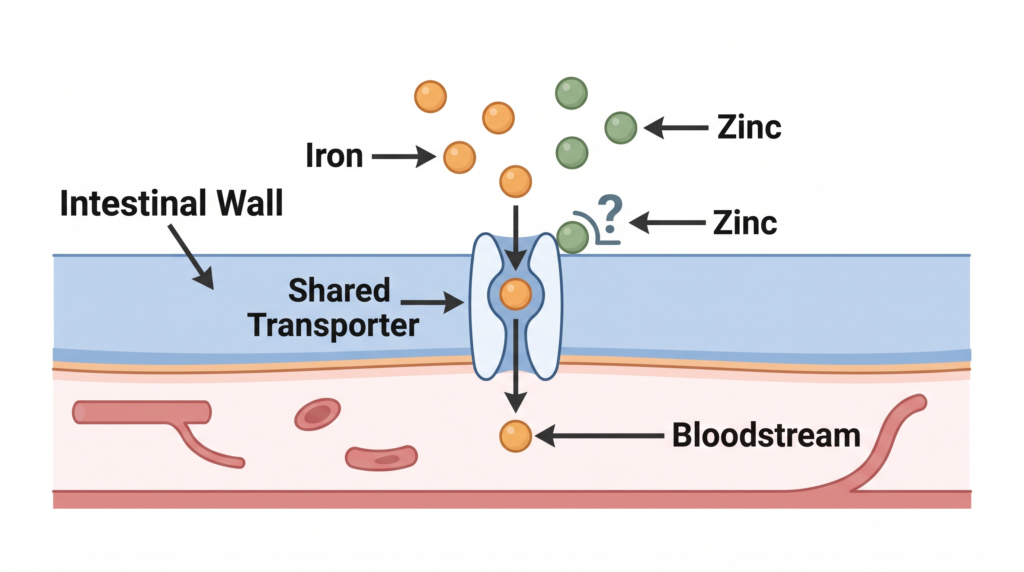
The diagram illustrates how mineral ions approach the lining of the small intestine, where specialized transport proteins help move them into intestinal cells.
Iron and zinc can both exist as divalent metal ions, but they do not depend on one identical transport pathway. DMT1 plays an important role in transporting divalent iron, while zinc absorption relies mainly on other transport systems.
Laboratory research suggests that these minerals can influence intestinal transport under certain conditions. However, this does not mean that zinc in ordinary cat food routinely prevents iron absorption.
The diagram is a simplified illustration of intestinal mineral transport rather than proof of direct iron–zinc competition in cats.
Can Too Much Zinc Affect Iron Absorption?
The relationship between excess zinc and iron absorption matters because unusually high mineral intake can sometimes change how the body absorbs or uses other nutrients.
Nutrition scientists call this type of interaction nutrient antagonism. It describes situations in which one nutrient reduces the absorption or use of another under particular conditions.
Research involving intestinal cell models and non-feline species has shown that zinc exposure can influence iron uptake and metabolism. However, the results are not always the same.
Some experimental conditions have shown reduced iron uptake when zinc concentrations were increased. Other studies found that zinc increased the expression of iron transport proteins, leading to greater iron uptake in the cells being studied.
These differences suggest that the effects depend on zinc concentration, exposure conditions, the chemical forms of the minerals, and the body’s regulatory response.
Importantly, these findings do not demonstrate that normal zinc concentrations in complete and balanced commercial cat foods cause clinically significant iron absorption problems in healthy cats.
An owner may also wonder why a cat has low iron levels despite a balanced diet. However, low iron-related blood test results do not automatically indicate a dietary absorption problem. Blood loss, inflammation, illness, and other medical conditions can affect iron status.
The zinc naturally included in a properly formulated cat food should also be distinguished from excessive zinc exposure. Unnecessary zinc supplementation may disturb mineral balance and should be discussed with a veterinarian.
If a veterinarian identifies concerns about a cat’s iron status, the underlying cause should be investigated rather than assuming that dietary zinc is responsible.
Key takeaway: Iron and zinc can influence each other’s absorption and regulation under certain conditions, but the interaction isn’t simply zinc blocking iron. Evidence from laboratory and non-feline studies helps explain possible mechanisms, while direct evidence of clinically important iron–zinc competition in cats consuming normal commercial diets remains limited. Mineral dose, chemical form, overall diet, and the individual cat’s health all matter.
What Can Cat Food Labels Tell You About Mineral Forms?
Understanding how iron and zinc interact is only part of the picture. The next step is learning how to identify mineral sources on a cat food label and understand what that information can—and cannot—tell you.
When comparing two bags of cat food, terms such as zinc sulfate, zinc proteinate, and zinc amino acid chelate can be confusing. This section explains how to recognize these terms, interpret ingredient order, and evaluate whether a higher-priced food offers a meaningful nutritional advantage.
How to Find Mineral Form on a Label?
The ingredient list is the first place to look when you want to identify the mineral sources used in cat food. Manufacturers may list minerals under names that describe their chemical form or the compound in which they are supplied.
For example, zinc sulfate identifies an inorganic zinc salt, while zinc proteinate identifies a zinc source associated with a protein-derived ligand. A label may also list terms such as zinc amino acid chelate or iron amino acid chelate. These names help identify the listed mineral source, but they do not establish how much of that mineral your cat will absorb.
Label-Reading Checklist: Checking Mineral Form
Use this checklist to identify mineral forms on a cat food label.
- Find the Ingredients panel. Read the complete ingredient list, usually printed on the back or side of the package. Front-of-package claims alone cannot tell you which mineral sources are used.
- Find the mineral you want to check. Look for names associated with zinc, iron, copper, calcium, or selenium.
- Read the full ingredient name. Examples include zinc sulfate, copper sulfate, zinc proteinate, copper proteinate, ferrous sulfate, and iron amino acid chelate.
- Identify the listed form. Terms such as sulfate identify an inorganic salt. Terms such as proteinate or amino acid chelate indicate a mineral supplied in a protein-associated or chelated form. The precise meaning depends on the ingredient named.
- Check the Guaranteed Analysis separately. This panel provides specified nutrient guarantees, but it generally does not disclose the exact contribution of every individual mineral ingredient or how much of each mineral is absorbed.
- Check the nutritional adequacy statement. Look for a statement that the food is complete and balanced for cats and appropriate for your cat’s life stage. Identifying a particular mineral form does not establish that the finished diet is nutritionally adequate.
Quick example: If the ingredient list names zinc sulfate, you have identified an inorganic zinc source. If it names zinc proteinate, you have identified a proteinate form. Neither term, by itself, proves that the food is nutritionally superior. The overall formulation and nutritional adequacy matter more than any single ingredient name.
Does Mineral Position on a Label Matter?
Ingredient order can provide limited context, but it is not a reliable way to estimate the amount of an individual mineral in cat food.
In many jurisdictions, ingredients are listed in descending order by weight under applicable labeling rules. However, concentrated vitamins and minerals are often included in relatively small quantities, so they may appear near the end of the ingredient list despite being nutritionally important.
A mineral listed earlier is not automatically better, and a mineral listed later is not automatically inadequate. Ingredient position also cannot establish whether a food provides too little, enough, or too much of a particular mineral.
Important label-reading rule: Seeing zinc sulfate or zinc proteinate near the end of a cat food ingredient list does not tell you how much zinc your cat consumes or absorbs.
For mineral adequacy, consider the nutritional adequacy statement, the available nutrient information, and the manufacturer’s detailed nutrient analysis when needed. Do not use ingredient order alone to compare the nutritional quality of two foods.
Why Do Some Labels List Zinc Twice in Different Forms?
A cat food ingredient list may name the same mineral more than once because the formula contains multiple sources of that mineral. For example, zinc may appear as zinc sulfate and zinc proteinate.
Seeing the same mineral listed twice is not automatically a labeling error or a sign of poor formulation. Different mineral sources may be included in one finished diet, but the ingredient list alone cannot establish why the manufacturer selected them or whether the combination improves absorption.
It is also important not to assume that the two forms contribute equally to the diet or that one is necessarily more effective. Their contribution depends on the finished formulation, and the label does not provide enough information to calculate the amount absorbed from each source.
If you want to understand why a particular food uses multiple mineral sources, contact the manufacturer and ask for information about its formulation and nutrient composition.
Why Ingredients May Be Listed Together
Manufacturers may use more than one source of a mineral when formulating a complete cat food. For example, a formula may contain both an inorganic mineral salt and an organic or amino-acid-associated form.
This is a formulation choice, not proof that one form is superior or that both forms provide the same nutritional contribution. The label shows which ingredients are listed, but it does not necessarily explain the manufacturer’s reasoning.
If the reason for using multiple sources matters to your decision, the manufacturer’s formulation information is more useful than trying to infer the purpose from ingredient order alone.
Zinc Sulfate or Zinc Chelate: Which Is Better?
The chemical form of zinc can influence its behavior during digestion and its bioavailability. However, zinc sulfate and chelated zinc should not be ranked by name alone. The specific mineral source, amount supplied, complete diet, and other dietary factors all matter.
| Comparison point | Zinc sulfate | Zinc chelate |
|---|---|---|
| Form | An inorganic zinc salt | Zinc bound to an organic ligand, such as an amino acid |
| Nutritional role | Can supply zinc in a properly formulated complete diet | Can also supply zinc in a properly formulated complete diet |
| Bioavailability | Depends on the finished diet and other relevant factors | May vary with the specific chelate and dietary context |
| Typical label wording | Zinc sulfate | Zinc proteinate, zinc amino acid chelate, or another specifically named form |
| Cost | May be less expensive, depending on the ingredient and manufacturer | May cost more, depending on the ingredient and manufacturer |
| What the label tells you | Identifies the listed zinc source, not the amount absorbed | Identifies a bound zinc source, but does not prove superior absorption |
| Practical takeaway | Can be an appropriate zinc source in a nutritionally adequate diet | Can also be appropriate; the word “chelated” does not automatically mean “better” |
When comparing two cat foods, do not choose based on zinc sulfate versus zinc chelate alone. Consider whether the food is complete and balanced for your cat’s life stage, the overall nutritional formulation, and any specific dietary needs identified by your veterinarian.
The comparison above describes general differences between mineral forms. It should not be interpreted as proof that one form consistently provides better absorption in every cat food.
Are Chelated Minerals Worth the Extra Cost?
Chelated mineral ingredients may cost more than some inorganic mineral sources, but the price difference alone does not demonstrate a nutritional advantage.
Whether a more expensive cat food is worth buying depends on the complete product, not just whether its label includes chelated minerals. A higher price may reflect ingredient sourcing, manufacturing, branding, or other product features. It does not establish that your cat will absorb more zinc or iron.
Inorganic mineral sources can support adequate nutrition when they are used appropriately in a complete and balanced diet. Similarly, the presence of chelated minerals does not guarantee that a food is better suited to every cat.
If your cat is healthy and eating a nutritionally adequate food, there is no reason to switch solely because another product advertises chelated minerals. If your cat has a diagnosed condition or a specific nutritional requirement, ask your veterinarian whether a different formulation is appropriate.
How Do I Know Minerals Are Absorbed?
Mineral bioavailability describes the extent to which a consumed mineral becomes available for absorption and subsequent use by the body. Reading an ingredient list can help you identify mineral sources, but it cannot directly measure how much your cat absorbs.
The finished diet matters. Mineral concentration, the specific chemical form, other dietary components, and the cat’s physiological condition can all influence nutrient availability. The effects vary, so a single ingredient name is not enough to predict the outcome.
Bioavailability Confirmation Checklist
Use this checklist to assess the available information about a cat food’s mineral content without assuming that a particular ingredient form guarantees better absorption.
- Check the exact mineral form. Identify terms such as zinc sulfate, copper sulfate, zinc proteinate, or amino acid chelate. Treat these as ingredient information, not proof of superior bioavailability.
- Check the nutritional adequacy statement. Confirm that the food is identified as complete and balanced for cats and the appropriate life stage.
- Review the Guaranteed Analysis. Use the information provided to understand the declared nutrient guarantees. Remember that these guarantees do not directly measure how much of each mineral an individual cat absorbs.
- Look for multiple mineral sources. If a mineral appears in more than one form, note the listed sources without assuming that one source provides all the mineral or that the sources contribute equally.
- Consider the complete formulation. Mineral availability can depend on the wider dietary composition and interactions among nutrients. Avoid judging the finished diet from a single ingredient.
- Ask the manufacturer for more information when needed. Request a detailed nutrient analysis or relevant formulation and bioavailability data if you need more information than the label provides. The usefulness of any data depends on what was measured and how the evidence applies to the finished food.
Quick rule: Ingredient form provides a clue, not proof of bioavailability. The complete diet’s nutritional adequacy and relevant supporting evidence are more informative than the word “chelated” alone.
If you are concerned that your cat may not be getting or using nutrients appropriately, especially if bloodwork or other health findings have raised questions, discuss the concern with your veterinarian. A food label cannot diagnose a deficiency or establish the cause of an abnormal result.
Understanding mineral terminology can make comparing cat foods easier. The goal is not to find a particular word on the bag, but to understand what the available information actually tells you—and when you need more evidence or professional guidance.
Next Steps If You Suspect an Absorption Problem
Understanding mineral forms and reading cat food labels can help you ask better questions, but these steps cannot confirm whether your cat has a mineral absorption problem. If you have noticed persistent symptoms, received an unexpected bloodwork result, or been advised to review your cat’s diet, personalized veterinary guidance is the next step.
This section explains how to prepare for a veterinary conversation, evaluate whether a food change is warranted, and support your cat’s nutritional needs without making unnecessary changes.
What Should I Ask My Vet About Minerals?
If you are concerned about mineral absorption, dietary adequacy, or a bloodwork result, discuss the concern with your veterinarian rather than relying on label reading alone. Your veterinarian can interpret the information in the context of your cat’s medical history, clinical signs, diet, and test results.
If you have noticed coat changes or your veterinarian has raised a question about mineral levels, bring the current food label to your appointment. Include information about treats, supplements, and any other foods your cat receives. These details can help your veterinarian evaluate the overall diet rather than focusing on one ingredient in isolation.
Mineral form can be relevant when reviewing a food’s formulation, but terms such as zinc sulfate and zinc proteinate do not independently establish how much zinc your cat absorbs. Whether a particular form matters depends on the specific diet and the reason for the evaluation.
Vet Conversation Guide: Mineral Form and Absorption
Use these questions to organize your discussion. You do not need to ask every question; choose those that fit your cat’s circumstances.
- Which mineral forms are present in this diet? Can we identify the listed sources of zinc, iron, copper, and other relevant minerals?
- Does the mineral form matter for my cat? Is there evidence that the specific form used in this food would change your recommendation?
- Is the overall nutrient content appropriate? Does the diet meet my cat’s nutritional needs for their life stage and health status?
- Could other dietary factors be relevant? Are there aspects of the overall formulation that matter for the nutritional concern we are investigating?
- Could an underlying health problem affect nutrient status? Are digestive disease, blood loss, inflammation, or another medical condition relevant to my cat’s findings?
- Do the test results establish a mineral problem? Which results support that conclusion, and what other explanations need to be considered?
- Is further testing needed? Would additional laboratory tests or a more detailed dietary assessment help clarify the concern?
- Should I change the diet or supplements? Is there a clear reason to make a change now, or should we investigate further first?
- Could supplementation be unnecessary or harmful? If my cat already eats a complete and balanced food, is there a specific reason to add a mineral supplement?
- Do we need follow-up monitoring? If a problem is identified, what monitoring or follow-up would be appropriate?
Bring to the appointment:
- The complete ingredient list.
- The Guaranteed Analysis and nutritional adequacy statement.
- Labels for supplements, including the listed ingredients and amounts.
- The amount of food, treats, and supplements your cat receives each day.
- Recent bloodwork or other relevant test results, if available.
- Details of recent diet changes and any symptoms you have observed.
A useful question to start with: “Is there evidence that my cat has a mineral deficiency, excess, or absorption problem, and would the mineral form in this particular diet change your recommendation?”
Should I Switch My Cat’s Food for Absorption?
Whether to switch cat food because of mineral form depends on the reason for concern, the nutritional adequacy of the current diet, and your cat’s individual needs. A label that advertises chelated minerals does not, by itself, establish that the food offers better nutrition or would be more suitable for your cat.
If you are considering a switch, first clarify what you are trying to address. A confirmed nutrient deficiency, an underlying health condition, a change in coat appearance, and curiosity about ingredient terminology are different situations. They do not automatically call for the same response.
A veterinarian can help determine whether a diet change is appropriate and whether the priority is reviewing the food, investigating an underlying condition, or making no immediate change. Avoid switching repeatedly or adding supplements simply to try to correct a suspected mineral interaction.
Food Switch Decision Matrix
Use this table to identify a reasonable next step based on the situation—not to diagnose a condition.
| Situation | Reasonable next step |
|---|---|
| A veterinarian has confirmed a nutrient deficiency or excess | Follow your veterinarian’s recommendations for investigating the cause and adjusting the diet or treatment as needed. |
| Your veterinarian suspects a mineral absorption problem | Ask what underlying causes need to be investigated and whether a diet change or additional testing is appropriate. |
| Your cat has a coat-color change but otherwise seems well | Document the change and discuss it at a routine appointment if it persists or concerns you. Do not assume that mineral form is responsible. |
| Coat changes occur with itching, hair loss, or skin lesions | Arrange a veterinary evaluation to investigate possible skin, parasitic, allergic, nutritional, or other causes. |
| Coat changes occur with weight loss, reduced appetite, or lower energy | Contact your veterinarian promptly, as these signs may indicate a broader health problem. |
| Your cat has no concerning signs and eats a complete and balanced food appropriate for their life stage | There is generally no reason to switch solely because another food lists a different mineral form. |
| The food is not complete and balanced for long-term feeding | Discuss an appropriate complete diet with your veterinarian, particularly if the food is being used as the main source of nutrition. |
| You want to switch because another brand advertises “better” mineral forms | Compare the overall nutritional information and ask whether the difference is meaningful for your cat before switching. |
Practical rule: Change your cat’s food for a clear nutritional or health reason, not simply because one ingredient name sounds better than another. If you are concerned about a persistent change or a possible deficiency, investigate the cause rather than relying on repeated food changes.
How Can I Help My Cat Absorb Minerals?
Supporting your cat’s mineral nutrition starts with providing an appropriate, complete and balanced diet and avoiding unnecessary supplements. There is no single food-label term or home observation that can guarantee mineral absorption.
A practical approach is to:
- Choose a nutritionally appropriate diet. Check that the food is complete and balanced for cats and the appropriate life stage.
- Feed consistently. Keep track of the food and treats your cat receives, especially if you are discussing a dietary concern with your veterinarian.
- Avoid unneeded supplementation. Adding individual minerals without professional guidance can disrupt nutrient balance or create excessive intake.
- Monitor meaningful changes. Record persistent changes in coat condition, grooming, appetite, weight, or energy rather than assuming they indicate a mineral problem.
- Review concerns with your veterinarian. If your cat has a diagnosed condition, abnormal test results, or ongoing symptoms, ask whether a more detailed dietary assessment is warranted.
Understanding mineral competition, chelated and inorganic forms, and label terminology can help you evaluate feeding information more confidently. However, these concepts are not a substitute for assessing the complete diet and your cat’s health.
If you notice a change after switching foods, record when the change began and discuss it with your veterinarian if it persists or is accompanied by other signs. A change occurring after a diet switch does not, by itself, prove that a particular ingredient caused it.
A Simple Monitoring Routine
A straightforward routine can help you track concerns without repeatedly changing your cat’s food.
- Observe: Note changes in coat condition, skin, grooming, appetite, weight, or energy.
- Review: Keep the current food label and a record of treats, supplements, and recent diet changes.
- Discuss: Share persistent changes or concerning findings with your veterinarian.
- Follow the plan: Make dietary changes or arrange follow-up tests when recommended.
This process supports informed decisions without treating every visible change as evidence of mineral imbalance.
Conclusion
Iron and zinc can interact during intestinal mineral absorption, but the relationship is complex, and laboratory findings do not establish that normal amounts of zinc in a complete and balanced cat food cause iron deficiency in cats.
Understanding mineral forms, reading ingredient lists, and reviewing nutritional adequacy statements can help you ask more informed questions. However, terms such as chelated, proteinate, and sulfate cannot independently establish how much of a mineral your cat absorbs or whether a food is nutritionally superior.
If you have noticed persistent coat changes, received an unexpected bloodwork result, or have concerns about your cat’s diet, discuss them with your veterinarian. The most useful next step is to understand what the evidence shows about your individual cat—not to assume that one ingredient or mineral interaction explains the problem.
What to Watch For
- Persistent changes in coat or skin condition.
- Hair loss, itching, sores, or excessive grooming.
- Bloodwork results your veterinarian identifies as requiring further investigation.
- Changes in appetite, weight, or energy, particularly when they occur alongside other symptoms.
- Recent diet changes, supplements, or feeding habits that may be relevant to your veterinarian’s assessment.
These observations can help guide a veterinary conversation, but they do not independently diagnose a mineral deficiency or absorption problem.
Questions to Ask Your Vet
- Is my cat’s current diet appropriate for their life stage and health history?
- Do the available findings indicate a genuine mineral deficiency, excess, or absorption problem?
- Could another health condition explain the symptoms or laboratory results?
- Is there evidence that a different mineral formulation would be beneficial for my cat?
- Would further testing or follow-up monitoring be useful?
Frequently Asked Questions
What’s the difference between chelated and non-chelated minerals for cats?
Chelated minerals are minerals bound to a ligand, often an amino acid or a related compound. Inorganic mineral salts, such as zinc sulfate, are different chemical forms. Both types can be used in complete and balanced cat foods. Their nutritional performance depends on the specific source and finished formulation, so the word “chelated” alone does not prove superior absorption.
Why does my vet care what form the minerals are in my cat’s food?
Mineral form can be one part of a dietary assessment, particularly when a veterinarian is investigating a specific nutritional concern. However, the form alone does not establish whether a cat is deficient, whether a mineral is being absorbed adequately, or whether a bloodwork result is diet-related. Your veterinarian will consider it alongside the complete diet, medical history, clinical signs, and relevant test results.
What does it mean when cat food minerals are bound to amino acids?
It generally means that the mineral is supplied in a form associated with an amino acid or amino-acid-related compound. The precise terminology depends on the ingredient. This type of binding can influence a mineral’s behavior in the digestive tract, but it does not establish that the mineral follows an entirely separate absorption route or that the finished food necessarily provides better absorption.
Is it bad if my cat food has inorganic minerals instead of chelated minerals?
Not inherently. Inorganic mineral sources, including appropriate sulfate salts, can contribute to adequate nutrition in a properly formulated complete diet. A food should not be considered inferior solely because it contains inorganic minerals. The complete formulation and the cat’s individual nutritional needs are more informative than one ingredient name.
How do I know if the minerals in my cat’s food are the good kind?
Start by checking the ingredient list and the nutritional adequacy statement. Terms such as zinc sulfate, zinc proteinate, and amino acid chelate identify listed mineral sources, but they do not prove how much your cat absorbs. If you have a specific nutritional concern, ask your veterinarian whether additional information about the finished diet is needed.
What should I ask my vet about mineral absorption in cat food?
Ask whether there is evidence of a mineral deficiency, excess, or absorption problem; whether the current diet is appropriate; and whether a different formulation would make a meaningful difference for your cat. Bring the food label, supplement information, and relevant test results. Your veterinarian can help distinguish a plausible nutritional concern from an assumption based on an ingredient name or symptom.
Disclaimer: This article is written for educational purposes only and does not replace professional veterinary advice. Always consult a licensed veterinarian before making changes to your cat’s diet or health management.
Refrences
| Claim in Article | Source | Year | Reference Link |
|---|---|---|---|
| DMT1 plays an important role in intestinal iron absorption. The study does not establish that iron and zinc share DMT1 as a common uptake route. | Shawki A, et al. Intestinal DMT1 is critical for iron absorption in the mouse but is not required for the absorption of copper or manganese. American Journal of Physiology—Gastrointestinal and Liver Physiology. | 2015 | https://journals.physiology.org/doi/full/10.1152/ajpgi.00160.2015 |
| Zinc can influence DMT1 expression and iron uptake under experimental conditions in human intestinal Caco-2 cells. | Yamaji S, et al. Zinc regulates the function and expression of the iron transporters DMT1 and IREG1 in human intestinal Caco-2 cells. FEBS Letters. | 2001 | https://febs.onlinelibrary.wiley.com/doi/10.1016/S0014-5793%2801%2902953-2 |
| Zinc-induced iron uptake involved DMT1 and PI3K/IRP2-related mechanisms in a human intestinal cell model. | Kondaiah P, et al. Zinc induces iron uptake and DMT1 expression in Caco-2 cells via a PI3K/IRP2 dependent mechanism. Biochemical Journal. | 2019 | https://pubmed.ncbi.nlm.nih.gov/31092704/ |
| Overview of intestinal absorption mechanisms and transport proteins involved in iron, copper, and zinc homeostasis. | Nishito Y, Kambe T. Absorption Mechanisms of Iron, Copper, and Zinc: An Overview. Journal of Nutritional Science and Vitaminology. | 2018 | https://pubmed.ncbi.nlm.nih.gov/29491267/ |
| Iron, copper, and zinc concentrations vary widely across commercial foods formulated for cats. | Summers S, Stockman J, Larsen JA. Evaluation of iron, copper and zinc concentrations in commercial foods formulated for healthy cats. Journal of Feline Medicine and Surgery. | 2022 | https://pmc.ncbi.nlm.nih.gov/articles/PMC10812249/ |
| Iron-deficiency anemia in cats is uncommon and may be associated with chronic blood loss or a severely unbalanced diet. | VCA Animal Hospitals. Anemia in Cats. | — | https://vcahospitals.com/know-your-pet/anemia-in-cats |
| Anemia in cats can result from blood loss, red blood cell destruction, or decreased red blood cell production. | Merck Veterinary Manual. Anemia in Cats. | — | https://www.merckvetmanual.com/cat-owners/blood-disorders-of-cats/anemia-in-cats |
| Excessive zinc exposure can interfere with the utilization of other minerals, including copper and iron. This concerns zinc toxicosis, not normal dietary zinc levels. | Merck Veterinary Manual. Zinc Toxicosis in Animals. | — | https://www.merckvetmanual.com/toxicology/zinc-toxicosis/zinc-toxicosis-in-animals |
| Zinc poisoning in pets can result from ingestion of zinc-containing objects, supplements, or other products. | VCA Animal Hospitals. Zinc Poisoning in Pets. | — | https://vcahospitals.com/know-your-pet/zinc-poisoning-toxicity-in-pets |
| Cats need an appropriate, balanced diet that provides essential nutrients; unnecessary supplementation can be harmful. | Cornell Feline Health Center. Feeding Your Cat. | — | https://www.vet.cornell.edu/departments-centers-and-institutes/cornell-feline-health-center/health-information/feline-health-topics/feeding-your-cat |

Saloni Nagar is the founder and lead content creator of Bark & Meow Tales. As a dedicated cat parent and researcher, she transitioned from personal loss to pet health advocacy, focusing on early warning signs and preventive care. Saloni specializes in translating complex veterinary concepts into actionable guidance for pet parents. Her work is driven by a commitment to helping others interpret subtle feline health signals before they escalate, ensuring that every cat has a voice through informed, compassionate care.