
By Saloni Nagar, Medically Reviewed by Dr. Jimisha Shah, B.V.Sc & A.H., PGDAW
Copper is essential for normal pigmentation in cats, but there is no confirmed evidence that dark-coated cats need more dietary copper than lighter-coated cats. Copper supports tyrosinase, a copper-dependent enzyme involved in melanin production. However, that biological role does not prove that a copper shortfall is responsible when a black cat’s coat starts looking brown, rusty, or faded.
You may notice that the black fur along your cat’s back looks almost sun-bleached, or that a coat that once looked jet black now appears more like dark chocolate. Sometimes, the change becomes obvious only when you compare old photos or look at your cat’s fur in the same lighting. Although coat color changes can be harmless, they should not automatically be dismissed as cosmetic—or assumed to indicate a nutritional deficiency.
Copper deficiency in cats is possible, but a change in coat color alone cannot establish it. Cats eating an appropriately formulated, complete and balanced commercial diet are generally expected to receive the copper they need. Other factors, including sunlight exposure, age, genetics, and the balance of nutrients in the diet, may also influence coat appearance. Research on dietary tyrosine in black cats is particularly relevant when investigating reddish or rusty fur.
This article separates what research establishes about copper and melanin from what remains uncertain about copper requirements and dark coat colors. You’ll learn how to observe changes in your cat’s coat, understand the role of copper in pigmentation, review your cat’s food, and decide when to discuss the change with your veterinarian. Avoid adding copper supplements or switching foods solely because your cat’s fur looks different. If the change persists or occurs alongside other symptoms, your veterinarian can help determine whether further investigation is appropriate.
Why Does a Black Cat’s Coat Turn Brown, Rusty, or Faded?
A black cat’s coat can appear brown, rusty, sun-bleached, or less vibrant over time. The location of the change, the lighting, and whether the fur’s texture has changed can all provide useful observations. However, coat color alone cannot tell you whether copper deficiency is involved.
Some cats develop an overall brownish cast, while others appear lighter mainly in sun-exposed areas or have localized patches of discoloration. These patterns can help you describe what you see, but they do not reliably identify the underlying cause. Sunlight, natural pigmentation, age, genetics, and nutritional factors may all be relevant.
Why Is My Black Cat’s Coat Turning Brown?
If your black cat’s fur once looked jet black but now resembles dark chocolate, you may notice the difference gradually during grooming or when comparing recent photographs with older ones. Sometimes, the last grooming session makes the color shift stand out, even though it has been developing for weeks or months.
A gradual change is useful to document, but it does not automatically mean the fading is normal, harmless, or caused by nutrition. Likewise, a sudden change does not identify a specific disease. Pay attention to whether the fur itself has changed, whether the skin looks different, and whether your cat has any other new symptoms.
If the change is sudden or extensive, or occurs alongside hair loss, skin irritation, appetite changes, weight loss, or reduced energy, contact your veterinarian. Persistent color changes are also worth discussing if you cannot identify an obvious explanation.
Gradual Fading Observation Checklist
Use this checklist to record what you notice. It is an observation aid, not a diagnostic test for copper deficiency.
Observations to Record
- Timing: Has the color changed gradually over weeks or months, or did you notice a sudden difference?
- Distribution: Is the change spread across the coat or concentrated in one area?
- Hair loss: Are there bald patches, thinning areas, or broken hairs?
- Hair texture: Does the coat feel unusually dry, brittle, greasy, or matted?
- Grooming: Is your cat grooming as usual, or licking, chewing, or scratching particular areas more often?
- Appetite: Is your cat eating about the same amount as usual?
- Energy and behavior: Have you noticed changes in activity, interaction, or general behavior?
- Skin appearance: Is there redness, scaling, crusting, or another visible change?
- Lighting: Does the fur look different in direct sunlight compared with indoor lighting?
- Progression: Is the color change staying the same, spreading, or becoming more noticeable?
When to Contact Your Veterinarian
Arrange a veterinary assessment if the discoloration persists without an obvious explanation, spreads, or occurs with hair loss, skin changes, persistent itching, or overgrooming. Seek advice sooner if your cat also develops changes in appetite, weight, energy, or general health.
Helpful habit: Photograph the same areas every few weeks under similar lighting. Consistent photographs can help you distinguish a lasting change from differences caused by lighting or viewing angle. Bring the images and a brief diet history to your veterinary appointment if you remain concerned.
Why Does My Black Cat Look Reddish in Sunlight?
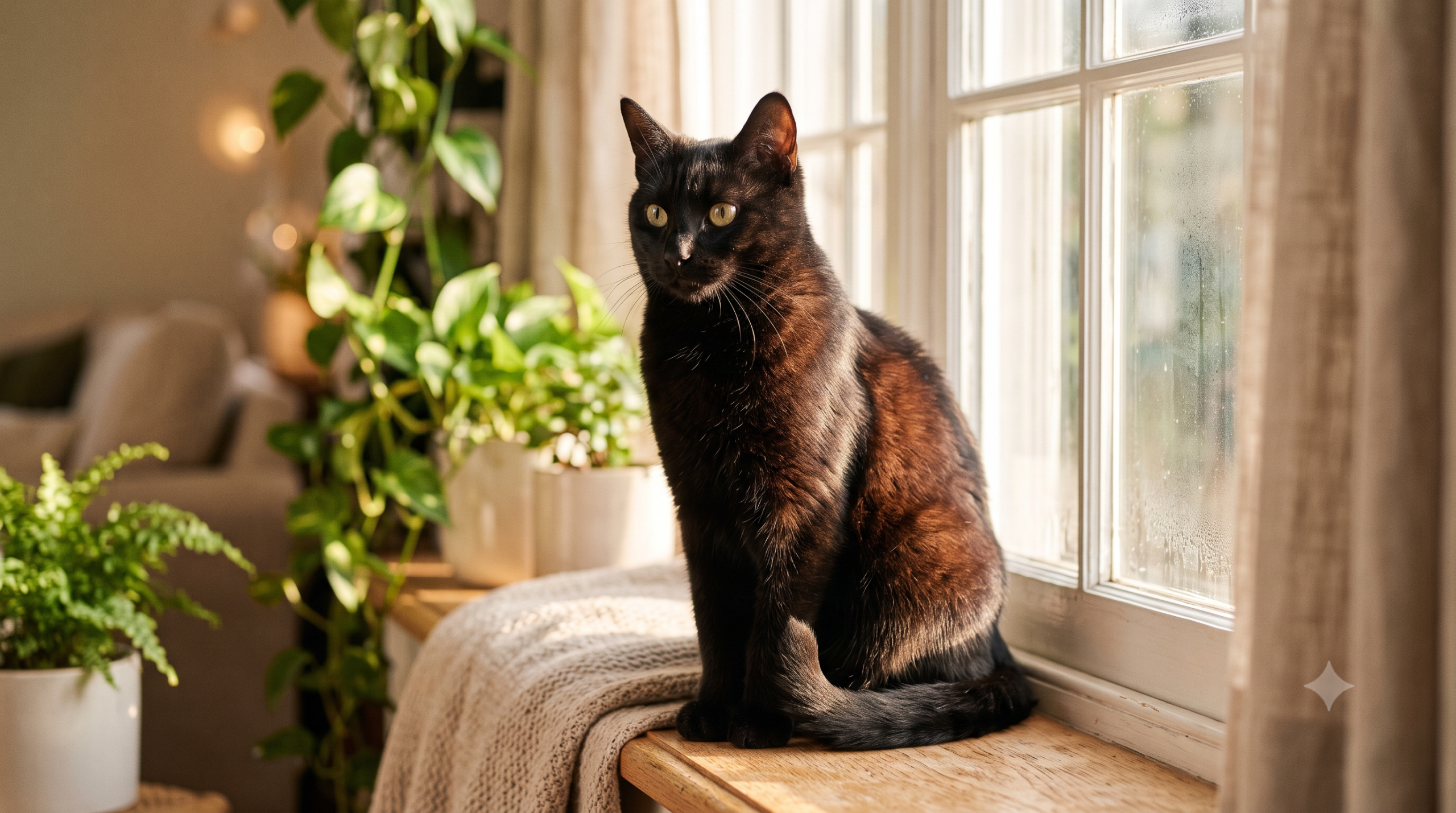
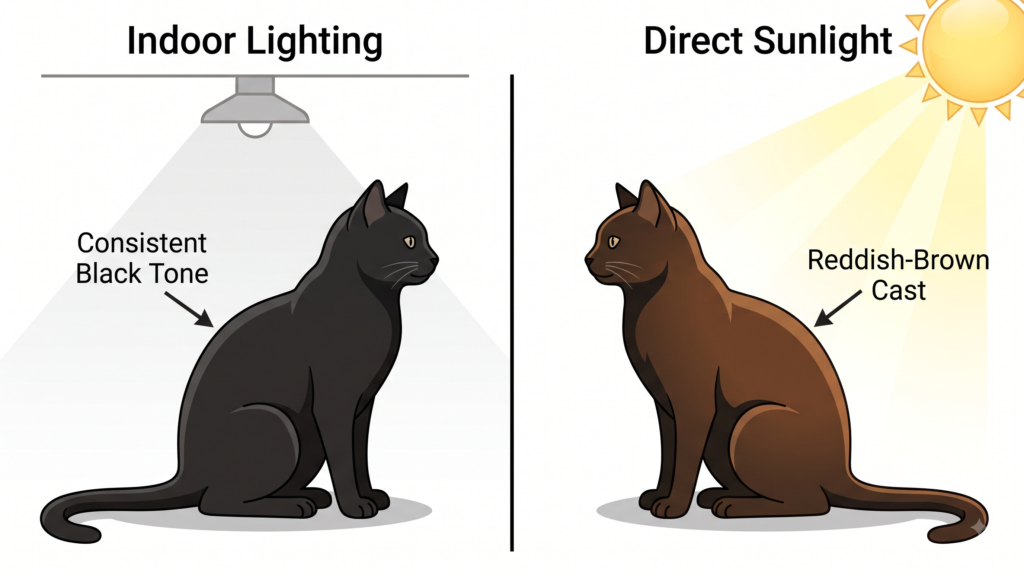
A black cat’s fur may look brown, bronze, or reddish in direct sunlight but appear much darker indoors. You might notice that the color shift is easier to see when running your hand over the coat near a window or examining the fur outdoors.
First, compare the coat in consistent lighting. Then note whether the tint is limited to sun-exposed areas, such as the back and shoulders, or is also visible in less-exposed parts of the body. These observations can help you describe the pattern to your veterinarian.
Sun exposure may contribute to changes in the appearance of dark fur, but sunlight is not automatically the explanation for every reddish tint. A lighting-dependent color difference can also make an existing coat variation more noticeable. If the discoloration persists indoors, continues to spread, or appears alongside skin or hair changes, consider a veterinary assessment rather than assuming sunlight is the only cause.
The next section explains how copper participates in pigment production—and why that biological role does not, by itself, prove that copper deficiency causes a black cat’s coat to turn brown.
Why Is My Cat’s Fur Fading in Patches?
A black cat’s coat may develop lighter areas on the back, shoulders, face, or other parts of the body. You might notice that the patch near his shoulders looks noticeably lighter than the rest of his coat, or that the fur around his face seems more reddish than before. These changes can be easier to spot when you compare photographs taken several weeks apart.
Patchy discoloration can have several explanations, including differences in sun exposure, friction, grooming, natural pigmentation, or a skin and coat problem. The location of the change may offer useful clues, but it cannot establish the cause on its own.
A nutritional factor may sometimes affect coat pigmentation, but there is not enough evidence to use an even or patchy pattern to identify copper deficiency in an individual cat. Copper supports normal pigment production, yet a lighter patch does not prove that the cat lacks copper or needs a supplement.
Look closely at whether the affected area has changed in color only or whether the fur is also thinning, breaking, or falling out. If the patch is spreading, appeared suddenly, or comes with itching, redness, scaling, or hair loss, arrange a veterinary assessment rather than relying on observation alone.
Is My Cat’s Fur Bleaching or Browning?
A black cat’s fur can look lighter, reddish, bronze, or brown for different reasons. Bleaching describes a loss of color intensity, while browning or rust-colored discoloration describes a shift toward warmer tones. These are useful descriptions of appearance, not diagnoses of the underlying cause.
It can help to compare the outer coat with the undercoat, examine the fur in consistent lighting, and look at older photographs. For example, the undercoat may look darker than the tips of the outer fur, or the coat may appear reddish in sunlight but much darker indoors. These observations can help you document the change, although they cannot reliably distinguish a nutritional problem from sun exposure or natural coat variation.
Bleaching vs. Browning Reference Chart
Use this chart to describe what you see rather than to determine the cause. The patterns below can overlap, and no single visual feature confirms a particular nutritional deficiency.
| Visual marker | What bleaching may look like | What browning or rust-colored fur may look like |
|---|---|---|
| Skin color | The fur looks lighter even though the skin appears unchanged | The fur looks warmer or more reddish while the skin may appear unchanged |
| Undercoat | The fur may look paler or less intensely colored | The fur may have a brown, bronze, or rusty cast |
| Hair color | Black fur looks washed out or less intense | Black fur looks brown, reddish, or bronze |
| Hair texture | Texture may remain normal or may change for other reasons | Texture may remain normal or may change for other reasons |
| Distribution | Changes may be more noticeable on sun-exposed areas | The color shift may be visible across the coat or in particular areas |
| Overall appearance | The coat looks lighter or faded | The coat looks warmer, redder, or browner |
Observation tip: Compare the same areas under similar lighting and take photographs over time. If the change is accompanied by hair loss, skin redness, scaling, itching, or a sudden change in appearance, contact your veterinarian.
What Else Causes a Black Cat’s Coat to Fade?
Copper is only one part of the biology of pigmentation, and the cause of a black cat’s fading coat cannot be determined from color alone. Other factors may influence how a dark coat looks, including sunlight exposure, age, genetics, and changes in the coat during shedding and regrowth.
Consider these possibilities:
- Sun exposure: Fur exposed to sunlight may develop a lighter or warmer appearance over time.
- Seasonal shedding and regrowth: The coat may look different as the undercoat and outer coat change.
- Age: Some cats develop changes in pigmentation as they grow older.
- Genetics: Natural variation can influence whether a cat’s black coat looks deep black, brownish, or warm-toned.
- Nutrition and health: Dietary inadequacy or an underlying health problem may warrant investigation, particularly when the color change occurs alongside other signs.
If your cat’s coat color is changing with age, do not assume that copper deficiency is responsible. Likewise, do not rule out a health concern simply because your cat is eating and behaving normally. Record when the change started, whether it is spreading, and whether other symptoms are present. If it persists or concerns you, discuss it with your veterinarian.
Understanding the appearance of a coat change is a useful first step. The next question is how copper participates in pigment production—and what feline research actually establishes about the relationship between copper and coat color.
Copper Is Essential for Producing Melanin in a Cat’s Coat
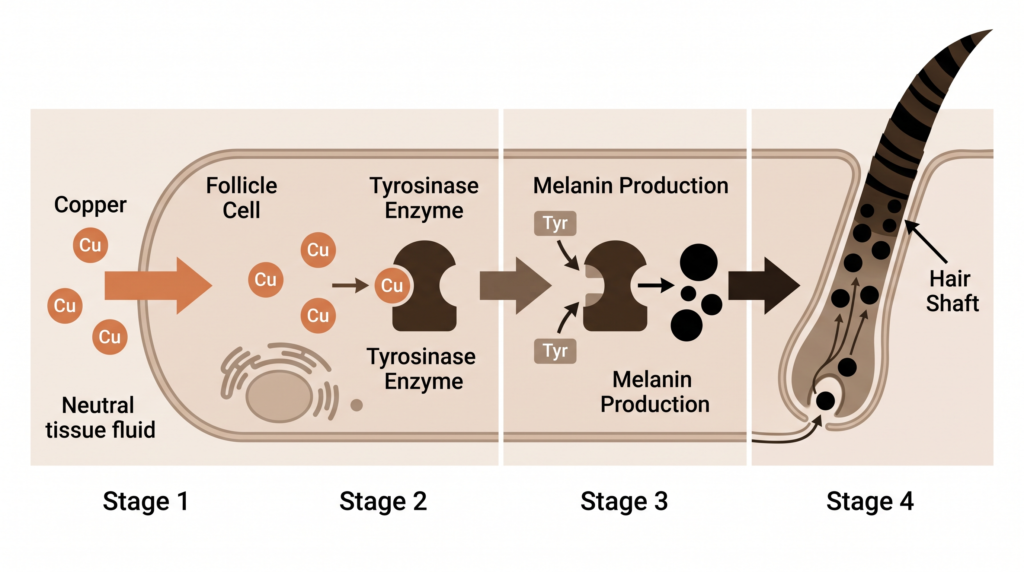
Copper plays an important role in normal pigmentation, but understanding that role requires separating established biology from what research has demonstrated about coat color in cats. The enzyme tyrosinase needs copper to function, and tyrosinase participates in producing melanin—the pigment responsible for much of a cat’s black and brown coloration.
However, this biological connection does not automatically mean that a black cat whose fur turns brown or rusty has a copper deficiency. Other nutritional factors, including the amino acid tyrosine, can influence dark-coat pigmentation. The key question is not simply whether copper is involved in pigment production, but whether insufficient copper explains the color change observed in an individual cat.
How Does Copper Affect My Cat’s Fur Color?
Copper is an essential trace mineral that helps tyrosinase function properly. Tyrosinase is an enzyme involved in melanogenesis, the biological process through which cells produce melanin. Melanin contributes to the color of a cat’s fur, including the dark pigmentation seen in black cats.
Copper also supports other important body functions, including connective tissue formation, normal nervous system function, and iron metabolism. Its role in pigmentation is therefore one part of a much broader set of nutritional needs.
But there is an important distinction: knowing that tyrosinase requires copper does not establish that copper deficiency is a common cause of rusty or brown fur in black cats. Research on black cats has also shown that dietary tyrosine can influence coat color. This means that a change in pigmentation should not automatically be attributed to copper levels alone.
For cat owners, the practical takeaway is straightforward: copper is necessary for normal body function and pigment production, but coat color by itself cannot establish whether a cat is getting too little copper. If your cat’s fur is changing color, consider the overall diet and other possible explanations rather than adding a copper supplement based on appearance alone.
What Happens When My Cat’s Copper Is Low?
Copper is required for normal body function, including the activity of tyrosinase, an enzyme involved in melanin production. However, the biological role of copper does not prove that a black cat whose fur turns brown or rusty has a copper deficiency.
If a cat genuinely has insufficient copper, the consequences may extend beyond coat appearance. The signs depend on the severity and duration of the deficiency and the cat’s overall nutritional and health status. A change in fur color alone is not a reliable way to identify copper deficiency.
Hair grows in cycles, and the color of newly growing fur reflects the pigment produced as that hair develops. This means that some changes in coat appearance may become noticeable gradually. However, the timing of a color change cannot establish whether copper, another nutrient, sunlight, genetics, or a health condition is responsible.
Copper Status and Coat Appearance: What Can You Conclude?
Copper is involved in normal pigment production, but coat appearance cannot reliably establish a cat’s copper status. Use the following table to separate what is known from what remains uncertain.
| Observation or finding | What it may tell you | What it does not prove |
|---|---|---|
| Coat color remains consistent | The cat’s pigmentation appears stable | That every aspect of the diet is nutritionally adequate |
| Fur looks less intensely black | A change in pigmentation or its appearance may have occurred | That copper intake is too low |
| Fur develops brown or rusty tones | Several factors may be involved, including sunlight, genetics, and nutrition | That copper deficiency is the cause |
| Coat changes alongside hair loss or skin irritation | A skin or coat problem may need investigation | A particular mineral deficiency |
| A diet is labeled complete and balanced for the cat’s life stage | The food is intended to provide the required nutrients when fed as directed | That an individual cat’s health or nutritional status has been confirmed |
Important: Copper supplementation should not be started solely because a cat’s fur looks faded or reddish. If the coat change persists or occurs alongside other symptoms, your veterinarian can assess the diet and decide whether further investigation is appropriate.
Do Darker Cats Genuinely Need More Copper?
There is no established evidence that black or dark-coated cats have a higher dietary copper requirement simply because of their coat color. Nutrient requirements are determined by factors such as life stage and physiological needs, not by an assumption that a darker coat must require more copper.
AAFCO publishes nutrient profiles used in the nutritional adequacy framework for cat foods in the United States. These profiles distinguish requirements by life stage, including growth and reproduction versus adult maintenance. They do not establish a separate copper requirement for black cats.
It is important to distinguish two different claims:
- Copper is involved in normal pigmentation. This is established biological knowledge.
- Dark-coated cats need more dietary copper than lighter-coated cats. This has not been established by the evidence discussed here.
The second claim does not follow automatically from the first. Coat color alone cannot establish whether a cat’s copper intake is adequate, insufficient, or excessive.
For a cat eating an appropriately formulated, complete and balanced commercial diet, there is generally no reason to add extra copper simply because the coat looks brown or faded. If you suspect a nutritional problem, review the diet with your veterinarian instead of trying to correct it with a supplement.
Why Does Fading Show Up More on Black Fur?
A change in dark fur can be easier to notice because a shift from deep black to brown or reddish tones creates a visible contrast. The same degree of color variation may be less obvious in a naturally light-colored coat.
This is a reasonable explanation for why some owners notice discoloration more readily in black cats. However, it is important to separate visibility from susceptibility. A change being easier to see does not establish that black cats develop copper deficiency more readily or require more copper.
There is also a separate consideration: research on black cats has examined the role of dietary tyrosine in maintaining dark coat coloration. That evidence is relevant when discussing rusty fur and should not be replaced by an assumption that copper is the cause.
The practical takeaway is simple: document the change, consider the cat’s overall diet and circumstances, and avoid inferring a mineral deficiency from coat color alone.
Is There Real Evidence Dark Cats Need More Copper?
The relationship between copper and tyrosinase is well established. What has not been established is that dark-coated cats need a different baseline amount of dietary copper from other cats.
The distinction matters because a biological mechanism can be real even when a proposed explanation for a particular symptom remains unproven.
Confirmed vs. Unconfirmed Evidence
| Evidence point | What the evidence supports |
|---|---|
| Copper and tyrosinase | Copper is required for normal tyrosinase activity, which participates in melanin production. |
| Melanin and coat color | Melanin contributes to the pigmentation of a cat’s fur. |
| Dietary tyrosine and black coats | Research in black cats has found that dietary tyrosine can influence coat coloration, including reddish discoloration. |
| Dark-coat copper requirements | The evidence discussed here does not establish that dark-coated cats need more copper than lighter-coated cats. |
| Coat color as a nutritional test | A brown, rusty, or faded coat cannot independently confirm copper deficiency. |
| Copper supplementation | Coat discoloration alone is not a sound basis for adding copper to a cat’s diet. |
| Complete-and-balanced food | An appropriate nutritional adequacy statement is useful when choosing a food, but it does not diagnose an individual cat’s nutritional status. |
The key research to consider is Morris, Yu, and Rogers’ 2002 study, Red Hair in Black Cats Is Reversed by Addition of Tyrosine to the Diet. It is directly relevant to the relationship between diet and rusty coloration in black cats. It does not justify assuming that every rusty coat is caused by low tyrosine, either.
The most defensible conclusion is that copper is essential for normal physiology and pigmentation, but the claim that dark cats have a higher copper requirement remains unproven. Keeping that distinction clear prevents a plausible biological explanation from being presented as a confirmed cause.
Can Genetics Explain My Black Cat’s Rusty Coat?
Yes, genetics can contribute to natural differences in coat color. Some cats have a warmer or browner appearance than others, even when their coats are generally described as black. A warm-toned coat does not automatically indicate a nutritional problem.
The useful question is whether the color is normal for that individual cat or represents a new change. Comparing recent photographs with older ones may help you identify a difference, although lighting can influence how black fur appears.
If the color has changed noticeably, consider the full picture: the cat’s age, sunlight exposure, diet, coat texture, and any accompanying signs. Genetics may be part of the explanation, but it should not be used to dismiss a persistent or otherwise concerning change.
Understanding the biology of pigmentation is useful, but the next practical question is whether your cat’s diet supplies the nutrients it needs.
A Complete Diet Should Meet Most Cats’ Copper Needs
For cat owners, the practical question is often whether a food change or supplement might improve a fading coat. The starting point is to check whether the cat receives a nutritionally appropriate diet—not to seek out the ingredient with the highest copper content.
Complete commercial cat foods are formulated to provide the nutrients required for their stated life stage. Copper is one of those essential nutrients. However, a coat color change does not automatically mean the current food is deficient, and adding more copper is not a reliable way to make a black coat darker.
What Foods Are High in Copper for Cats?
Some ingredients, including liver and certain shellfish, naturally contain more copper than many muscle meats. But an ingredient’s copper content does not establish that it is suitable to feed in large amounts or that it will improve a cat’s coat.
For cats eating a complete commercial diet, extra copper-rich ingredients are generally unnecessary unless a veterinarian has identified a specific dietary need. For cats eating home-prepared food, the entire recipe needs to be assessed for nutritional adequacy rather than relying on one or two nutrient-rich ingredients.
The food bag may say “complete and balanced,” so it is understandable to wonder why the coat is changing. That statement is an important starting point: it indicates that the food is intended to meet established nutritional requirements for its stated use. It does not mean that every change in coat appearance is caused by something outside the diet, nor does it prove that copper deficiency is responsible.
Checking the nutritional adequacy statement is more useful than judging a food by whether liver, fish, or another copper-containing ingredient appears on the label.
Copper Content by Ingredient: What to Know
Copper content varies with the ingredient, species, preparation, and source. Rather than treating individual ingredient values as feeding recommendations, use this comparison to understand why a single food cannot establish the adequacy of a complete diet.
| Ingredient or food type | General copper contribution | Practical consideration |
|---|---|---|
| Liver | Can be relatively copper-rich, depending on the animal and type of liver | Large additions can unbalance a homemade diet; do not use liver as a copper supplement without professional guidance. |
| Certain shellfish | Some types contain substantial amounts of copper | Not necessary as an addition to a complete commercial cat food. |
| Fish such as salmon | Copper content varies by species and product | Fish should not be used as a targeted copper source. |
| Eggs | Provide several nutrients, including some copper | They do not replace a complete and balanced feline diet. |
| Muscle meat | Generally contributes a different nutrient profile from organ meats | Meat alone does not supply every nutrient a cat requires. |
| Complete commercial cat food | Nutrient levels depend on the formulation | The food is designed to meet established nutrient requirements for its stated life stage when fed as directed. |
Important: Do not use a single ingredient’s copper content to decide whether your cat’s diet is adequate. If you retain exact milligram values in this table, verify each one against the relevant USDA FoodData Central entry and identify the specific food and preparation method. Ingredient composition figures are not a substitute for formulating a complete feline diet.
For a commercial food, the ingredient list also cannot tell you the exact amount of copper in the finished product. Ingredients are listed by weight, not ranked according to how much of a particular mineral the cat will absorb.
How Much Copper Does My Cat Actually Need?
Cats need copper in appropriate amounts, but the requirement depends on the nutritional standards applicable to the cat’s life stage and the overall formulation of the diet. A single universal amount should not be applied without considering the food’s nutrient basis and the cat’s circumstances.
Cats eating an appropriately formulated, complete commercial diet are generally expected to receive the copper they need. Nutritional inadequacy is a concern when a diet does not provide the required nutrients, which is one reason home-prepared diets need careful formulation.
If you are unsure whether your cat’s food is appropriate, check its nutritional adequacy statement and intended life stage. Switching foods solely because the coat looks faded may not solve the problem, particularly when the change has another explanation.
The body uses copper as part of a wider nutritional system. The total diet matters, and simply adding an ingredient or supplement does not guarantee better nutrient status or improved pigmentation.
Diet changes may be appropriate when a genuine dietary problem has been identified, but they are not a guaranteed solution for coat discoloration. Discuss persistent changes or concerns about nutrient intake with your veterinarian before making substantial changes.
Complete Diet Verification Checklist
Use this checklist when reviewing a cat-food package.
- Find the nutritional adequacy statement. Look for wording indicating that the food is complete and balanced for a specified use.
- Check the intended species. Confirm that the food is formulated for cats.
- Check the life stage. Confirm whether it is intended for growth, adult maintenance, reproduction, or all life stages.
- Read the full adequacy statement. Look for the stated nutritional standard or feeding-trial basis, where applicable.
- Do not rely on ingredients alone. The presence of meat, liver, fish, or added minerals does not independently prove that the finished food is complete.
- Distinguish complete food from treats and supplements. Products intended for intermittent or supplemental feeding should not automatically replace a complete diet.
- Follow the feeding directions. Consider the intended use and feeding guidance for the product.
- Keep product information available. The product name, manufacturer, and lot details can be useful if you need to ask the company about nutrient information.
Quick verification rule: Start with the nutritional adequacy statement, not the length of the ingredient list. For home-prepared diets, this checklist is not enough to establish adequacy; the entire recipe needs appropriate formulation and evaluation, ideally with guidance from a veterinary nutrition professional.
Is Too Much Copper Bad for Cats?
Yes. Copper is essential, but more is not automatically better. Excessive intake can be harmful, and adding a copper supplement without a demonstrated need can create nutritional risks rather than improve coat health.
Copper also interacts with other minerals, including zinc. The consequences depend on the overall diet and the amount and duration of exposure. This is another reason not to try to correct a coat color change by adding individual minerals without veterinary guidance.
A food formulated to meet established nutrient requirements does not ordinarily need extra copper added simply because a cat’s coat looks faded. If there is a genuine concern about nutrient intake, your veterinarian can review the diet and determine whether further assessment is warranted.
Copper–Zinc Interaction Reference
Copper and zinc are both essential minerals, and the balance of the overall diet matters. High zinc exposure can interfere with copper availability in some circumstances, but there is no single zinc-intake category or coat-color pattern that can independently diagnose copper deficiency in an individual cat.
| Factor | What is known | Practical interpretation |
|---|---|---|
| Balanced intake of both minerals | Both copper and zinc are required for normal function. | Feed an appropriate complete diet rather than adjusting individual minerals without guidance. |
| Excessive zinc exposure | High zinc exposure can interfere with copper metabolism and may contribute to deficiency. | Do not add high-dose zinc unless there is a veterinary reason. |
| Inadequate copper intake | Insufficient copper can compromise normal physiological functions. | Evaluate the whole diet rather than trying to correct a suspected problem based on coat color. |
| Mineral supplements | Adding one mineral can affect the overall balance of the diet. | Discuss supplements with your veterinarian before use. |
| Coat discoloration | Brown or rusty fur does not establish a copper–zinc imbalance. | Investigate persistent changes in context instead of using coat appearance as a mineral test. |
The goal is not to maximize copper intake. It is to provide the right nutrients in an appropriate, balanced diet. If your cat’s coat has changed, start by documenting the change and reviewing the food rather than adding supplements.
These feeding considerations provide a starting point for deciding what to do when a coat color change has already appeared. The next section looks at how to respond safely and when veterinary advice may be useful.
What Should I Do If My Cat’s Coat Color Changes?
If your cat’s coat is becoming brown, rusty, or faded, start by documenting the change rather than assuming it is caused by a nutritional deficiency. Notice when it began, which areas are affected, whether the fur’s texture has changed, and whether your cat has any other symptoms.
Next, review your cat’s current food. Check whether it is labeled complete and balanced for the appropriate life stage. You can also consider whether your cat spends time in direct sunlight or whether the color difference becomes noticeable only under particular lighting conditions.
It’s not like she’s sick or acting different; the coat is just… off is an understandable observation. A cat that is eating and behaving normally may still have a coat change worth investigating, particularly if the change persists or progresses.
Take photographs every few weeks under similar lighting. Note whether the discoloration is spreading, remaining in one area, or becoming more noticeable. These details can help you describe the change to your veterinarian.
Waiting to see whether the color improves on its own can feel uncertain. Monitoring is reasonable for a mild, isolated change, but it should not replace veterinary advice when the change is rapid, persistent, or accompanied by other symptoms.
Initial Coat-Change Observation Checklist
Before deciding what to do next, record the following details:
- When did you first notice the change? Estimate the date or how long the discoloration has been present.
- Where is it located? Note whether the face, back, belly, legs, tail, or several areas are affected.
- Is the change symmetrical? Compare both sides of the body.
- What does the color look like? Describe whether the fur appears lighter, brown, reddish, bronze, or gray.
- Has the undercoat changed? Gently part the fur and compare the underlying hair with the outer coat.
- Has the texture changed? Look for unusual dryness, brittleness, greasiness, or matting.
- Is there hair loss? Check for thinning, broken hairs, or bald patches.
- Does the skin look different? Note redness, scaling, crusting, or irritation.
- Is your cat scratching or overgrooming? Watch for repeated licking, chewing, rubbing, or scratching.
- Has grooming changed? Note whether your cat is maintaining its usual grooming habits.
- Is the change progressing? Compare current photographs with older images.
- Are there other symptoms? Record changes in appetite, weight, energy, activity, or behavior.
Before the next step: Take clear photographs under similar lighting. Keep a note of any recent food changes, new supplements, or changes in sun exposure. This information may help your veterinarian assess the situation.
Should I Give My Cat a Copper Supplement?
Do not start a copper supplement simply because your cat’s coat looks faded or rusty. Copper is essential, but excessive intake can be harmful, and additional copper will not necessarily improve pigmentation when the cause is unrelated to copper deficiency.
It’s tempting to add a supplement and hope it fixes the problem. However, doing so without identifying the cause may add an unnecessary nutrient without addressing the actual issue.
If you are considering a supplement, discuss it with your veterinarian first. They can review the complete diet, consider your cat’s medical history, and decide whether a nutritional deficiency is plausible.
For a cat already eating an appropriately formulated, complete and balanced commercial food, extra copper is not automatically necessary. If the diet is home-prepared or otherwise incomplete, the entire nutrient profile should be reviewed rather than correcting copper in isolation.
How Is Low Copper Diagnosed in Cats?
A coat color change alone cannot diagnose copper deficiency. Your veterinarian may begin by reviewing your cat’s diet, medical history, physical examination findings, and any other symptoms.
Bloodwork may help investigate broader health concerns, but routine blood tests do not necessarily provide a definitive answer about copper status in every cat. The usefulness of particular tests depends on the clinical situation, and your veterinarian can determine whether further nutritional assessment or specialized testing is warranted.
Copper levels in cats should not be interpreted through an at-home test or inferred from fur color. If testing is appropriate, the results need to be considered alongside the cat’s diet and overall health rather than treated as an isolated diagnosis.
The purpose of veterinary assessment is to investigate plausible causes and decide what action, if any, is needed. A copper supplement should not be used as a substitute for that process.
When Should I Take My Cat to the Vet?
A gradual color change without other symptoms may be suitable to discuss at a routine appointment. However, a persistent or spreading change, hair loss, skin irritation, or changes in appetite, weight, or behavior warrant more timely advice.
Even if your cat seems completely normal, it is reasonable to mention a coat change at the next checkup. If the change is progressing or you are uncertain about its significance, contact your veterinary clinic rather than waiting indefinitely.
A veterinarian can assess the coat and skin, review the diet, and decide whether further investigation is appropriate. A breeder may be able to provide context about inherited coat-color variation, but a new or unexplained change should not automatically be attributed to genetics.
Vet Visit Urgency Decision Matrix
Use this table as general guidance for deciding how promptly to seek veterinary advice. The urgency depends on the complete picture, not the coat color alone.
| What you notice | Suggested response |
|---|---|
| Gradual color change only, with normal appetite, activity, grooming, and skin | Document the change and mention it at the next routine veterinary visit if it persists or concerns you. |
| Gradual discoloration with a persistent change in coat texture | Arrange a veterinary appointment if the change continues or worsens. |
| Color change with hair thinning, bald patches, itching, or repeated overgrooming | Arrange a veterinary assessment to investigate the skin and coat. |
| Coat change with reduced appetite, unexplained weight change, or persistent lethargy | Contact your veterinarian promptly for advice. |
| Rapid or widespread change with skin redness, sores, crusting, or significant irritation | Contact your veterinarian promptly and describe the extent of the changes. |
| Severe weakness, collapse, breathing difficulty, repeated vomiting, or another serious acute symptom | Seek urgent veterinary care rather than waiting for a routine appointment. |
Rule of thumb: A coat color change alone does not establish an emergency or a nutritional deficiency. The speed of the change, accompanying skin findings, and your cat’s overall health are more useful when deciding what to do next.
How Is Copper Deficiency Treated in Cats?
Treatment depends on whether a deficiency is actually present and what caused it. If a copper-related nutritional problem is confirmed, a veterinarian may recommend correcting the diet or using a suitable supplement under professional guidance.
The appropriate approach depends on the cat’s nutritional intake, health status, and any relevant test findings. There is no single treatment or supplement dose that should be applied to every cat with a faded coat.
The aim is to correct the underlying problem, not simply to darken the fur. If the color change has another cause, adding copper may not help.
This article does not provide copper doses or treatment protocols because those decisions require an assessment of the individual cat.
How Long Until My Cat’s Coat Color Returns?
There is no reliable, universal timeline for a cat’s coat to return to its previous color. If a reversible factor is responsible, any visible improvement may depend on the cause and the growth of new fur. If the change is genetic or related to normal pigmentation variation, the original color may not return.
A cat’s coat is continually renewed, but individual hairs do not all grow and shed at the same time. This is one reason changes in coat appearance can become noticeable gradually rather than across the entire body at once.
A black cat’s coat being unlikely to fully recover is not something you should assume in advance. Equally, improvement should not be promised simply because a dietary change or supplement has been made. The outcome depends on what caused the discoloration in the first place.
Hair Growth Cycle: What Owners Should Know
| Hair-cycle phase | What happens | What it means for coat appearance |
|---|---|---|
| Anagen — active growth | A hair follicle actively produces a growing hair. | The characteristics of newly formed hair develop during growth. |
| Catagen — transition | The follicle moves from active growth toward a resting phase. | Hair growth slows as the follicle transitions. |
| Telogen — resting | The hair remains in the follicle during a resting phase. | Existing hair can remain visible even as its growth has stopped. |
| Exogen — shedding | An older hair is released and shed. | Changes may become more noticeable as old hairs are replaced. |
| New growth | A new hair develops as the follicle returns to active growth. | The appearance of the coat changes as new hairs emerge and replace older ones. |
Important timing point: There is no single fixed hair-growth timeline that applies to every cat or every body region. Coat type, season, health, and the individual hair follicles can affect growth and shedding. A visible improvement therefore cannot be promised within a specific number of weeks.
Continue taking photographs under similar lighting if you are monitoring a change. If the coat continues to fade, the change spreads, or new symptoms appear, discuss the progression with your veterinarian.
What Happens If I Ignore a Coat Color Change?
A coat color change does not automatically mean that something is wrong with your cat’s health. It may reflect normal pigmentation variation or environmental influences. However, persistent or worsening changes can also accompany nutritional, skin, or other health concerns.
You do not need to assume the worst when you notice a rusty tint. At the same time, it is unwise to assume that the change is harmless simply because your cat is eating and playing normally.
Document the appearance, review the current diet, and monitor for other changes. If the discoloration persists, progresses, or occurs alongside other symptoms, a veterinary assessment can help determine whether anything needs attention.
The goal is not to treat every color change as a medical problem. It is to avoid overlooking a meaningful change or treating an unconfirmed copper deficiency with unnecessary supplements.
Several Different Conditions Can Mimic Copper-Related Coat Fading
A black cat’s coat can look lighter, browner, or rustier for several reasons. Comparing the possible explanations can help you organize your observations, but no coat-color pattern can independently identify the cause.
Is My Cat’s Coat Fading From Age or Diet?
Natural pigmentation variation, age, sunlight exposure, and changes during shedding can influence how a cat’s coat looks. Nutritional factors may also be relevant, particularly if the diet is incomplete or has changed significantly.
A gradual color change in a cat that otherwise appears well may be less urgent than a change accompanied by hair loss, skin irritation, or other symptoms. However, the speed and distribution of the change cannot reliably distinguish age-related variation from a nutritional problem.
If several cats eat the same food but only one develops a coat change, that is useful context to share with your veterinarian. It does not prove that the food is adequate for every individual or that the affected cat has a deficiency. Age, genetics, individual health, and exposure to sunlight may differ between cats.
Coat-Change Comparison Guide
| Observed pattern | What it may help you consider | What it cannot establish |
|---|---|---|
| Gradual change over time, without other symptoms | Natural pigmentation variation, age, environmental exposure, or other explanations | That the change is harmless or age-related |
| Color change more noticeable on sun-exposed areas | Whether sunlight may contribute to the appearance | That sunlight is the only cause |
| Change noticed after a substantial diet change | Whether the overall diet deserves review | That a specific ingredient or mineral caused the change |
| Patchy discoloration with hair loss or irritation | Whether a skin or coat problem needs assessment | A specific skin disorder or nutritional deficiency |
| Color change with appetite, weight, or behavior changes | Whether a broader health assessment is warranted | A particular diagnosis |
These patterns are best used to describe what you see and decide what information to share with your veterinarian—not to choose a diagnosis at home.
Sun Bleaching or Copper Deficiency: Which Is It?
Sun exposure can contribute to a lighter or warmer appearance in exposed fur. A nutritional problem may also affect coat appearance, but the distribution of the color change cannot reliably distinguish the two.
| Factor | What may be observed with sun exposure | What to know about a possible nutritional cause |
|---|---|---|
| Location | Changes may be more noticeable in areas exposed to sunlight. | Distribution alone cannot identify a nutritional deficiency. |
| Season | The appearance may vary with exposure and seasonal habits. | Seasonal timing does not rule a nutritional cause in or out. |
| Hair appearance | The outer coat may look lighter or more weathered. | Coat color and texture are nonspecific observations. |
| Indoor lifestyle | Less direct exposure may reduce some sun-related effects. | Indoor cats can still have coat changes for many reasons. |
| Diet history | Sun exposure is not itself a dietary factor. | A complete diet review may be useful, but a recent food change does not prove causation. |
If your cat spends a lot of time outdoors or beside a sunny window, noting the location of the color change is a sensible first step. However, do not assume that sunlight explains every reddish or brown area. If the change persists or comes with other signs, seek veterinary advice.
What Does the Research Actually Show?
Copper is required for the normal function of tyrosinase, an enzyme involved in melanin production. This biological role is well established. What has not been established is that dark-coated cats have a higher baseline copper requirement than lighter-coated cats.
Research on dietary tyrosine in black cats is also relevant. Morris, Yu, and Rogers’ 2002 study, Red Hair in Black Cats Is Reversed by Addition of Tyrosine to the Diet, examined the relationship between dietary tyrosine and reddish coat coloration. This is an important reason not to attribute every rusty coat to copper deficiency.
AAFCO nutrient profiles provide nutritional standards for cat foods according to life stage; they do not establish a separate copper requirement based on coat color. A complete-and-balanced food is a useful starting point for reviewing a cat’s diet, but the label does not diagnose an individual animal’s nutritional status.
The evidence therefore supports a cautious conclusion: copper is essential for normal physiology and pigmentation, but a coat color change does not establish copper deficiency, and the claim that dark-coated cats need more copper has not been demonstrated.
Research Summary: What the Evidence Supports
| Evidence point | What can reasonably be concluded | Important limitation |
|---|---|---|
| Copper and tyrosinase | Copper is required for normal tyrosinase activity. | This does not prove that copper deficiency caused a particular cat’s coat change. |
| Melanin and coat color | Melanin contributes to coat pigmentation. | Pigmentation can be influenced by more than one biological and nutritional factor. |
| Dietary tyrosine research | A feline study found that dietary tyrosine can influence reddish coloration in black cats. | This does not establish the cause of every rusty coat. |
| Dark-coated cats’ copper needs | The evidence discussed here does not establish a higher copper requirement based on coat color. | Lack of evidence for a different requirement is not proof that every individual cat has identical nutritional needs. |
| Complete-and-balanced foods | Nutritional adequacy statements help identify foods intended to meet established requirements for a specified life stage. | They do not prove that every health concern is unrelated to diet. |
| Coat color as a diagnostic sign | Color change is a useful observation to document. | Coat appearance alone cannot diagnose copper deficiency or another condition. |
| Copper and zinc | Mineral balance matters, and excessive zinc exposure can interfere with copper metabolism in some circumstances. | A coat pattern or simple ratio cannot diagnose an individual cat’s mineral status. |
How to interpret the evidence: The strongest conclusions are those directly supported by research or established nutritional standards. When the evidence does not establish a cause, describe it as a possibility to investigate rather than a confirmed explanation.
Conclusion
Copper is essential for normal body function and plays a role in melanin production. However, there is no established evidence that dark-coated cats need more dietary copper simply because their fur is black. A black cat’s coat turning brown or rusty does not, by itself, establish copper deficiency.
Sun exposure, natural pigmentation variation, age, genetics, nutritional factors, and skin or health problems may all be relevant. The most useful next step is to document the change, review the diet, and consider whether any other symptoms are present.
Avoid adding copper supplements or changing a complete diet solely to restore coat color. If the discoloration persists, progresses, or occurs alongside other symptoms, discuss it with your veterinarian.
What to Watch For
- Whether the coat change developed gradually or suddenly.
- Whether the change is spread evenly across the coat or concentrated in one area.
- Whether the color looks different in direct sunlight and indoor lighting.
- Whether the fur’s texture has changed or hair loss is present.
- Whether the skin looks red, irritated, scaly, or otherwise different.
- Whether appetite, energy, weight, grooming, or behavior has changed.
- Whether other cats in the household show a similar change.
Questions to Ask Your Vet
- Could my cat’s coat change be related to the current diet?
- Is the food complete and balanced for my cat’s life stage?
- Could sunlight, age, genetics, or another factor explain the discoloration?
- Do the examination findings suggest a need for bloodwork or other tests?
- Is there any reason to investigate a nutritional deficiency?
- Should I avoid any supplements or dietary changes while the cause is being assessed?
- What changes would mean I should arrange a follow-up sooner?
Frequently Asked Questions
Can copper deficiency in cats be fixed through diet alone?
If a cat’s copper intake is inadequate because its diet is incomplete or unbalanced, correcting the diet may help address the nutritional problem. However, coat changes alone cannot confirm copper deficiency, and dietary correction may not resolve a change caused by another condition. A veterinarian can assess the cat’s diet and overall health and determine whether a dietary change or another intervention is appropriate.
Is a black cat’s coat turning brown always a sign of a health problem?
No. A black cat’s coat can develop a brown or rusty tint for several reasons, including sun exposure, natural coat variation, and changes associated with aging. A nutritional issue is another possibility, but coat color alone cannot identify the cause. If the change is new, persistent, patchy, or accompanied by hair loss, itching, appetite changes, or unusual behavior, discuss it with your veterinarian.
Do all-black cats have a higher copper requirement than other cats?
There is no established evidence that black cats require more dietary copper than cats with lighter coats. Copper is essential for normal pigmentation, but that does not mean a dark coat creates a higher nutritional requirement. A change in coat color is not a reliable test of copper status, and cats eating a complete, balanced diet should not automatically receive extra copper because their fur looks rusty.
How quickly does a cat’s coat respond once copper levels are corrected?
There is no established timeline for coat-color recovery after a copper-related nutritional problem is corrected. Because visible coat changes depend partly on hair growth, any improvement may become apparent gradually as new fur grows. Recovery also depends on whether copper deficiency was actually responsible for the change. A veterinarian can advise what to expect once the underlying cause has been assessed.
Can sun exposure alone cause a black cat’s coat to look brown?
Yes. Sun exposure can contribute to a reddish or brown appearance in dark fur, particularly on areas that receive more sunlight, such as the back and shoulders. However, the pattern of fading cannot confirm sun bleaching or rule out other causes. Comparing photos taken in similar lighting and noting where the color change occurs can help you describe the change to your veterinarian if it persists or concerns you.
Disclaimer: This article is written for educational purposes only and does not replace professional veterinary advice. Always consult a licensed veterinarian before making changes to your cat’s diet or health management.
Refrences
| Claim in Article | Source | Link |
|---|---|---|
| Copper minimum requirements for cats by life stage, including adult maintenance and growth/reproduction | AAFCO — Official pet food nutrient profile information | https://www.aafco.org/consumers/understanding-pet-food/frequently-asked-questions |
| Copper deficiency may contribute to a dull, dry coat, patchy hair loss, and loss of normal hair pigmentation | VCA Animal Hospitals Canada — Nutrition and Your Cat’s Skin and Haircoat | https://vcacanada.com/know-your-pet/nutrition-skin-and-cats |
| Copper’s role in pigmentation biology and research on nutrition and hair color in cats and dogs | Nutrition and Hair Color in Cats and Dogs (2017 review) | https://www.researchgate.net/publication/317276845_Nutrition_and_hair_color_in_cats_and_dogs |
| Dietary tyrosine can influence black-cat coat coloration; red hair in black cats was reversed under the study’s dietary conditions | Morris, J. G., Yu, S., and Rogers, Q. R. (2002). Red Hair in Black Cats Is Reversed by Addition of Tyrosine to the Diet. The Journal of Nutrition, 132(6 Suppl 2), 1646S–1648S. | https://academic.oup.com/jn/article/132/6/1646S/4687872 |
| What “complete and balanced” means on a pet-food label | U.S. Food and Drug Administration (FDA) — “Complete and Balanced” Pet Food | https://www.fda.gov/animal-veterinary/animal-health-literacy/complete-and-balanced-pet-food |
| Copper’s role among nutrients that support normal skin and coat health | Purina — Promote a Healthy & Shiny Cat Coat | https://www.purina.com/articles/cat/health/skin-fur-ears/healthy-skin-and-coat |

Saloni Nagar is the founder and lead content creator of Bark & Meow Tales. As a dedicated cat parent and researcher, she transitioned from personal loss to pet health advocacy, focusing on early warning signs and preventive care. Saloni specializes in translating complex veterinary concepts into actionable guidance for pet parents. Her work is driven by a commitment to helping others interpret subtle feline health signals before they escalate, ensuring that every cat has a voice through informed, compassionate care.