
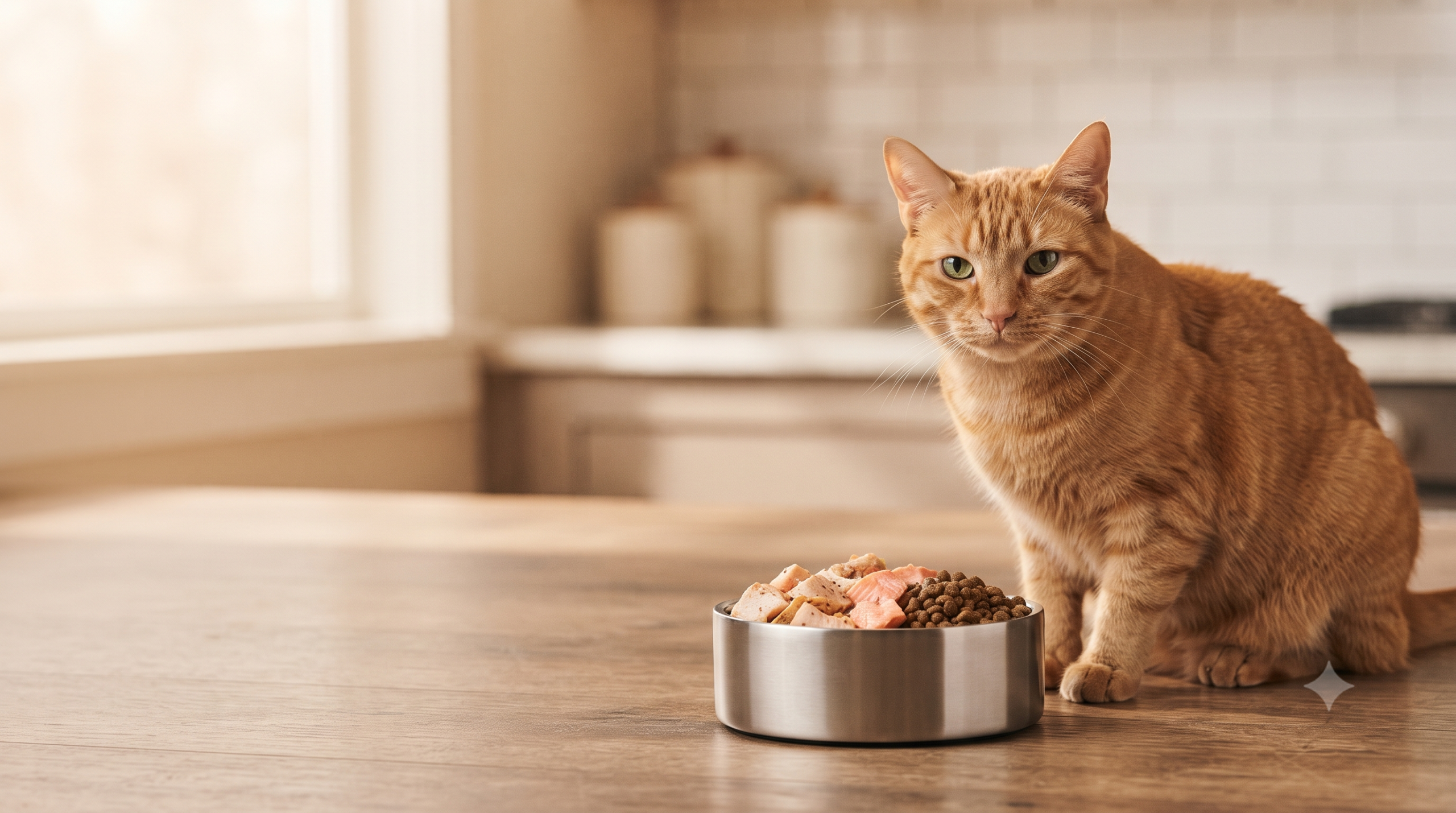
By Saloni Nagar, Medically Reviewed by Dr. Jimisha Shah, B.V.Sc. & A.H., PGDAW
Cats cannot produce enough niacin (vitamin B3) from tryptophan to meet their dietary needs. One important reason is an enzyme called picolinic carboxylase, which diverts a key intermediate in the metabolic pathway away from niacin production. As a result, niacin is a true dietary essential for cats. Unlike dogs and humans, cats cannot rely on this pathway to provide enough niacin for normal body functions.
You may have landed here after noticing a change in your cat, reading a pet food label, or checking a homemade or raw diet. You may also be wondering why cats need niacin when other animals can produce some of their own. If you want a straight answer before you call the vet, understanding the basics is a sensible place to start.
Niacin deficiency is not generally expected in cats eating an appropriately formulated, nutritionally complete diet. However, an unbalanced homemade diet or other nutritional problems can put a cat at risk. A change in appetite, energy, or general condition does not automatically mean niacin deficiency, because these signs can have several possible causes.
Still, understanding why cats can’t make niacin helps explain their unique nutritional requirements. It can also make ingredient labels and dietary recommendations easier to understand.
The reason comes down to a specific step in tryptophan metabolism. It is not a failure of protein digestion or amino acid metabolism as a whole.
This guide explains what niacin does, why the tryptophan-to-niacin pathway works differently in cats, what niacin deficiency may look like, and how cats compare with other animals. It also covers dietary sources of niacin and what to discuss with your veterinarian if you are concerned about your cat’s food.
Signs of Niacin Deficiency in Cats
Niacin deficiency can affect a cat’s health, but its signs are not always easy to recognize from everyday observations. Historical research on niacin-deficient cats has documented problems such as reduced appetite, poor growth, weight loss, weakness, and diarrhea. These findings do not mean that every cat showing one of these signs has a niacin deficiency.
The risk depends partly on what the cat eats. A nutritionally complete and balanced diet is designed to provide the niacin cats need, while an unbalanced homemade diet or an inadequately formulated diet may leave nutritional gaps.
The subsections below explain which changes are worth noticing, what the evidence tells us about niacin deficiency, and when to seek veterinary advice.
What Are the Early Signs of Niacin Deficiency in Cats?
A cat that is lethargic and has bad breath may have a health problem that deserves attention. Although weakness and reduced activity have been described in niacin-deficient cats, neither lethargy nor bad breath can identify this deficiency on its own.
Your cat seems more tired than usual lately, and you notice her breath smells different than normal. Perhaps you noticed the change gradually rather than all at once, or she still seems playful, just a little off.
These observations are worth recording, but they do not establish a nutritional cause. Bad breath in cats is commonly associated with dental disease and can also occur with other health conditions. Reduced energy may accompany many illnesses.
Historical research into niacin deficiency provides useful background, but it should not be used to diagnose a cat from a symptom checklist. A veterinarian needs to consider the cat’s diet, medical history, physical examination, and other findings.
Keeping track of any changes in appetite or energy over a few days can help you describe what has changed. If the problem persists or worsens, arrange a veterinary assessment rather than assuming it is a vitamin deficiency. Seek prompt advice if your cat is markedly lethargic, stops eating, or develops other concerning symptoms.
Early Warning Signs Observation Checklist
Use this checklist to record specific changes you can see in your cat right now. These signs are not diagnostic on their own, but noticing a pattern can help you decide what to document and discuss with your veterinarian.
| ✓ | Early Sign to Check | What to Observe |
|---|---|---|
| ☐ | Appetite change | Eating less than usual, leaving food behind, skipping meals, or showing an unusual change in food interest |
| ☐ | Energy change | Sleeping or resting more than usual and showing less interest in normal activities |
| ☐ | Grooming change | Grooming noticeably less, or repeatedly licking or chewing one particular area |
| ☐ | Coat change | Coat becoming dull, rough, greasy, matted, or noticeably different in color or texture |
| ☐ | Hair loss or thinning | New sparse areas, broken hairs, or clearly visible patches where the coat is thinner |
| ☐ | Skin changes | New redness, scaling, crusts, sores, swelling, or other visible abnormalities |
| ☐ | Movement change | Hesitating before familiar jumps, moving differently, or becoming less active around the home |
| ☐ | Behavior change | Hiding more often, becoming unusually withdrawn, reacting differently to handling, or showing a noticeable change from normal behavior |
Tip: If you notice one of these signs, record when it started, how often it occurs, and whether it is getting better or worse. Photos or short videos can be particularly useful for changes in the coat, skin, movement, or behavior.
What Mouth Symptoms Can Niacin Deficiency Cause?
A cat with a red sore tongue or painful-looking mouth may have an oral health problem that needs examination. Mouth inflammation and ulceration have been associated with niacin deficiency in some historical research involving other species. However, these findings should not automatically be attributed to niacin deficiency in cats.
You might notice that she winces or pulls away when you touch her mouth, or that her tongue looks redder or more irritated than usual. You may also find yourself searching for cat mouth sores vitamin deficiency because you suspect a dietary problem.
The important distinction is that a visible mouth lesion does not reveal its cause. Dental disease, oral inflammation, injury, and certain infections can produce similar signs. In the Merck Veterinary Manual’s discussion of niacin deficiency in cats, historical reports of severely deficient kittens describe poor growth, diarrhea, weight loss, and death; those kittens did not develop the skin or oral lesions sometimes associated with deficiency in other species.
This means that the connection between niacin deficiency and mouth changes needs careful qualification in a cat-health article. It would be misleading to suggest that a red tongue or mouth sore is a characteristic or reliable sign of feline niacin deficiency.
Mouth pain, drooling, or difficulty eating warrants veterinary attention. If your cat is reluctant to eat or appears to be in pain, contact your veterinarian promptly rather than waiting to see whether the symptoms resolve.
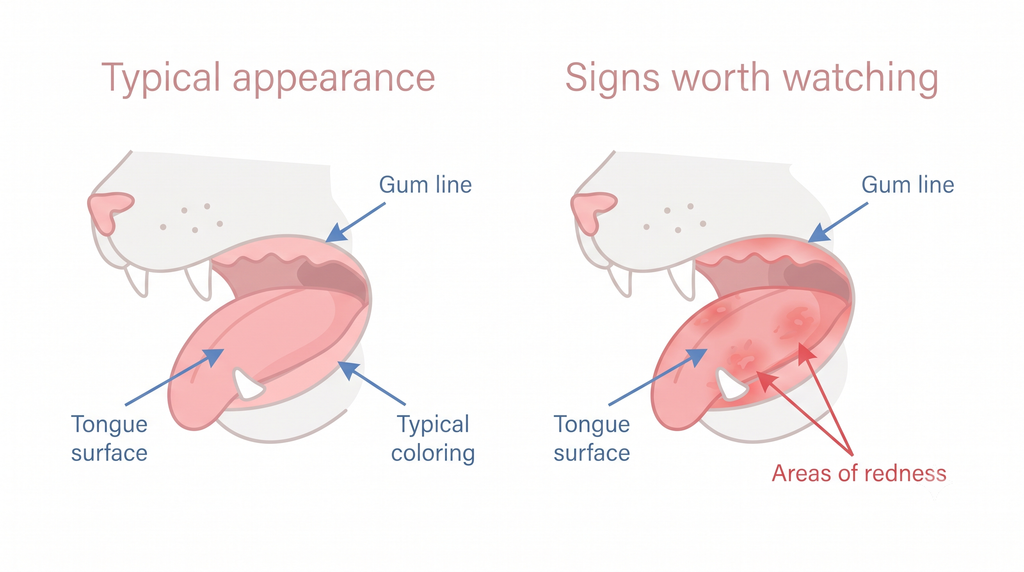
This diagram provides a visual, side-by-side comparison for pet owners to help identify potential health issues in a cat’s mouth.
The Two Panels Explained
- Typical appearance (Left Panel):
- This shows what a healthy cat’s mouth and tongue should look like.
- The key features are a smooth, consistent Gum line and a Tongue surface with a uniform, healthy pink color (labeled Typical coloring).
- Signs worth watching (Right Panel):
- This shows what to look for if something might be wrong (e.g., stomatitis, injury, or infection).
- The crucial difference is the appearance of inflamed, sore-looking red patches on the tongue surface, specifically pointed out by the arrows for Areas of redness.
In summary, the diagram teaches you to differentiate between a healthy, pink, uniform mouth and one showing visible signs of inflammation or irritation. If you see the signs on the right, it is a good indication that a visit to the veterinarian is in order.
Which Coat Changes Should You Discuss With Your Vet?
A cat that has a dull coat and inflamed gums may have one or more health issues, but these signs are not established indicators of niacin deficiency in cats.
Coat changes are often noticeable because you see and touch your cat every day. Her coat has lost some of its usual shine, or the fur may feel rougher than before. These changes can be worth discussing with your veterinarian, especially if they occur alongside changes in appetite, weight, grooming, or energy.
Coat and skin condition depend on several aspects of health, including adequate nutrition, grooming, and the absence of certain skin disorders. A dull coat alone cannot identify which nutrient, if any, is lacking.
Gum inflammation also needs to be considered separately. Dental disease is a common cause of red, swollen gums in cats and may cause pain, bad breath, drooling, or reluctance to eat. It should not be treated as evidence of niacin deficiency without further assessment.
If you notice several changes together, describe them to your veterinarian rather than assuming they share a nutritional cause. The timing of each change and your cat’s usual diet can help provide useful context.
Coat and Gum Change Reference Chart
Changes in the coat or gums can sometimes occur alongside nutritional problems, but they are nonspecific signs. The same appearance can result from dental disease, skin conditions, grooming changes, systemic illness, or other factors. This table is therefore best used as an observation guide rather than a diagnostic tool.
| Coat or Gum Appearance Change | General Nutritional Pattern Association |
|---|---|
| Dull, dry, or unkempt coat | Commonly reported with broader nutritional imbalance, but also occurs with poor grooming, illness, skin disease, or dehydration |
| Reduced coat density or increased hair loss | Sometimes associated with nutritional problems, but more commonly requires investigation of dermatologic, hormonal, parasitic, or systemic causes |
| Loss of normal coat pigmentation | Possible nutritional association, particularly with certain mineral or amino-acid deficiencies, but coat color alone cannot establish a deficiency |
| Brittle or easily damaged hair | Possible nutritional association, but can also reflect environmental exposure, grooming behavior, or underlying skin disease |
| Red, swollen, or bleeding gums | More commonly associated with oral/dental disease than with a general nutritional pattern |
| Pale gums | Can occur with anemia or reduced blood oxygenation and should not be assumed to represent a dietary deficiency |
| Yellowish gums | May indicate jaundice or altered bilirubin metabolism and warrants veterinary evaluation rather than dietary self-treatment |
| Unusual gum pigmentation | Often varies naturally between individual cats, although a new or rapidly changing pigmentation pattern should be checked |
Key takeaway: Coat changes can sometimes provide clues about nutritional status, but gum color changes deserve particular caution because they can reflect problems that are unrelated to diet. A new, persistent, or rapidly changing coat or gum abnormality is best evaluated in the context of the cat’s diet, physical examination, and other clinical findings.
Can Niacin Deficiency Cause Drooling or Appetite Changes?
A cat that is drooling and avoiding food or has stopped grooming herself may be experiencing discomfort or another health problem. These changes are important to notice, but they do not specifically identify niacin deficiency.
You catch her drooling more than normal at mealtime, and she picks at her food instead of eating normally. You may also notice that she has stopped grooming herself the way she used to.
These observations can help you describe what has changed, but they should not be used as a diagnostic pattern for niacin deficiency. Oral pain can make eating and grooming uncomfortable, while reduced grooming may also accompany illness, pain, or reduced mobility.
Historical descriptions of niacin deficiency in cats include reduced appetite and weakness. That supports discussing appetite and energy changes in this article, but it does not establish that drooling or grooming changes are specific consequences of the deficiency.
Rather than trying to determine the cause from the combination of signs, noting whether symptoms are getting better, worse, or staying the same can help you give your veterinarian a clearer history.
Drooling combined with difficulty eating or apparent mouth pain deserves prompt veterinary advice. If your cat is not eating, do not wait several days simply to complete an observation log.
Symptom Cluster Reference Table
Individual signs such as drooling, appetite loss, or reduced grooming can have many possible explanations. When several appear together, the combination and timing can provide more useful context than any single sign alone.
| Sign | When It Appears Alone | When Combined With Other Signs |
|---|---|---|
| Drooling | May be associated with oral irritation, dental problems, nausea, an unpleasant taste, or other causes. | Drooling + appetite loss may increase concern about oral discomfort, nausea, or another condition affecting eating. |
| Appetite loss | Can occur with stress, food preference changes, nausea, pain, illness, or other causes. | Appetite loss + drooling + reduced grooming suggests a broader change that deserves veterinary attention rather than assuming simple food refusal. |
| Reduced grooming | May occur temporarily because of stress, discomfort, environmental changes, or normal variation. | Reduced grooming + appetite loss + coat deterioration can indicate that the cat is experiencing a broader health problem. |
| Coat becoming dull or unkempt | May reflect reduced grooming, environmental factors, skin problems, or nutritional issues. | Dull coat + reduced grooming + appetite loss is more concerning than a coat change occurring by itself and warrants assessment. |
| Weight loss | May result from reduced food intake, increased energy expenditure, illness, or other factors. | Weight loss + appetite loss + reduced grooming represents a broader pattern that should be discussed with a veterinarian promptly. |
| Low activity | Can occur after normal exertion, environmental changes, stress, or simply a quieter day. | Low activity + appetite loss + other physical changes makes a medical cause more important to investigate. |
Important: A symptom cluster can help identify when a veterinary evaluation is appropriate, but it does not identify the underlying diagnosis. If your cat stops eating, has persistent drooling, or develops several new symptoms at once, contact your veterinarian rather than trying to correct the problem with dietary supplements alone.
Are Kittens More at Risk of Niacin Deficiency?
A kitten showing signs of vitamin deficiency needs careful assessment because growth depends on an adequate supply of essential nutrients. However, it is not established that kittens necessarily develop niacin deficiency signs faster than adult cats.
Historical research described severely niacin-deficient kittens that stopped growing, developed diarrhea, lost weight, and became seriously ill. These findings demonstrate that inadequate niacin intake can have serious consequences. They do not establish a precise timeline for deficiency in every kitten or prove that every poorly growing kitten has a niacin deficiency.
Your kitten seems to be growing but not quite thriving may describe a genuine concern, but poor growth has many possible causes. Insufficient food intake, an unbalanced diet, parasites, infections, and other health problems can affect a kitten’s development.
Kittens need food formulated to meet the nutritional requirements of growth. A complete-and-balanced kitten diet helps supply the nutrients they need, including niacin. A homemade diet should be formulated with appropriate professional guidance rather than assembled from a few ingredients.
If your kitten is losing weight, failing to grow as expected, eating poorly, or developing diarrhea or weakness, contact your veterinarian promptly. Young animals can become seriously unwell, and it is important to identify the underlying problem instead of assuming a particular nutrient is responsible.
Understanding these possible warning signs is only the first step. The next section explains why cats cannot produce enough niacin from tryptophan and why obtaining adequate niacin through their diet matters.
Kitten vs. Adult Nutrient Reserve Comparison
Kittens are growing rapidly, so their nutrient requirements and tolerance for prolonged nutritional disruption differ from those of healthy adult cats. However, there is no universal number of days after which a nutrient deficiency will appear. The timing depends on the specific nutrient, severity of the shortfall, previous body stores, diet, and the kitten’s health.
| Life Stage | Nutrient Turnover Speed | Reserve Size | Typical Time-to-Show Signs |
|---|---|---|---|
| Kitten | Generally higher because nutrients support rapid growth and tissue development | Generally more limited relative to ongoing growth demands | Potentially faster when intake is substantially inadequate; timing varies greatly by nutrient |
| Adult cat | Generally lower than during active growth | Generally more established after reaching mature body size | Often slower for nutrients with meaningful body stores, but some deficiencies or illnesses can produce signs sooner |
Important context
This comparison should not be interpreted as a fixed timeline for deficiency. Some nutrients are stored extensively in the body, while others have limited reserves and require regular dietary intake. A kitten that is eating poorly or receiving an unbalanced diet can therefore become nutritionally compromised more quickly than an otherwise healthy adult, particularly during periods of rapid growth.
For both life stages, persistent appetite loss, weight loss, poor growth, lethargy, or other new signs warrant veterinary attention rather than waiting for a presumed nutrient-reserve timeline.
Understanding what these signs can look like makes it easier to appreciate why they happen at all. That’s the biological question the next section explores in full.
Why Cats Cannot Make Enough Niacin
The key to understanding feline niacin requirements lies in how cats process tryptophan, an essential amino acid found in dietary protein. The tryptophan to niacin pathway works differently, limiting their ability to make enough niacin to meet their nutritional needs.
This is not because cats lack the entire pathway. Instead, a particular enzyme activity redirects tryptophan metabolism, reducing the amount available for niacin synthesis.
It starts with why protein alone cannot guarantee adequate niacin. From there, we can examine the enzyme involved and the metabolic steps that explain this difference. You want to understand what’s actually happening inside her body, so the following sections break down the science in straightforward terms.
Why Do Cats Need Dietary Niacin Despite Eating Protein?
Niacin is essential for cats even when they eat plenty of protein. This is because consuming tryptophan, an amino acid found in protein, does not guarantee that the body can convert enough of it into niacin.
You assumed protein alone would cover her nutritional needs, which is understandable. Protein supplies amino acids that cats need for growth, tissue maintenance, and other body functions. Tryptophan can also enter a metabolic pathway that contributes to niacin production.
However, cats cannot rely on this pathway to meet their niacin requirements. They must obtain sufficient niacin directly from their diet.
Niacin is vitamin B3. The body uses it to produce important coenzymes, including nicotinamide adenine dinucleotide (NAD). NAD helps cells carry out chemical reactions involved in energy metabolism and other essential processes.
This is why niacin is a true dietary essential for cats rather than a nutrient they can reliably manufacture from another dietary component. Protein remains essential, but adequate protein intake and adequate niacin intake are two different nutritional considerations.
Can Cats Produce Niacin From Tryptophan Like Dogs?
Dogs and humans can produce some niacin internally through the metabolism of tryptophan. Cats, however, cannot depend on this process to supply enough niacin for their needs.
You’re comparing her diet to what works fine for your dog, and it is reasonable to wonder why the requirements differ. Both cats and dogs need protein and niacin, but their ability to meet niacin requirements through internal synthesis is not the same.
The important distinction is that cats do not completely lack the biochemical machinery involved in tryptophan metabolism. Instead, the pathway is regulated differently, limiting how much niacin they can produce.
Research dating back to the 1950s demonstrated that adding tryptophan to experimental diets did not adequately replace dietary niacin in cats. These findings helped establish that cats have a distinct nutritional requirement for preformed niacin.
This evidence supports the central conclusion: cats cannot make their own niacin in sufficient amounts from tryptophan to meet their dietary needs. It does not mean that dogs or humans can always meet their entire niacin requirements through internal production.
Species Niacin Synthesis Comparison
Niacin (vitamin B3) biology differs among species. Cats are particularly dependent on preformed dietary niacin, while dogs and humans have some capacity to produce niacin-related compounds from tryptophan. The amount that can be produced, however, does not mean that dietary niacin is unnecessary.
| Species | Internal Synthesis Capability | Reliance Level | Dietary Requirement Type |
|---|---|---|---|
| Cat | Very limited ability to synthesize niacin from tryptophan | High reliance on dietary niacin | Requires preformed dietary niacin as part of a nutritionally complete diet |
| Dog | Can synthesize niacin-related compounds from tryptophan | Lower reliance than cats, although dietary niacin remains important | Can obtain vitamin B3 from dietary niacin and metabolic conversion of tryptophan |
| Human | Can synthesize niacin from tryptophan | Lower reliance on preformed niacin, but dietary intake remains important | Can obtain niacin equivalents from preformed niacin and tryptophan conversion |
Key takeaway: Cats have a much more limited ability to use tryptophan to meet their niacin needs than dogs or humans. This is one of the nutritional adaptations associated with the cat’s obligate-carnivore biology.
Important: The conversion of tryptophan to niacin is not equally efficient across species, and dietary protein quality, tryptophan availability, health status, and other metabolic factors can influence the contribution of this pathway.
Which Enzyme Affects Niacin Production in Cats?
An enzyme called picolinic carboxylase plays a central role in explaining why cats cannot efficiently produce enough niacin from tryptophan. This enzyme is associated with a metabolic diversion that limits the amount of tryptophan-derived material available for niacin synthesis.
Tryptophan is broken down through several chemical steps, including reactions in the kynurenine pathway. This pathway produces different compounds, some of which can contribute to other metabolic processes.
In cats, the activity historically described as picolinic carboxylase is unusually high compared with that measured in certain other species. This helps explain why tryptophan metabolism is directed away from producing meaningful amounts of niacin.
It is important not to describe this as a complete blockage of the pathway. Cats possess the enzymes involved in tryptophan metabolism, but the balance of activity at a key step limits their ability to make enough niacin.
Research published in the Journal of Nutrition in 1952 showed that tryptophan supplementation did not adequately prevent niacin deficiency in experimentally fed cats. Later research helped clarify the biochemical explanation for this species difference.
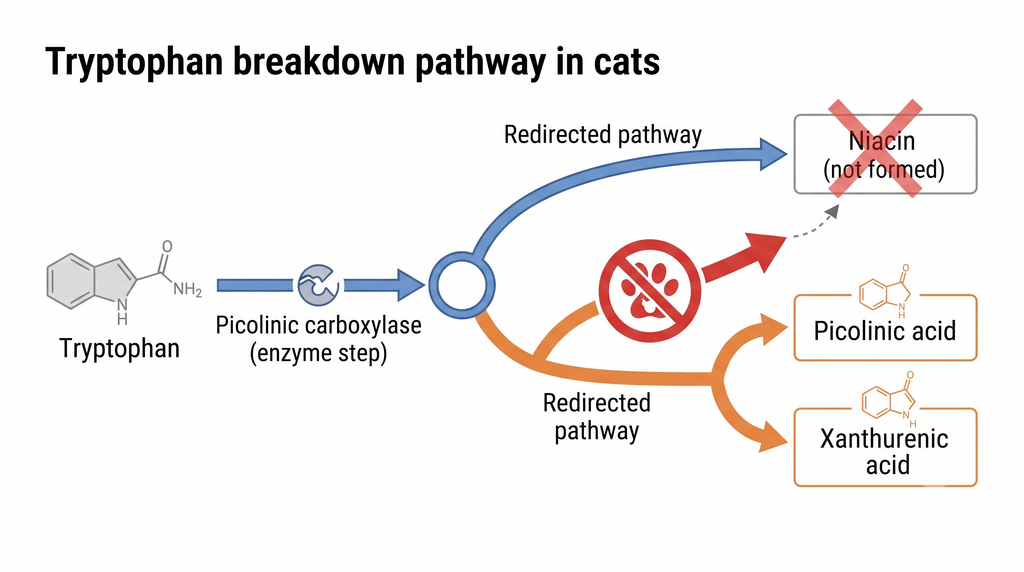
This diagram explains a specific metabolic quirk in cats: why they cannot use tryptophan (an amino acid) to create niacin (Vitamin B3).
Here is the breakdown of the pathway shown:
- The Starting Point: The process begins with the molecule Tryptophan on the left.
- The Normal Pathway (Blocked): In most animals, tryptophan flows through several steps to become Niacin.
- The Cat’s Difference: In cats, a specific enzyme step—Picolinic carboxylase—is hyperactive or over-represented. This acts like a switch that redirects the flow away from Niacin production.
- The Redirected Path: Instead of becoming Niacin, the tryptophan is converted into two other byproducts:
- Picolinic acid
- Xanthurenic acid
- The Result: The large red “X” over “Niacin (not formed)” indicates the final result. Because of this metabolic pathway, cats are unique among mammals in that they require a direct source of pre-formed niacin in their diet; they cannot synthesize it from tryptophan.
How Does Picolinic Carboxylase Affect Niacin Production?
This enzyme is far more active in cats than in several other studied species. This difference is an important part of the explanation for why cats depend on dietary niacin.
Research has reported hepatic picolinate carboxylase activity approximately 30–50 times higher in cats than in rats. The liver is a major site of tryptophan metabolism, so this difference helps explain why cats cannot rely on tryptophan to provide enough niacin.
The relationship is important: greater activity at this metabolic diversion reduces the availability of material for niacin synthesis. It does not mean that every aspect of tryptophan metabolism is absent or defective in cats.
In a review published in Nutrition Research Reviews, James G. Morris discussed unusual feline nutrient requirements as adaptations associated with the evolutionary history of cats. The review provides useful context for understanding why cats have nutritional requirements that differ from those of many other mammals.
The evidence supports a species-related metabolic difference. It does not establish that enzyme activity is completely unaffected by every dietary or physiological condition.
Enzyme Activity Research Citation
Research source: WikiVet attributes the feline niacin-conversion difference to Morris (2002), noting that cats have high activity of picolinic carboxylase, which diverts tryptophan away from the pathway used to synthesize niacin. As a result, cats cannot synthesize significant amounts of niacin from tryptophan and depend on preformed dietary niacin. WikiVet
Primary research attribution: Morris, J. G. (2002), Idiosyncratic nutrient requirements of cats appear to be diet-induced evolutionary adaptations, Nutrition Research Reviews, 15, 153–168. CiNii Research
Source type: Comparative feline nutrition research, as summarized by WikiVet and attributed to Morris (2002).
Why Can Tryptophan Not Meet Cats’ Niacin Needs?
Tryptophan alone is not enough for cats to reliably meet their niacin needs. Even when a diet supplies adequate protein, the amount of tryptophan available does not guarantee sufficient niacin production.
This may seem counterintuitive. In some metabolic pathways, providing more of a starting compound can increase the amount of a product the body makes. But that relationship depends on the enzymes and reactions involved.
In cats, the metabolic diversion described above limits how much niacin can be produced from tryptophan. Simply increasing protein or tryptophan is therefore not a dependable way to correct a dietary niacin shortfall.
This is why preformed niacin refers to niacin that’s already present in the food itself. Cats need a reliable dietary source rather than depending on their bodies to manufacture sufficient amounts from tryptophan.
The distinction matters when evaluating homemade diets, raw diets, or other feeding plans. A food’s protein content alone cannot establish that it supplies all the nutrients a cat needs.
Protein Label Reading Prompt
Take your cat’s food package and check the Ingredients panel and nutritional information. Then note:
Does the label list a specific niacin or vitamin B3 source separately from the food’s protein ingredients?
- ☐ Yes — I can find a niacin/vitamin B3 ingredient or supplement listed.
- ☐ No — I cannot find niacin or vitamin B3 listed separately.
- ☐ Not sure — The label uses a broader vitamin/mineral or premix term that I don’t understand.
Look for terms such as:
niacin, niacinamide, nicotinamide, vitamin B3, or a vitamin/mineral premix.
Important: Don’t assume that a high-protein ingredient automatically tells you how much usable niacin the finished food provides. For a complete cat food, the nutritional adequacy statement and manufacturer’s nutrient information are more useful for evaluating whether the diet meets feline requirements.
Where Does Tryptophan Metabolism Divert From Niacin Production?
The difference in feline tryptophan metabolism becomes clearer when we look at the compounds produced along the pathway.
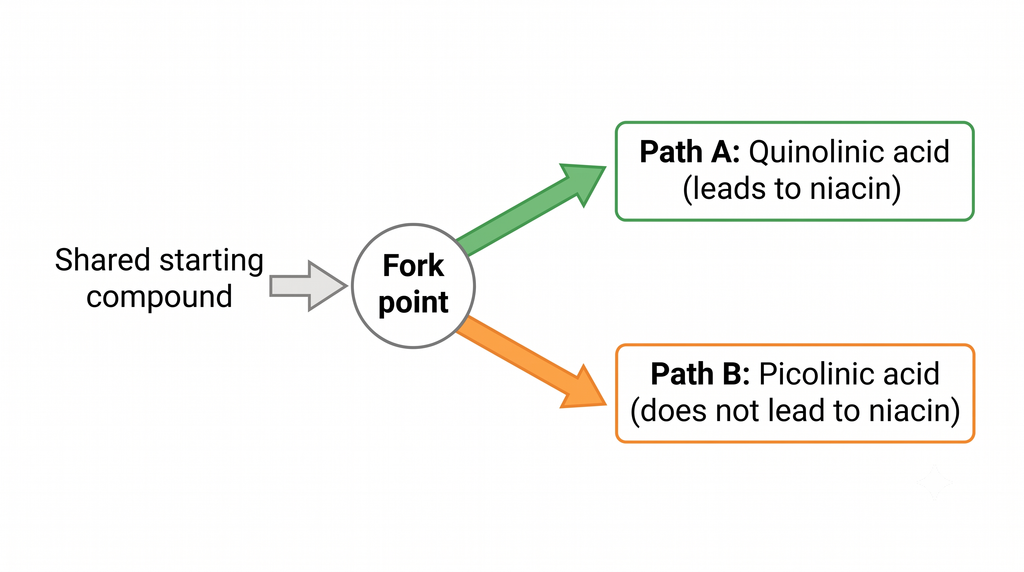
As tryptophan is broken down, it passes through several intermediates. One branch of this metabolism can lead to quinolinic acid, which contributes to the pathway used to produce NAD and ultimately supports the body’s niacin-related requirements.
Other reactions direct tryptophan-derived intermediates toward different products. The high activity of picolinate carboxylase in cats contributes to a diversion away from efficient niacin synthesis.
The conversion process gets redirected before niacin can form in sufficient amounts. This is the central idea behind why the niacin pathway is different in cats.
However, it would be inaccurate to describe the mechanism simply as quinolinic acid being converted directly into picolinic acid. These compounds are associated with different reactions in the broader metabolic network. The important point is that competing reactions divert material away from the route that contributes to niacin production.
This is not a general failure of protein digestion or amino acid use. It is a specific difference in how cats process tryptophan through their metabolic pathways.
Here is the breakdown:
- Shared starting compound: The process begins with a single, identical molecule.
- Fork point: This molecule reaches a point where it must enter one of two distinct routes.
- Path A (Green): If it takes this route, it is converted into Quinolinic acid, which eventually leads to the production of niacin (Vitamin B3).
- Path B (Orange): If it takes this route, it is converted into Picolinic acid, which does not lead to niacin.
In short, the diagram explains that the ultimate function of the starting compound depends entirely on which path it is directed to at this metabolic fork.
How Active Is Picolinic Carboxylase in Cats?
Research has reported that hepatic picolinate carboxylase activity in cats is approximately 30–50 times that measured in rats. This comparison helps explain the limited ability of cats to synthesize niacin from tryptophan.
A foundational study by da Silva, Fried, and de Angelis, published in the Journal of Nutrition in 1952, investigated niacin requirements and tryptophan metabolism in domestic cats. The researchers found that tryptophan supplementation did not adequately prevent niacin deficiency under the experimental conditions.
The study demonstrated the nutritional consequence of this metabolic difference: cats need dietary niacin and cannot rely on tryptophan as a sufficient substitute.
The enzyme-activity comparison comes from related biochemical research and should not be attributed to the 1952 feeding study alone. Together, these lines of evidence support the established conclusion that cats have a limited capacity to synthesize sufficient niacin from tryptophan.
The issue is not that cats cannot use niacin once they obtain it from food. Rather, they cannot reliably produce enough of it internally to meet their requirements.
This explains why dietary niacin matters so much in feline nutrition. The next section compares cats with other animals and explores how these species differences affect their nutritional needs.
Enzyme Activity and Niacin Output Reference
In the tryptophan-to-niacin pathway, picolinic carboxylase activity is particularly relevant to feline nutrition. Higher activity of this enzyme diverts more tryptophan away from niacin synthesis, so the relationship is best understood as a pathway diversion pattern, rather than a simple measure of “more enzyme = less vitamin.”
| Studied Species | Picolinic Carboxylase Activity | Niacin Synthesis From Tryptophan | General Interpretation |
|---|---|---|---|
| Cat | High | Very limited | More tryptophan is diverted toward picolinic acid, leaving little available for meaningful niacin synthesis |
| Dog | Lower than cats | Greater than cats | More tryptophan can contribute to the pathway leading toward niacin equivalents |
| Human | Lower than cats | Present | Humans can convert tryptophan to niacin equivalents, although the conversion is not sufficient to make dietary niacin irrelevant |
Key takeaway: Cats’ unusually high picolinic carboxylase activity is one reason they cannot rely on tryptophan conversion to meet their niacin requirement. This is a species-specific metabolic adaptation, not simply a consequence of eating less protein.
Research basis: The feline difference is discussed in comparative nutrition literature, including Morris (2002), which describes the unusually high activity of picolinic carboxylase in cats and its effect on tryptophan metabolism.
Understanding how this builds at the enzyme level makes it easier to see how cats compare to other animals more broadly. That’s what the next section explores in detail.
Differences in Niacin Production Between Cats and Dogs
Having covered the specific enzyme mechanism, this section widens the lens to look at how that mechanism plays out across species. Cats and dogs process niacin differently, and understanding why helps answer a question many owners naturally ask when comparing pet foods or reading conflicting advice online. The sections below build from a direct dog comparison toward the broader conditionally essential versus true essential distinction that sits at the heart of this topic.
Why Do Cats Produce Less Niacin From Tryptophan Than Dogs?
Cats and dogs process niacin differently because dogs retain a working version of the conversion pathway that cats largely don’t, at least not to any meaningful degree that matters nutritionally. This isn’t a matter of one species being better at nutrition in some general sense. It’s a genuine biological difference in how each species’ body handles the same starting material.
You’re comparing her diet to what works fine for your dog, and it’s a fair comparison to make, since dogs and cats are often assumed to have broadly similar nutritional needs. But why can’t cats convert tryptophan like dogs comes down to that same enzyme difference discussed throughout the previous section. Dogs and humans can produce meaningful amounts of niacin internally, while cats largely cannot rely on this internal production to any significant extent. This is exactly why a diet formulated specifically for a dog isn’t automatically appropriate for a cat, even when the ingredient list looks fairly similar on paper.
Cat vs. Dog Niacin Pathway Comparison
Cats and dogs both require niacin, but their ability to obtain niacin through tryptophan metabolism differs. This difference is one of the metabolic adaptations that makes feline nutrition distinct from canine nutrition.
| Comparison Point | Cat | Dog |
|---|---|---|
| Picolinic carboxylase activity | High | Lower than in cats |
| Tryptophan diversion | A greater proportion of tryptophan is diverted toward the picolinic acid pathway | Less tryptophan is diverted through this pathway |
| Niacin synthesis from tryptophan | Very limited | Greater capacity |
| Ability to meet niacin needs through conversion | Not sufficient to meet requirements | Can contribute to niacin availability |
| Dietary reliance | High reliance on preformed dietary niacin | Lower reliance on preformed niacin, although dietary niacin remains important |
| Practical nutrition implication | A complete feline diet must provide adequate preformed niacin | Dogs have greater metabolic flexibility in obtaining niacin from dietary tryptophan |
Key takeaway: A high-protein diet does not automatically mean a cat can manufacture enough niacin from its amino acids. Cats have a distinctive tryptophan metabolic pathway that limits this conversion, making dietary niacin essential.
Do Cats Have Different Dietary Niacin Requirements Than Dogs?
Yes, cats need more niacin than dogs relative to their overall diet, as a direct consequence of not being able to produce their own internal supply the way dogs can. This higher requirement isn’t arbitrary. It’s the nutritional adjustment needed to compensate for what the body simply can’t manufacture on its own.
Cats need more niacin than dogs because dogs have a built-in backup system that cats simply don’t have to the same extent, if at all. According to WikiVet’s citation of National Research Council guidelines, this difference in dietary requirement is well documented and is one of several reasons cat food and dog food end up formulated so differently, even when they share some of the same base ingredients.
Relative Niacin Requirement Reference
Niacin requirements are best compared on a dietary energy basis, rather than simply by body weight, because cats and dogs differ substantially in body size, energy needs, and nutrient metabolism. The table below therefore uses relative categories rather than implying that a single mg/kg body-weight value applies to every animal.
| Species | Relative Dietary Niacin Requirement | Best Comparison Basis | Practical Interpretation |
|---|---|---|---|
| Cat | Higher dietary dependence | Per unit of dietary energy | Cats have very limited ability to synthesize niacin from tryptophan, so their complete diet needs to provide adequate preformed niacin. |
| Dog | Lower dietary dependence than cats | Per unit of dietary energy | Dogs can obtain some niacin equivalents through tryptophan metabolism, although dietary niacin remains an important nutrient. |
| Cat vs. Dog | Cats: greater reliance on preformed niacin | Dietary energy is more meaningful than body weight alone | Comparing the two species solely by mg/kg body weight can be misleading because their metabolic pathways and energy requirements differ. |
Important note
There is no single universal “cat needs X times more niacin than a dog” conversion that should be applied to individual pets. Established nutrient profiles should be used for the appropriate species, life stage, and dietary energy density.
For a commercial food, the more useful question is whether the food is complete and balanced for cats and formulated to meet the appropriate feline nutrient profile—not whether its niacin concentration matches a canine food on a simple body-weight basis.
Why Can Dogs Make Some Niacin From Tryptophan?
In nutrition terms, dogs and humans are generally described as having niacin is conditionally essential in dogs, meaning the body can produce some amount on its own if dietary intake happens to fall short on a given day. Cats, by clear contrast, need niacin as a true dietary essential, meaning the body cannot reliably manufacture meaningful amounts regardless of circumstances.
This is a conditionally essential nutrient in its clearest possible form, and the distinction explains essentially everything else covered in this article. Dogs and humans can produce meaningful amounts of niacin internally when the situation calls for it, giving their bodies some genuine flexibility if a meal or two happens to fall short on niacin specifically. This makes niacin a true dietary requirement rather than a backup system for cats in particular. There’s no internal fallback mechanism to lean on, which is precisely why consistent dietary intake matters so much more for cats than it does for many other companion species people commonly compare them to.
Conditionally Essential vs. Truly Essential
True essential nutrient: A nutrient is considered essential when an animal cannot synthesize enough of it internally to meet its physiological needs, so it must obtain an adequate amount from the diet under normal conditions.
Conditionally essential nutrient: A nutrient is normally synthesized by the body in sufficient amounts, but under specific physiological or pathological conditions, the body’s production may no longer meet requirements. Dietary supply may then become necessary or more important.
Why the distinction matters: “Conditionally essential” does not mean “less important.” It describes whether the body’s ability to synthesize enough of the nutrient depends on the animal’s particular physiological circumstances.
For cats: Several nutrients have species-specific essentiality because feline metabolism differs from that of many other mammals. When a nutrient is classified as essential for cats, the complete diet must provide it in an appropriate amount rather than relying on a metabolic pathway that cats cannot perform adequately.
Why Must Cats Obtain Niacin From Their Diet?
Because internal conversion simply isn’t reliable in feline biology, cats need preformed niacin from meat, meaning niacin that already exists in a ready-to-use form, rather than raw materials their body would need to build it from scratch through the broken pathway. Animal tissue is naturally rich in this preformed form, which is a large part of why meat-based diets suit feline biology so well.
Cats need preformed niacin from meat because that’s precisely where the nutrient already exists in a usable, ready-made form, sidestepping the conversion step that doesn’t function reliably in cats to begin with. This single fact is a significant part of why meat-based ingredients sit at the center of complete and balanced cat food formulation across the industry, and it sets up the more practical feeding guidance covered later in this guide.
Animal Protein Source Identification Guide
When reading a cat-food label, look for specific animal-tissue ingredients that can naturally contribute niacin and other B vitamins. Ingredient names can vary by manufacturer, so focus on what the ingredient actually represents.
Look for these animal-tissue ingredients
- Chicken / chicken meat — animal muscle tissue and a potential source of naturally occurring niacin.
- Turkey / turkey meat — animal tissue that can contribute niacin.
- Beef / beef muscle — animal tissue containing naturally occurring B vitamins, including niacin.
- Pork / pork meat — another animal-tissue source of naturally occurring niacin.
- Fish / specific fish species — fish tissue can contribute niacin, with amounts varying by species.
- Liver — an organ-tissue ingredient containing several B vitamins, although it should not be assumed to provide all nutrients in the correct proportions.
- Meat meal — concentrated rendered animal tissue that can contribute nutrients, depending on the specific source and processing.
- Poultry meal — rendered poultry tissue that can contribute naturally occurring nutrients.
Be careful with broad terms
Ingredients such as “animal digest,” “meat by-products,” or “animal fat” provide less information about the specific animal tissue involved. They should not automatically be treated as equivalent to a named muscle-meat ingredient when evaluating a diet.
Important: The ingredient list can show potential nutrient sources, but it cannot tell you exactly how much niacin the finished food provides. For a complete cat food, the nutritional adequacy statement and manufacturer nutrient information are more useful for confirming that the diet meets feline niacin requirements.
Do Other Carnivores Share This Limitation in Niacin Synthesis?
This specific enzyme pattern has been most thoroughly studied in cats specifically, and while it’s entirely reasonable to wonder whether other strict meat-eating species share the same trait, the research covering other obligate carnivores and niacin requirements more broadly remains fairly limited. This is genuinely an area where caution is appropriate rather than confident, sweeping claims.
Cats are one of the most well-studied examples of an obligate carnivore, which simply means an animal whose body is built to rely on meat as its primary and necessary food source, rather than being able to thrive on a more varied omnivorous diet. This trait may be shared with other strict meat-eating species, given that the underlying evolutionary pressures — a historically meat-heavy diet in essence — would presumably have applied to them too. That said, this remains a reasonable hypothesis rather than a confirmed finding across all obligate carnivores, and it simply isn’t an area with the same depth of research behind it as feline-specific studies have accumulated over the decades.
Understanding how cats compare to other species sets up a natural next question worth exploring: why did this particular difference develop in cats in the first place?
Evolution and Cats’ Dependence on Dietary Niacin
This section steps back from the enzyme-level mechanism and looks at the bigger evolutionary picture. It explains why this trait may exist, rather than only how it works day to day.
The goal is to connect the biology with the real-world risk factors discussed throughout this guide. Once the mechanism is clear, the next natural question is why cats evolved this way at all.
How Might Evolution Explain Cats’ Dependence on Dietary Niacin?
Cats likely evolved to depend on dietary niacin because a cat’s evolutionary diet was already rich in ready-made niacin, meaning the internal conversion pathway was simply never under much evolutionary pressure to stay fully functional over time. This is best understood as a scientific hypothesis grounded in comparative biology, not as a settled, universally proven fact.
A cat’s evolutionary diet consisted almost entirely of animal tissue. Prey animals naturally contain preformed niacin in a form cats can already use.
According to WikiVet’s citation of Morris (2002), published in Nutrition Research Reviews, cats’ unusual nutrient requirements are considered diet-induced evolutionary adaptations. The general idea is that traits the body rarely needs may face less pressure to remain fully functional over long periods.
In this case, cats consistently obtained enough niacin from animal tissue. Their bodies therefore had little need to maintain a strong internal pathway for making it from tryptophan.
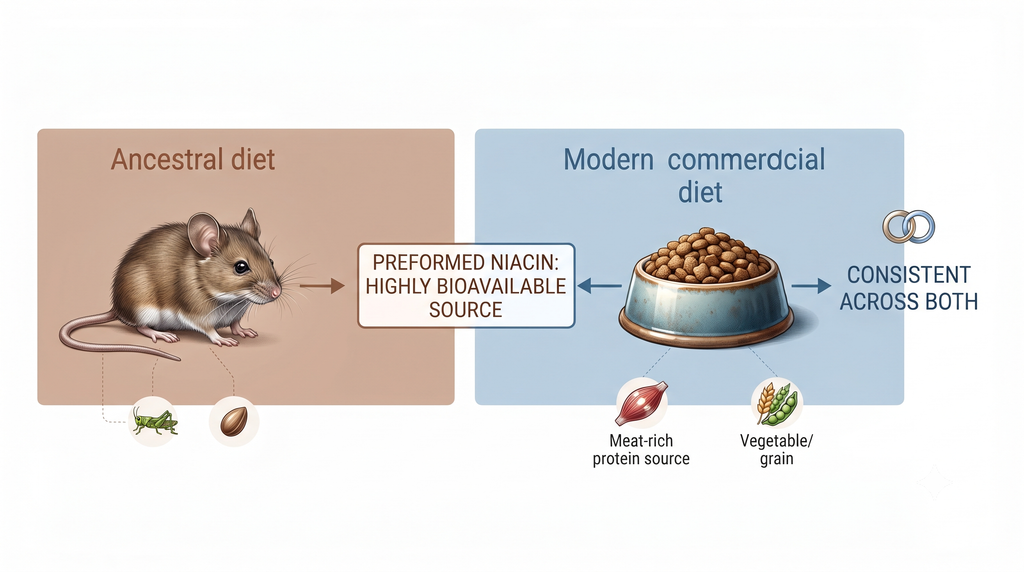
This diagram illustrates that the critical nutrient Niacin is consistently provided in both a cat’s natural ancestral diet and a modern commercial diet. It highlights that this essential nutrient is not lost through domestication.
Here is the breakdown:
- Ancestral Diet (Left):
- This shows a wild mouse, which represents the cat’s natural prey.
- Arrows from the mouse and its components (a grasshopper and a seed) point to a central box.
- Modern Commercial Diet (Right):
- This shows a bowl of dry cat food (kibble).
- Arrows from the food, and the ingredients it’s made from (meat-rich protein sources and vegetables/grains), also point to the central box.
- Consistent Across Both (Center):
- The central box, linked by arrows from both diets, contains the core message: PREFORMED NIACIN: HIGHLY BIOAVAILABLE SOURCE.
- An additional label to the right, marked with a ‘consistency’ symbol (the linked rings), reinforces this with the text: CONSISTENT ACROSS BOTH.
In short, the diagram explains that whether a cat eats a wild mouse or a high-quality commercial kibble, they are getting the same essential, pre-formed Niacin.
Which Cats May Face a Higher Risk of Niacin Deficiency?
Cats eating a complete and balanced commercial diet are very unlikely to develop a niacin deficiency of any kind, since these diets are specifically formulated with a cat’s unique requirements already accounted for. Cats at genuinely higher relative risk tend to be those on unbalanced homemade or raw diets, or those who consistently avoid fortified food due to persistent picky eating over time.
According to Cornell’s Feline Health Center and broader feline nutrition guidance, most commercial cat foods are formulated with this requirement already built in. This is one reason deficiency from a typical, well-made store-bought diet remains uncommon.
Homemade and raw diets can carry more risk when they are not properly formulated. It is easy to assume that a high-protein diet automatically provides enough niacin, but this article has already shown why that assumption does not always hold.
Timothy, who feeds his senior Norwegian Forest Cat a homemade diet, decided to double-check the recipe against current guidelines. While reviewing it, he realized niacin was not accounted for and confirmed the gap with his veterinarian.
He adjusted the recipe, and her energy levels improved over the following weeks. If you are unsure whether your cat’s diet truly meets her needs, that is a reasonable and specific question to discuss with your veterinarian.
Understanding who faces more risk leads naturally to the next practical question: how do you make sure your own cat is actually getting enough niacin?
Relative Risk Factor Table
The risk of a nutrient shortfall depends largely on whether the overall diet is properly formulated and consistently consumed. The categories below are broad guidance, not a diagnosis of an individual cat’s nutritional status.
| Diet / Feeding Factor | Relative Risk Level | Why |
|---|---|---|
| Homemade diet without professional formulation | 🔴 Higher | Missing or imbalanced nutrients can occur when recipes are not formulated to meet established feline nutrient requirements, even when the ingredients appear nutritious. |
| Picky eating / consistently avoiding parts of a meal | 🟠 Moderate | Selective eating can reduce intake of specific nutrients if the cat regularly leaves certain components or eats too little overall. |
| Unformulated raw diet | 🔴 Higher | Raw ingredients do not automatically create a nutritionally complete diet; deficiencies or excesses can occur without appropriate formulation. Food-safety concerns also need consideration. |
| Complete and balanced commercial diet | 🟢 Lower | A properly labeled complete and balanced food is formulated to meet established nutrient requirements for its stated species and life stage when fed as directed. |
| Complete commercial diet + frequent supplements | 🟡 Variable | Adding supplements without veterinary guidance can alter nutrient intake and, for some nutrients, create an unnecessary excess rather than correcting a deficiency. |
Key takeaway: The formulation of the whole diet matters more than whether individual ingredients sound nutritious. A food containing meat, liver, fish, or other nutrient-rich ingredients is not automatically complete and balanced.
Understanding who faces more risk naturally leads into the practical question every owner eventually finds themselves asking: how do you make sure your own cat is actually getting enough?
Meeting Cats’ Dietary Niacin Needs
This section moves from biology into practical, everyday feeding. You’re not sure if her food is giving her everything she needs, and that is a reasonable question to have.
The sections below explain what to look for and how to think about niacin without making feeding decisions unnecessarily complicated.
How Much Niacin Does a Cat Need Each Day?
Cats need niacin in their diet in amounts specifically calculated to account for the fact that their bodies can’t reliably produce their own internal supply. How much niacin should be in cat food can shift slightly depending on life stage and other individual factors, so it’s worth checking current standards rather than relying on a single fixed number.
You’re double checking before you change anything about her diet, which is a sensible approach given everything discussed so far.
According to WikiVet’s citation of National Research Council guidelines, researchers have established specific niacin requirements for cats through controlled studies. Exact needs can vary somewhat by life stage.
Current AAFCO, or Association of American Feed Control Officials, standards can help confirm whether a commercial food meets recognized nutritional requirements. Your veterinarian or a veterinary nutritionist can also help with individual feeding amounts. [REDIRECT TO VET FOR DOSAGE SPECIFICS]
Keeping a simple log of what your cat eats and how she’s doing can give you a clearer picture over time.
Life Stage Niacin Requirement Chart
AAFCO-style nutrient profiles distinguish growth/reproduction from adult maintenance, rather than creating a separate “senior” nutrient profile. For cats, the published AAFCO profile lists a minimum niacin concentration of 60 mg/kg dry matter for both growth/reproduction and adult maintenance in the profile available from AAFCO. AAFCO
| Life Stage | General Niacin Requirement | AAFCO-Style Reference | Practical Interpretation |
|---|---|---|---|
| Kitten / Growth | 60 mg/kg dry matter minimum | Growth & Reproduction | Growing kittens need a complete diet that meets the feline nutrient profile; niacin is not something to estimate from protein content alone. AAFCO |
| Adult / Maintenance | 60 mg/kg dry matter minimum | Adult Maintenance | A complete adult diet should provide at least the established minimum concentration when formulated according to the applicable profile. AAFCO |
| Senior | No separate AAFCO niacin minimum | Generally covered under adult maintenance unless another life-stage/medical formulation applies | “Senior” is not a separate AAFCO nutrient-profile category. The cat’s health, calorie intake, and overall diet may still affect nutritional management. |
Important: These are diet-formulation reference values, not a daily mg dose for an individual cat. AAFCO nutrient profiles are expressed relative to diet and/or metabolizable energy, and actual feeding amounts depend on the food’s calorie density and the cat’s intake. AAFCO
For your article, I would label the column “AAFCO-style reference” rather than “daily requirement,” because that avoids implying that every kitten or adult cat should receive exactly 60 mg of niacin per day.
Could Your Cat’s Diet Provide Too Little Niacin?
Cat food niacin content is too low is unlikely to be the case if the food in question carries a genuine complete and balanced label, since that designation specifically confirms the food has been formulated to meet established nutritional standards, niacin included among them. Is my cat’s diet missing niacin is a question best answered by checking this label first, before assuming anything more complicated is going on.
You’ve started reading the ingredient label more carefully, which is a useful habit for questions like this. Checking the label for a complete and balanced statement can offer reassurance because it shows the food is designed to meet recognized nutrient requirements.
According to PetMD, the AAFCO nutritional adequacy statement is one of the simplest ways to check whether a food meets established standards. You do not need to interpret every ingredient individually to make that first assessment.
Complete and balanced cat food niacin may also be reflected through added niacin sources in the ingredient list. However, the complete-and-balanced statement is more useful than trying to judge the food’s total niacin content from the ingredient panel alone.
Label Reading Checklist for Niacin Adequacy
Use this checklist to evaluate whether a cat food is designed to provide adequate niacin. The ingredient list alone cannot confirm the actual amount of niacin supplied.
- 1. Find the nutritional adequacy statement — Look for “complete and balanced” and confirm that it applies specifically to cats and the appropriate life stage.
- 2. Check the intended life stage — Confirm whether the food is formulated for growth, adult maintenance, reproduction, or all life stages.
- 3. Locate the Guaranteed Analysis — Review the nutritional information provided on the package. Remember that niacin may not always be listed individually in the Guaranteed Analysis.
- 4. Scan the ingredient list for niacin sources — Look for terms such as niacin, niacinamide, nicotinamide, vitamin B3, or a vitamin/mineral premix.
- 5. Look beyond protein ingredients — Meat, fish, poultry, and organ ingredients can naturally contribute niacin, but their position on the ingredient list does not tell you the exact niacin concentration.
- 6. Check whether the product is a complete food — Treats, toppers, supplements, and complementary foods may contain niacin but are not necessarily formulated to meet all feline nutrient requirements.
- 7. Check the feeding directions — Confirm that the food is intended to be fed as the cat’s primary diet and follow the manufacturer’s feeding guidance.
- 8. Ask the manufacturer when the label is unclear — If you need the actual niacin concentration, request the complete nutrient analysis from the manufacturer rather than trying to calculate niacin from the ingredient list.
Quick rule
The strongest label-level evidence is the nutritional adequacy statement. Seeing “niacin” or a meat ingredient on the label can identify a potential source, but it does not independently prove that the finished diet provides adequate niacin.
How Can You Help Prevent Niacin Deficiency Through Food?
The most reliable way to prevent a niacin gap from developing in the first place is consistently feeding a complete and balanced commercial diet appropriate for your cat’s current life stage. Consistency matters here just as much as the specific food choice itself, since real gaps tend to develop during prolonged periods of inadequate intake rather than from any single missed meal.
You’ve been feeding her the same food for years without a second thought, and for most cats eating a complete and balanced diet, that consistency can be a good thing.
Avoiding long stretches of picky eating on unfortified food also matters. Treats or table scraps should not make up such a large share of the diet that they replace nutritionally complete food.
This helps make sure your cat’s main nutritional needs, including niacin, continue to be met consistently.
Which Foods Provide Niacin for Cats?
Animal-tissue sources, including muscle meat and organ meat, are naturally rich in the kind of preformed niacin cats specifically need, making them a reliable foundation for any niacin-adequate diet. Niacin rich foods for cats generally come down to quality animal-based ingredients overall, rather than any single so-called superfood ingredient doing all the work.
Looking for named animal protein sources near the top of the ingredient list can give useful context about the food’s animal-based ingredients. These sources naturally contain preformed niacin in usable amounts.
However, the complete-and-balanced status of the final food remains more important than relying on one ingredient alone.
If you are considering an additional supplement, veterinary guidance is the safer approach. Adding a supplement on your own is not automatically better than feeding a properly formulated complete diet.
Label Reading Checklist for Niacin Adequacy
Use this checklist to evaluate whether a cat food is designed to provide adequate niacin. The ingredient list alone cannot confirm the actual amount of niacin supplied.
- 1. Find the nutritional adequacy statement — Look for “complete and balanced” and confirm that it applies specifically to cats and the appropriate life stage.
- 2. Check the intended life stage — Confirm whether the food is formulated for growth, adult maintenance, reproduction, or all life stages.
- 3. Locate the Guaranteed Analysis — Review the nutritional information provided on the package. Remember that niacin may not always be listed individually in the Guaranteed Analysis.
- 4. Scan the ingredient list for niacin sources — Look for terms such as niacin, niacinamide, nicotinamide, vitamin B3, or a vitamin/mineral premix.
- 5. Look beyond protein ingredients — Meat, fish, poultry, and organ ingredients can naturally contribute niacin, but their position on the ingredient list does not tell you the exact niacin concentration.
- 6. Check whether the product is a complete food — Treats, toppers, supplements, and complementary foods may contain niacin but are not necessarily formulated to meet all feline nutrient requirements.
- 7. Check the feeding directions — Confirm that the food is intended to be fed as the cat’s primary diet and follow the manufacturer’s feeding guidance.
- 8. Ask the manufacturer when the label is unclear — If you need the actual niacin concentration, request the complete nutrient analysis from the manufacturer rather than trying to calculate niacin from the ingredient list.
Quick rule
The strongest label-level evidence is the nutritional adequacy statement. Seeing “niacin” or a meat ingredient on the label can identify a potential source, but it does not independently prove that the finished diet provides adequate niacin.
Do Kittens Need Different Amounts of Dietary Niacin?
Growing cats have higher niacin needs relative to their size compared to fully grown adult cats, reflecting the same growth-stage biology discussed earlier in this guide. Kittens need more niacin than adult cats do overall, and pregnant or nursing cats represent another life stage with proportionally elevated needs of their own.
This is one reason kitten-specific and other life-stage formulas exist. They are designed around higher nutrient needs during growth or periods of increased physical demand.
If you are making feeding decisions during one of these life stages, your veterinarian can help with the specifics. Individual guidance may be more useful than relying on general recommendations alone.
Understanding these feeding principles leads naturally to a feeding approach where niacin questions often come up: raw and homemade diets.
Growth Stage Needs Comparison
Niacin is especially important during periods of rapid growth and increased metabolic demand. Cats rely heavily on dietary niacin because they have a very limited ability to make enough niacin from tryptophan. The exact requirement depends on the complete diet, energy intake, life stage, and formulation—not simply body weight.
| Life Stage | Relative Niacin Need Level | Why the Need Is Different |
|---|---|---|
| Kitten / Growth | Higher | Rapid growth increases overall nutrient and energy demands. A complete growth diet needs to provide adequate niacin to support normal metabolism and tissue development. |
| Pregnant / Nursing Queen | Higher | Pregnancy and especially lactation increase metabolic and nutrient demands. Dietary niacin needs to remain adequate to support the mother while nutrients are also being used for fetal development and milk production. |
| Adult / Maintenance | Standard maintenance | Growth has stopped, so nutrient demands associated with tissue development are lower. A complete and balanced adult diet should provide sufficient niacin for normal maintenance and metabolism. |
Key point: “Higher” does not mean that owners should automatically add a niacin supplement. A properly formulated complete-and-balanced diet appropriate for the cat’s life stage should be the starting point.
Understanding these general feeding principles sets up a closer look at one increasingly common feeding approach where niacin questions tend to come up especially often: raw and homemade diets.
Niacin in Raw and Homemade Cat Diets
This section looks specifically at raw and homemade feeding, where questions about niacin and overall nutrient balance often come up. These diets need careful formulation to ensure they provide all the nutrients cats require.
Raw meat contains niacin, but that does not automatically make a raw diet nutritionally better than kibble or other commercial cat food. The important questions are whether the finished diet is complete and balanced, how it is prepared, and whether it poses food-safety risks.
Does Raw Meat Provide More Niacin Than Kibble?
The answer to raw meat has more niacin than kibble is that there is no reliable general rule that raw meat always contains more niacin than kibble. Niacin is naturally present in animal tissues, but the amount in a food depends on its ingredients, formulation, and processing.
You’ve heard raw feeding is better but you’re not fully convinced, which is understandable. Claims about raw feeding should be assessed individually rather than assuming that less processing automatically means better nutrition.
Niacin is relatively stable during many common heat-processing methods. Some nutrients can be lost during food preparation or manufacturing, but the extent depends on the nutrient and the processing conditions. It is therefore inaccurate to assume that cooking or commercial processing always removes large amounts of niacin.
Commercial cat-food manufacturers formulate the finished product to meet the applicable nutritional requirements. Depending on the recipe, ingredients and added nutrients may contribute to the final niacin content.
A properly formulated commercial diet and a properly formulated raw diet may both provide adequate niacin. However, a raw diet also needs to meet all other nutritional requirements and be assessed for food-safety risks. Raw meat can carry harmful bacteria and parasites, so its unprocessed state should not be treated as a nutritional advantage by itself.
The more useful comparison is between the nutritional adequacy and safety of the finished diets, rather than raw versus cooked alone.
Raw vs. Kibble Niacin Content Comparison
Niacin can come from animal ingredients naturally, while commercial cat foods may also contain added niacin to help the finished diet meet its nutritional requirements. The amount available in a raw ingredient can vary considerably by animal species, tissue, and preparation, so the ingredient itself should not be treated as a guarantee of dietary adequacy.
| Factor | Raw Meat | Commercial Kibble |
|---|---|---|
| Natural niacin content | Naturally contains niacin, with amounts varying by meat type and especially by organ vs. muscle tissue. | Can contain naturally occurring niacin from meat, poultry, fish, and other ingredients used in the recipe. |
| Processing loss | No extrusion step, but storage, freezing, cooking, or preparation can affect nutrient levels. | Heat processing and manufacturing can cause some nutrient losses, depending on the nutrient and processing conditions. |
| Fortification practice | Usually no standardized vitamin premix unless the raw diet is commercially formulated or supplemented. | Commercial complete diets commonly use a vitamin/mineral premix or other controlled nutrient sources to help meet the target nutrient profile. |
| Consistency of final niacin supply | Can vary substantially when meals are prepared from individual ingredients or homemade recipes. | Generally more controlled because the manufacturer formulates the entire diet to meet its nutritional specifications. |
| Does the meat ingredient prove adequacy? | No. A meat-heavy recipe does not automatically provide enough niacin for the whole diet. | No ingredient alone proves adequacy. Look for the appropriate complete-and-balanced nutritional adequacy statement. |
| Best label clue | For commercial raw foods, check whether the product is formulated as a complete diet for the intended life stage. | Check the nutritional adequacy statement and intended life stage; niacin may also appear among added vitamins or the manufacturer’s nutrient analysis. |
Key point: Raw meat provides naturally occurring niacin, but a homemade raw diet can become nutritionally inconsistent if the entire recipe is not properly formulated. Commercial kibble can combine natural food sources with controlled vitamin supplementation, making the complete diet formulation more important than whether the food is raw or dry.
How Can You Balance Niacin in Homemade Cat Food?
Homemade cat food is missing niacin in some cases, particularly when a recipe has not been formulated to meet a cat’s full nutritional requirements. However, niacin is only one of many nutrients that can be inadequate or excessive in an unbalanced homemade diet.
You switched her to a homemade diet and now you’re second-guessing it, which is a reasonable reason to review the recipe rather than guess at its nutritional value.
How to balance tryptophan and niacin in homemade cat food cannot be answered reliably by looking at protein content alone. Cats cannot make substantial amounts of niacin from tryptophan, so a recipe must provide adequate dietary niacin as well as the other nutrients cats need.
Adding more meat or increasing protein does not automatically correct a nutritional imbalance. The amounts and proportions of vitamins, minerals, amino acids, fats, and other nutrients all matter.
Working with a veterinary nutritionist before making changes to a homemade diet is the safer approach. A qualified professional can formulate a recipe for your cat’s life stage and health needs, including an appropriate source of niacin. Avoid adding individual vitamins or changing ingredient amounts without reviewing the balance of the entire recipe.
Veterinary Nutritionist Insight
Homemade diets can contain niacin-rich ingredients and still fail to provide a consistently adequate amount for a cat. The challenge is that niacin is only one part of the nutritional picture: the recipe also needs the appropriate balance of protein, amino acids, vitamins, minerals, energy, and other essential nutrients.
A board-certified veterinary nutritionist or veterinarian with appropriate nutrition expertise can evaluate the complete recipe, ingredient quantities, supplements, preparation method, and intended life stage rather than judging adequacy from a single ingredient. This is particularly useful when a homemade diet is fed as the cat’s primary food over the long term.
Why this matters for niacin: Cats have a limited ability to synthesize sufficient niacin from tryptophan, so dietary supply deserves particular attention when a homemade recipe replaces a complete commercial diet. A nutrition professional can determine whether the formulated diet—not just the meat ingredients—provides an appropriate nutrient supply.
How Can You Choose Cat Food That Meets Niacin Needs?
How to pick cat food with enough preformed niacin starts with checking whether the finished food is labelled as complete and balanced for cats and appropriate for the intended life stage.
Named animal ingredients can provide useful information about the food’s composition, but an ingredient list cannot reliably tell you the finished food’s total niacin content. The amount of niacin provided depends on the full recipe and any nutrients added during formulation.
You also do not need to see a specific niacin amount on every ingredient panel to establish that a food meets recognised nutritional standards. Label requirements differ by country, and a complete-and-balanced statement is generally a more useful starting point than trying to calculate niacin from individual ingredients.
This applies when comparing raw, wet, and dry foods. If a commercial raw food is labelled complete, check the nutritional adequacy statement and confirm that it is intended for cats and the appropriate life stage. A complementary food, topper, or treat should not be assumed to provide a cat’s full nutritional needs.
For homemade diets, a label is not available to confirm nutritional adequacy. The recipe should be formulated and reviewed by a qualified veterinary nutritionist
Preformed Niacin Food Selection Checklist
- Check the nutritional adequacy statement — Look for wording indicating the food is complete and balanced for cats and the appropriate life stage.
- Confirm the intended life stage — Make sure the food is formulated for growth, reproduction, adult maintenance, or all life stages as appropriate.
- Look for animal-based ingredients — Meat, poultry, fish, organ meats, and meat meals can naturally contribute niacin to the diet.
- Check for added niacin or vitamin B3 — If listed, look for terms such as niacin, niacinamide, nicotinamide, or vitamin B3 in the ingredient or nutrient information.
- Do not rely on one meat ingredient — The presence of chicken, beef, fish, or liver does not by itself prove that the finished food supplies adequate niacin.
- Check whether it is a complete food or a treat/topper — Treats, toppers, and complementary foods should not automatically be counted as the cat’s primary source of essential nutrients.
- For homemade diets, verify the complete recipe — Check the entire recipe and supplement plan rather than estimating niacin from individual ingredients.
- Ask the manufacturer for nutrient information when needed — If niacin is not declared on the label, request the complete nutrient analysis or formulation information from the manufacturer.
Quick rule: For reliable niacin intake, prioritize a complete-and-balanced food appropriate for the cat’s life stage rather than selecting a food based solely on one niacin-containing ingredient.
How Does Cooking Affect Niacin in Cat Food?
Cooking reduces niacin in cat food is too broad as a general statement. Niacin is relatively stable during many common forms of heat processing, although nutrient retention can vary with the food, processing method, temperature, time, and handling conditions.
Commercial food manufacturing takes nutrient requirements and processing into account when formulating the finished product. Manufacturers may add vitamins and other nutrients as needed to meet the intended nutritional profile, but it would be inaccurate to assume that every food loses the same amount of niacin or that every manufacturer follows an identical process.
Manufacturers account for this by adding niacin back into the finished product; therefore, this is better understood as a possible part of formulation, not a universal description of what happens during every manufacturing process. The relevant question is whether the finished food meets the applicable nutritional requirements.
Raw fed cats and niacin deficiency should not be assessed on the assumption that avoiding heat processing protects cats from deficiency. A raw diet can still be unbalanced, and raw feeding carries additional food-safety concerns. Lack of cooking does not guarantee adequate niacin or overall nutritional completeness.
Whether a diet is raw, cooked, wet, or dry, the priority is to choose a safe, nutritionally complete diet appropriate for the cat’s needs. If you are considering a homemade or raw feeding plan, ask your veterinarian or a qualified veterinary nutritionist to review it before making changes.
Steps to Take for Suspected Niacin Deficiency
If you are worried that your cat may not be getting enough niacin, the next step is to review the diet and speak with a veterinarian—not to diagnose a deficiency or start supplements at home. Changes in appetite, coat condition, or general health can have several possible causes, and these signs alone cannot confirm a niacin deficiency.
What Should You Do if Your Cat’s Food Lacks Niacin?
If you suspect that your cat’s food does not provide enough niacin, start by checking whether it is labeled as a complete and balanced diet for your cat’s life stage. Diets made from a limited number of ingredients, unbalanced homemade recipes, and foods intended only for occasional or supplemental feeding may not provide all the nutrients cats need.
The concern behind the search Cat food does not have enough niacin is worth taking seriously, but it should not be assumed to apply to every commercial cat food. A food’s nutritional adequacy statement is a more useful starting point than judging its niacin content from the ingredient list alone.
You want a straight answer before you call the vet, and here it is: do not try to correct a suspected deficiency with a niacin supplement before getting veterinary guidance. A supplement may be unnecessary, and adding individual nutrients without reviewing the whole diet can create other problems.
Discussing any diet change with your vet before switching your cat over can help determine whether the current food is appropriate and whether a change is needed. If a change is recommended, ask how to make the transition and whether your cat’s medical history calls for a specific diet.
Next Step: Bridge to Vet Conversation
If you’re concerned that your cat’s current food may not provide enough niacin, the most useful first step is not to start a vitamin supplement on your own. Instead, bring the exact food label—or your complete homemade recipe—to your veterinarian and discuss whether the diet is nutritionally complete for your cat’s life stage.
Start the conversation with:
“I’m concerned about whether my cat’s current diet provides adequate niacin. Can you review the complete diet and tell me whether it meets my cat’s nutritional needs, and whether any changes or supplementation are actually necessary?”
Bring these details to the appointment:
- The exact food name and formula
- A clear photo of the ingredient list and nutritional adequacy statement
- How much your cat eats each day
- All treats, toppers, supplements, and table foods
- For homemade diets: the complete recipe, ingredient quantities, and supplements used
- Your cat’s age and life stage
- Any recent changes in appetite, weight, energy, grooming, or coat condition
The goal: Let the veterinarian assess the whole diet and the cat’s overall situation, rather than trying to determine niacin adequacy from a single ingredient or symptom.
Does Your Cat Need a Niacin Supplement?
Whether a cat needs a niacin supplement cannot be determined reliably from symptoms alone. A veterinarian can review your cat’s usual food, treats, supplements, feeding amounts, medical history, and current signs. A physical examination and additional tests may be appropriate, depending on what the veterinarian finds.
Bloodwork may help investigate some health problems, but it should not be presented as a routine, definitive test for niacin deficiency in every cat. The assessment needs to fit the individual case, including whether the diet could plausibly be inadequate.
You’re wondering if this is something to mention at her next checkup, and that is a sensible question—especially if you have noticed a persistent change in appetite, weight, coat condition, or behavior. Asking your vet directly if a supplement is ever necessary for your cat is more reliable than deciding based on an online symptom list.
Bring the food packaging or a photo of its nutritional adequacy statement, along with details of any treats, homemade foods, and supplements your cat receives. This information can help your veterinarian assess the overall diet and decide whether further investigation is needed. If your cat is unwell or has stopped eating, do not wait for a routine checkup; contact your veterinarian promptly.
Vet Visit Preparation Checklist
- Bring the exact food label — Take clear photos or the package showing the ingredient list, nutritional adequacy statement, guaranteed analysis, and feeding directions.
- Record everything your cat eats — Include the main food, treats, toppers, table foods, and any supplements.
- Write down the supplement details — Bring the product container or photograph the label showing the ingredient, amount per serving, serving size, and manufacturer’s directions.
- Record the daily amount given — Note how much food and supplement your cat receives each day and how often it is given.
- Document why the supplement was started — Write down what prompted you to use it and whether it was recommended by a veterinarian, manufacturer, breeder, or another source.
- Note recent diet changes — Record any new food, recipe change, treat change, supplement addition, or change in feeding amount.
- Track relevant observations — Note changes in appetite, weight, energy, grooming, coat, stool, vomiting, drinking, or general behavior.
- Bring your cat’s recent weight information — Include the current weight if known and any noticeable gain or loss over recent weeks or months.
- Prepare your questions — Ask whether the supplement is necessary, whether the dose is appropriate, whether it could interact with other nutrients or medications, and whether monitoring is needed.
- Bring homemade-diet information if applicable — Take the complete recipe, ingredient quantities, preparation method, and every supplement used.
Tip: Bring the actual supplement container whenever possible. The veterinarian can assess the exact formulation and dose instead of relying on a product name or memory.
What Should You Ask Your Vet About Niacin Supplements?
If you receive a vet-recommended niacin supplement for cats, it means your veterinarian has decided that supplementation may be appropriate for your cat’s particular circumstances. That recommendation does not necessarily mean that a blood test confirmed niacin deficiency. It may follow a review of the diet, clinical findings, and other relevant information.
A supplement is not automatically necessary for every cat, and it should not be treated as a standalone fix for an unbalanced diet or an unexplained health problem. Your veterinarian can explain the reason for the recommendation and whether a dietary change or additional assessment is also needed.
The appropriate product, amount, and duration depend on the individual cat and the reason for supplementation. Do not use a human niacin supplement or choose a dose from general online guidance unless your veterinarian has specifically advised you to do so.
Understanding what a supplement recommendation means leads into the next part of this guide: how a veterinarian may investigate a suspected nutritional deficiency and decide on an appropriate treatment plan.
Supplementation Should Be Evidence-Led
Veterinary nutrition guidance generally supports evaluating the whole diet and the cat’s clinical situation before adding an individual nutrient supplement. Merck Veterinary Manual notes that cats fed complete-and-balanced diets rarely develop nutritional deficiencies, while indiscriminate mineral supplementation can create nutrient imbalances. It also emphasizes that cats have specific nutrient requirements and that homemade or limited-ingredient diets can be inadequate. Merck Veterinary Manual
For niacin specifically, Merck Veterinary Manual states that cats cannot synthesize substantial amounts of niacin from tryptophan and therefore need their niacin requirement supplied through the diet. However, niacin deficiency is uncommon in cats eating complete-and-balanced diets. Merck Veterinary Manual
Practical takeaway: A supplement should not be added simply as a precaution because a food label does not prominently display niacin. The more appropriate approach is to review the complete diet, identify whether there is a documented nutritional concern, and discuss whether supplementation is actually warranted with a veterinarian.
Diagnosing and Treating Niacin Deficiency in Cats
If a veterinarian suspects niacin deficiency, the assessment may include your cat’s diet history, physical examination, clinical signs, and selected tests. The aim is to determine whether the diet could be inadequate and whether another condition might explain the symptoms.
Diagnosis and treatment depend on the individual cat. The information below explains the general approach, not a substitute for a veterinary assessment.
How Do Vets Assess Possible Niacin Deficiency in Cats?
Vets test for niacin deficiency in cats by assessing the overall picture rather than relying on one symptom alone. A veterinarian may review the cat’s usual food, treats, supplements, appetite, weight changes, and medical history, along with findings from a physical examination.
Clinical signs such as reduced appetite, weight loss, diarrhea, or changes in the mouth can raise concerns, but they are not specific to niacin deficiency. Other health problems can cause similar signs, so a veterinarian needs to consider alternative explanations.
WikiVet describes a specialized nicotinamide-loading test, which measures the urinary excretion of niacin-related metabolites. However, this test is not routinely available through many veterinary reference laboratories. Its availability should not be confused with the availability or reliability of routine bloodwork.
Blood tests confirm niacin deficiency is therefore too broad a statement. Ordinary bloodwork may help investigate other illnesses, but it should not be presented as a standard, definitive test for niacin deficiency in every cat. The veterinarian will decide whether specialized testing or further investigation is appropriate.
Observations such as changes in appetite, energy, weight, or the appearance of the mouth are useful to share with your veterinarian. They help describe what has changed, but they cannot establish the cause on their own.
Diagnostic Approach Reference Table
The same sign can have many possible causes, so veterinarians generally start with the cat’s history and physical examination rather than assuming a specific nutrient deficiency. The exact tests depend on the signs, duration, diet history, and examination findings.
| Common Presenting Sign | General Diagnostic Approach a Vet May Take | Why the Approach Matters |
|---|---|---|
| Reduced appetite | Diet and feeding history + physical examination; additional bloodwork or imaging if indicated | Helps distinguish a feeding issue from pain, gastrointestinal disease, systemic illness, or other causes |
| Weight loss | Confirm weight trend + dietary intake review + physical examination; laboratory testing may follow | Determines whether inadequate intake, increased metabolic demand, nutrient problems, or disease may be contributing |
| Poor coat quality | Examine skin and coat + review diet, grooming, parasites, and recent changes; further testing if indicated | Coat changes are nonspecific and can have nutritional, dermatologic, environmental, or systemic causes |
| Hair thinning or hair loss | Skin and coat examination + history of grooming, itching, parasites, diet, and medications; targeted dermatologic testing when appropriate | Helps distinguish localized skin problems from broader nutritional or systemic concerns |
| Lethargy or reduced activity | Full history and physical examination + appropriate laboratory testing based on findings | A broad sign that can occur with many conditions and should not automatically be attributed to a nutrient deficiency |
| Vomiting or diarrhea | Dietary history + physical examination; fecal, blood, imaging, or other testing depending on severity and duration | Helps investigate gastrointestinal, dietary, infectious, metabolic, or systemic causes |
| Suspected nutrient deficiency | Review the complete diet and feeding amount + physical examination + targeted laboratory evaluation when clinically justified | Nutrient deficiency generally requires assessment of the whole nutritional and clinical picture rather than one symptom alone |
| Concern about a supplement | Review the exact product, dose, frequency, other supplements, medications, and complete diet | Helps identify unnecessary supplementation, excessive intake, nutrient interactions, or an inappropriate product |
| Multiple signs together | Broader history and examination, followed by targeted laboratory or diagnostic testing | A combination such as weight loss + appetite change + coat deterioration may warrant a wider investigation |
| No clinical signs but concern about diet adequacy | Review the food’s nutritional adequacy statement, life stage, feeding amount, treats, and supplements | A complete-and-balanced diet may not require additional supplementation simply because an individual nutrient is not prominently displayed on the label |
Important: This is a general reference, not a diagnostic protocol. A veterinarian may choose different tests—or no immediate testing—depending on the individual cat’s history and examination findings.
Which Tests May Help Investigate Niacin Deficiency?
What tests confirm a cat needs niacin depends on the clinical situation and the tests that are available. There is no basis for presenting one routinely available test as a universal confirmation method for every suspected case.
A veterinarian may begin with a detailed dietary history and physical examination, then decide whether additional tests are needed to investigate the symptoms or rule out other conditions. Specialized testing that measures urinary niacin metabolites has been described, but it is not routinely offered by many veterinary reference laboratories.
Routine bloodwork can provide useful information about a cat’s general health, but an abnormal result should not automatically be interpreted as proof of niacin deficiency. Test results need to be considered alongside the diet history, clinical findings, and other possible explanations.
If you are concerned about your cat’s diet, bring the food packaging or a photograph of its nutritional adequacy statement to the appointment. Include details of treats, homemade foods, and supplements. This gives your veterinarian a clearer picture of the nutrients your cat is receiving.
How Is Niacin Deficiency in Cats Treated?
Niacin deficiency in cats is treatable, but the appropriate plan depends on the reason for the suspected deficiency and the cat’s condition. Treatment may involve correcting an inadequate diet, veterinarian-guided niacin supplementation, or both.
How to treat niacin deficiency in cats is not a decision to make from symptoms alone. If the current diet is inadequate, correcting its nutritional balance is an important part of addressing the problem. A veterinarian can decide whether a complete and balanced commercial diet is suitable or whether the cat needs a more individualized nutritional plan.
Supplementation may be recommended when the veterinarian considers it necessary. The appropriate product, amount, and duration depend on the individual case, so a general online dosage should not be used as a treatment protocol.
Veterinary literature describes niacin deficiency in cats fed diets lacking sufficient niacin, but the available evidence does not establish one treatment plan or recovery schedule for every cat. Follow-up helps the veterinarian assess the response and decide whether the plan needs to change.
What Should You Feed a Cat With Niacin Deficiency?
When an inadequate diet is suspected, cat diet is changed for niacin deficiency should mean correcting the overall nutritional balance not simply adding one ingredient or supplement.
What to feed a cat with niacin deficiency depends on the cat’s health, current diet, and nutritional needs. A complete and balanced commercial cat food appropriate for the cat’s life stage may be suitable in many cases, but a veterinarian should advise whether it fits the individual cat’s situation.
Discussing any diet change with your vet before switching your cat over can help prevent further nutritional problems. Ask whether the change should be gradual or whether the cat’s condition requires a different approach. Do not assume that a new food alone will address every symptom or replace any treatment your veterinarian recommends.
If the suspected deficiency is linked to a homemade or otherwise unbalanced diet, review the entire recipe with a qualified veterinary nutrition professional rather than trying to correct it by adding individual nutrients at random.
How Long Can Recovery From Niacin Deficiency Take?
Niacin deficiency recovery takes time, but a reliable recovery timeline for an individual cat cannot be predicted from the diet change alone. The outcome may depend on the severity of the problem, the cat’s overall health, whether other conditions are present, and how promptly the nutritional issue is addressed.
Whether diet alone reverses niacin deficiency depends on the individual case. Correcting an inadequate diet may be an important part of treatment, but some cats may also need veterinarian-directed supplementation or care for other health problems. There is not enough evidence to promise that diet alone will be sufficient in every case.
Watching for gradual improvement once a diet issue has been addressed can be useful, but improvement or a lack of visible improvement does not by itself confirm whether the deficiency has resolved. Keep any recommended follow-up appointments and tell your veterinarian about persistent, worsening, or new symptoms.
Recovery is individual, so avoid relying on a fixed number of days or weeks as proof that your cat is better. Your veterinarian can assess progress and adjust the plan when needed.
Recovery Monitoring Timeline Reference
When a veterinarian identifies a nutritional concern and recommends a diet or supplement change, monitoring is usually based on the cat’s overall response rather than one isolated sign. The timeline below is a practical observation framework; the actual follow-up schedule can vary depending on the underlying problem and treatment plan.
| Monitoring Phase | What an Owner Might Reasonably Watch For | What to Record |
|---|---|---|
| First few weeks | Appetite, food acceptance, vomiting/diarrhea, stool changes, energy, grooming, and any unexpected reaction after a diet or supplement change | Daily food intake, supplement amount, notable symptoms, and major behavior changes |
| 1–2 months | Weight trend, body condition, coat appearance, grooming, activity, and whether the original concern appears to be changing | Weekly weight if practical, photos of the coat/skin from similar angles, appetite and activity trends |
| Ongoing monitoring | Whether improvements are maintained and whether new or recurring signs appear | Periodic weight, diet changes, supplement changes, and any return of previous signs |
| At the veterinarian’s recommended follow-up | Clinical findings and any requested laboratory results or other assessments | Bring your food/supplement records and a summary of changes observed since the previous visit |
| Any time the cat worsens | Rapid appetite reduction, significant weight loss, marked lethargy, repeated vomiting, breathing difficulty, collapse, or other concerning changes | Contact the veterinarian promptly rather than waiting for the next scheduled monitoring point |
Key point: Nutritional and coat-related changes may not resolve immediately after a diet is corrected. Continue following the veterinarian’s plan and use trends over time rather than expecting a specific visible change within a fixed number of days.
Conclusion
Cats process tryptophan differently from many other animals because an enzyme called picolinic carboxylase is highly active in their metabolism. It redirects an intermediate in the tryptophan pathway away from niacin production, so cats cannot make enough niacin from tryptophan to meet their needs.
Unlike dogs and humans, cats must rely on dietary niacin to meet their requirements. This is a normal, well-documented feature of feline biology—not a flaw or a sign of illness.
This is why food quality and nutritional formulation matter. Whether you feed a commercial diet, are considering raw feeding, or prepare homemade meals, the overall diet needs to provide the nutrients your cat requires in appropriate amounts and proportions.
You just want to know she’s getting what she needs to thrive, and understanding this nutritional requirement can help you make more informed feeding decisions.
If you notice persistent changes in appetite, weight, energy, or the condition of your cat’s mouth, speak with your veterinarian. These signs can have several causes and do not, on their own, confirm niacin deficiency. Veterinary guidance is also important before making major dietary changes, particularly when considering a raw or homemade diet.
Niacin deficiency is uncommon in cats fed an appropriate complete and balanced diet. Understanding why cats depend on dietary niacin is one more way to make thoughtful choices about their nutrition.
What to Watch For
The following observations are worth discussing with your veterinarian. They are not a checklist for diagnosing niacin deficiency.
- Persistent changes in appetite, energy, or body weight
- Redness, soreness, or visible irritation in or around the mouth
- Increased drooling, especially when accompanied by reduced eating
- Noticeable changes in coat condition or grooming habits
- Poor growth or reduced energy in a kitten
- Whether your cat’s food is labeled complete and balanced for the appropriate life stage
If your cat stops eating or appears unwell, contact your veterinarian promptly rather than waiting several days to see whether the problem resolves.
Questions to Ask Your Vet
- Does my cat’s current diet provide the nutrients needed for her life stage, including niacin?
- Could the changes I’ve noticed be related to nutrition, or are other causes more likely?
- If I’m considering a raw or homemade diet, how can I ensure it is nutritionally complete and balanced?
- Based on my cat’s diet and symptoms, is any testing or dietary change appropriate?
FAQ
What breeds are more sensitive to niacin deficiency in cats?
There is no strong evidence that specific cat breeds are more prone to niacin deficiency than others. Cats’ limited ability to make sufficient niacin from tryptophan is a general feature of feline metabolism, not a known breed-specific trait.
If you have concerns about your cat’s individual health or nutritional needs, your veterinarian can help assess them.
Why does my cat’s food list niacin separately from other ingredients?
Niacin may appear separately on a pet-food ingredient list because it has been added as a nutrient ingredient. Manufacturers formulate foods to meet established nutritional requirements, and added niacin can contribute to that formulation.
However, seeing niacin on the ingredient list does not, by itself, tell you the total amount in the finished food or confirm that the entire diet is nutritionally adequate. Check the food’s nutritional adequacy statement and follow the manufacturer’s feeding guidance.
What causes pellagra-like symptoms in cats?
Pellagra is the disease associated with niacin deficiency in humans, and related deficiency signs have been described in other species. However, findings from people or dogs should not automatically be applied to cats.
In a historical experimental study, cats fed a niacin-deficient diet developed weight loss and diarrhea. The study did not report skin or oral lesions in those cats. The signs of a possible nutritional deficiency can overlap with those of other illnesses, so a veterinarian should assess the cause rather than relying on a resemblance to pellagra.
Is niacin essential for cats or can they make it themselves?
Niacin is an essential dietary nutrient for cats. Cats have the metabolic pathway for converting tryptophan into niacin, but high activity of picolinic carboxylase diverts a key intermediate away from that route. As a result, they cannot produce enough niacin from tryptophan to meet their needs.
Cats therefore need to receive sufficient niacin through their diet.
Why is niacin essential for cats specifically?
Niacin is essential because cats cannot rely on their own production to meet their needs. The high activity of picolinic carboxylase redirects an intermediate in tryptophan metabolism away from niacin synthesis.
This differs from species such as dogs, which can produce some niacin from tryptophan. For cats, an appropriately formulated diet must supply sufficient niacin directly.
Veterinary Disclaimer: This article is for educational purposes only and does not replace professional veterinary advice, diagnosis, or treatment. Symptoms discussed here do not confirm niacin deficiency in cats. Consult your veterinarian before changing your cat’s diet or giving supplements, and seek prompt advice if your cat stops eating or shows persistent symptoms.
References and Further Reading
Niacin Requirements and Feline Metabolism
- Merck Veterinary Manual. Nutritional Requirements of Small Animals.
https://www.merckvetmanual.com/management-and-nutrition/nutrition-small-animals/nutritional-requirements-of-small-animals - Da Silva, A. C., Fried, S., and De Angelis, R. C. (1952). The Domestic Cat as a Laboratory Animal for Experimental Nutrition Studies. III. Niacin Requirements and Tryptophan Metabolism. The Journal of Nutrition, 46(3), 399–409.
https://pubmed.ncbi.nlm.nih.gov/14939075/ - Morris, J. G. (2002). Idiosyncratic Nutrient Requirements of Cats Appear to Be Diet-Induced Evolutionary Adaptations. Nutrition Research Reviews, 15(1), 153–168.
https://pubmed.ncbi.nlm.nih.gov/19087402/ - Rogers, Q. R., and Morris, J. G. (2008). The 13th Nestle Purina Nutrition Forum. Journal of Feline Medicine and Surgery, 10(1).
https://pmc.ncbi.nlm.nih.gov/articles/PMC10911144/ - WikiVet. Vitamin B3 (Niacin) – Nutrition.
https://en.wikivet.net/Vitamin_B3_%28Niacin%29_-_Nutrition
Cat Food, Nutritional Adequacy, and Feeding Guidelines
- Association of American Feed Control Officials (AAFCO). Reading Labels.
https://aafco.org/consumers/understanding-pet-food/reading-labels/ - U.S. Food and Drug Administration (FDA). “Complete and Balanced” Pet Food.
https://www.fda.gov/animal-veterinary/animal-health-literacy/complete-and-balanced-pet-food - FEDIAF. Nutritional Guidelines for Complete and Complementary Pet Food for Cats and Dogs.
https://europeanpetfood.org/self-regulation/nutritional-guidelines/ - Cornell University College of Veterinary Medicine, Feline Health Center. Feeding Your Cat.
https://www.vet.cornell.edu/departments-centers-and-institutes/cornell-feline-health-center/health-information/feline-health-topics/feeding-your-cat
Homemade Diets, Raw Feeding, and Food Processing
- Villaverde, C., and Chandler, M. (2022). Commercial vs Homemade Cat Diets: What You Need to Know. Journal of Feline Medicine and Surgery, 24(5), 415–428.
https://pmc.ncbi.nlm.nih.gov/articles/PMC11104037/ - Davies, R. H., Lawes, J. R., and Wales, A. D. (2019). Raw Diets for Dogs and Cats: A Review, with Particular Reference to Microbiological Hazards. Journal of Small Animal Practice, 60(6), 329–339.
https://pmc.ncbi.nlm.nih.gov/articles/PMC6849757/ - Riaz, M. N., Asif, M., and Ali, R. (2009). Stability of Vitamins During Extrusion. Critical Reviews in Food Science and Nutrition, 49(4), 361–368.
https://pubmed.ncbi.nlm.nih.gov/19234945/ - British Veterinary Association (BVA). What Should I Feed My Cat?
https://www.bva.co.uk/pet-owners-and-breeders/advice-for-pet-owners/pet-food-diets/what-should-i-feed-my-cat/
Supplement Safety
- Merck Veterinary Manual. Toxicoses in Animals From Human Multivitamins and Supplements.
https://www.merckvetmanual.com/toxicology/toxicoses-in-animals-from-human-vitamins-minerals-and-dietary-supplements/toxicoses-in-animals-from-human-multivitamins-and-supplements

Saloni Nagar is the founder and lead content creator of Bark & Meow Tales. As a dedicated cat parent and researcher, she transitioned from personal loss to pet health advocacy, focusing on early warning signs and preventive care. Saloni specializes in translating complex veterinary concepts into actionable guidance for pet parents. Her work is driven by a commitment to helping others interpret subtle feline health signals before they escalate, ensuring that every cat has a voice through informed, compassionate care.