
By Saloni Nagar, Medically Reviewed by Dr. Jimisha Shah, B.V.Sc. & A.H., PGDAW
Cats process protein in a distinctive way. Their liver maintains relatively high activity of enzymes that break down amino acids, even when dietary protein intake falls. Unlike many other species, cats have a limited ability to reduce the activity of certain amino-acid-processing pathways in response to a lower-protein diet.
This does not mean that cats break down exactly the same amount of protein under every dietary condition. However, when protein intake is inadequate, their bodies may struggle to maintain the amino acids needed for essential functions. Over time, inadequate protein intake, especially when combined with insufficient calories or illness, can contribute to the loss of muscle mass.
This can feel confusing because most owners assume that if a cat eats less protein, its body will simply need less. You may also wonder why your cat seems to be losing muscle tone despite eating normally. Sometimes, a veterinarian may mention protein catabolism during a checkup without explaining exactly what it means.
Understanding this metabolic trait helps explain why cats need more protein than dogs do. It also highlights the importance of providing enough dietary protein as part of a complete and balanced diet. Although this metabolic characteristic is typical of cats across life stages, an individual cat’s nutritional needs and risk of muscle loss can vary with age, health, activity, and overall food intake.
This article explains how feline protein metabolism works, which changes in muscle condition are worth noticing, and why muscle loss does not always mean a cat is eating too little protein. You’ll also learn how to support your cat’s nutritional needs and when to speak with your veterinarian.
Muscle Loss in Cats Has Several Possible Causes
Before exploring why protein metabolism works differently in cats, it helps to understand what muscle loss can look like at home. Some changes develop gradually and may be easy to overlook. Others become more noticeable once you know where to look.
A cat’s coat and muscle tone can reveal changes that the number on the scale does not show. You may notice a more prominent spine, less fullness around the hips, or a change in your cat’s overall shape. These observations do not automatically mean your cat is eating too little protein, but they are worth paying attention to.
The following sections explain what you may notice, why muscle loss can occur even when a cat continues eating normally, and when it is worth seeking veterinary advice.
Can Cats Lose Muscle While Eating Normally?
A cat can lose muscle even when it continues eating its usual meals. This can feel confusing because appetite and muscle condition do not always change together.
She’s eating the same amount she always has, so the muscle loss can feel confusing. It’s easy to assume a good appetite means everything is fine. You might even find yourself watching your cat eat, wondering how she can be losing weight when nothing about her meals seems to have changed.
This is why searches such as cat is losing muscle but still eating normally, cat eating fine but looks thinner, and cat losing weight despite eating well reflect a genuine concern among pet owners. Some cats may also look thinner or less muscular without a clear change in their appetite.
Eating enough food and getting enough protein are not necessarily the same thing. The nutritional value of a diet matters, as does the amount of food a cat actually consumes. However, muscle loss despite a normal appetite can have several causes, including age-related changes and underlying health problems. Low dietary protein is one possible contributor, not the only explanation.
A cat that appears thinner despite eating normally may also be losing body fat, muscle, or both. These changes can be difficult to distinguish by looking at the cat alone.
Noticing these changes early gives you a reason to look more closely at your cat’s overall health and diet. If your cat’s body condition is changing unexpectedly, arrange a veterinary assessment rather than assuming that a protein deficiency is responsible.
The next step is to understand which physical changes may suggest a loss of muscle.
Appetite vs. Protein Intake
Veterinary Perspective
A cat can have a normal appetite and still receive inadequate protein if its food is poorly formulated, nutritionally incomplete, or fed in insufficient quantities. Veterinarians assess the complete diet, daily food intake, body weight, and muscle condition together because appetite alone cannot confirm that a cat’s protein requirements are being met.
What Physical Signs Suggest Muscle Loss?
Physical signs of muscle loss often appear gradually along a cat’s back, hips, and shoulders. These changes involve muscle mass specifically, which is different from overall weight loss.
You might notice your cat’s spine feels a little more prominent when you pet her. The ridges along the back may feel sharper than they used to, or the hindquarters may look less filled out than they did a few months ago.
Common owner observations include:
- A more visible spine: The bones along your cat’s back appear more prominent than before.
- Prominent shoulder blades: The bones around the shoulders seem easier to see or feel.
- A bonier back or hips: Your cat’s frame feels less covered by muscle than it used to.
- A thinner-looking topline: The area along the back appears less full.
- Reduced fullness around the hindquarters: The muscles around the hips and thighs seem less developed.
These observations may help you recognize signs of muscle wasting in cats, but they cannot confirm the cause. Coat thickness, body fat, posture, age, and natural body shape can all affect how a cat looks and feels.
Imagine an owner who notices that their Ragdoll cat’s spine feels more prominent than it did a few months ago. When they check the scale, the cat’s weight appears unchanged. It may seem confusing at first, but muscle condition and overall body weight do not always change together. A veterinary assessment can help determine whether the cat has lost muscle and what might be contributing to the change.
This is why a cat can lose muscle without showing an obvious drop in overall weight. Body fat can sometimes conceal a reduction in muscle mass, so veterinary nutritional assessments consider muscle condition separately from overall body condition.
If you notice that your cat’s backbone feels unusually bony or that the muscles along the spine appear to be shrinking, mention the change to your veterinarian. The same applies if your cat looks leaner despite a stable number on the scale.
You can gently observe your cat’s shape at home and keep notes about changes over time. Avoid pressing hard on the spine or trying to assign a clinical muscle-condition score yourself. A veterinarian can assess muscle condition more reliably through a physical examination and a broader nutritional and health evaluation.
Keeping an eye on your cat’s body condition over time can help you notice changes early. If possible, record your cat’s weight, appetite, feeding routine, and the changes you have noticed. Comparing these observations over time can give your veterinarian useful information.
Body Condition Observation Checklist
Use this checklist to observe your cat’s body shape and muscle coverage at home. These observations can help you notice changes in weight or muscle condition, but they cannot diagnose a nutritional deficiency on their own. Check your cat gently while they are standing naturally, and compare what you see with previous observations.
Spine prominence — Gently feel along your cat’s back. Note whether the vertebrae feel unusually sharp or prominent compared with what is normal for your cat.
Shoulder blade visibility — Look at the shoulder area from above and from the side. Notice whether the shoulder blades appear more visible or feel more pronounced than before.
Hindquarter fullness — Observe the muscles around the hips and upper hind legs. Note any new hollowness or reduced fullness.
Topline changes — Look along your cat’s back from the side and above. Record any new dips, ridges, or changes in muscle contour.
Rib coverage — Gently feel the ribs without pressing hard. They should generally be easy to feel under a thin covering, not sharply protruding or difficult to locate beneath excess fat.
Waist shape — From above, check whether your cat has a slight waist behind the ribs. Note if the waist has become much narrower or has disappeared.
Abdominal profile — From the side, observe the outline of the abdomen. Record any noticeable change, while remembering that a slight abdominal tuck can be normal.
Thigh muscle fullness — Compare the muscle coverage on both upper hind legs. Note any new thinning or asymmetry.
Overall body weight and shape — If possible, weigh your cat under similar conditions and record the result. Compare it with previous weights rather than relying only on appearance.
Movement and jumping — Notice whether your cat is walking, climbing, and jumping as usual, or seems weaker or less willing to move.
When to contact your veterinarian:
Arrange an assessment if you notice progressive weight loss, prominent bones, shrinking muscles, or reduced activity. If your cat stops eating, becomes markedly weak, or deteriorates rapidly, seek veterinary advice promptly.
Remember:
Body condition and muscle condition are related but different. A cat can carry excess body fat and still lose muscle, so weight alone does not tell the whole story.
How Quickly Can Cats Lose Muscle?
There is no single timeline for muscle loss in cats eating a low-protein diet. The speed and extent of change depend on factors such as the severity and duration of inadequate protein intake, total calorie intake, starting body condition, age, and underlying health.
Research in cats supports the importance of adequate dietary protein for maintaining lean body mass. In one study of adult cats, reducing dietary protein was associated with greater weight loss despite no significant difference in calorie intake. The findings also showed that maintaining nitrogen balance does not necessarily mean a cat is maintaining its muscle mass.
This helps explain why the question how fast do cats lose muscle without enough protein? does not have one reliable answer. A cat receiving a mildly inadequate diet may not show the same changes as a cat with a severe nutritional shortfall or an illness that affects its ability to maintain muscle.
It is also important not to assume that cats always lose muscle faster than dogs. Cats have distinctive nutritional requirements and aspects of amino acid metabolism that differ from those of dogs, but the available evidence does not establish a universal timeline in which cats lose muscle more quickly.
If your cat seems to be losing muscle, do not wait for a particular number of days or weeks before seeking advice. Persistent or unexplained muscle loss deserves veterinary assessment, even if your cat is still eating normally.
Understanding these physical changes raises an important question: why are cats so dependent on adequate dietary protein, and how does their metabolism respond when protein intake falls?
Muscle Loss Progression Timeline
Muscle loss in cats does not follow one predictable timeline. The speed and visibility of changes depend on the underlying cause, how much the cat is eating, age, activity level, and overall health. The table below provides a general observation guide—not a deadline for when specific signs should appear.
| General Timeframe | What May Become Observable | What Owners Should Watch For |
|---|---|---|
| Early changes — days to weeks | Subtle reduction in muscle fullness may begin, although it can be difficult to notice visually. | Changes in appetite, activity, jumping, or how prominent the spine and shoulder blades feel. |
| Over several weeks | The back, shoulders, hips, or hind legs may appear less rounded if muscle loss continues. | Compare body shape with earlier photos and gently feel muscle coverage along the back and hindquarters. |
| Over one to two months | Progressive muscle loss may become easier to see, particularly around the spine, shoulder blades, and hips. | Record weight trends, changes in movement, and whether the cat seems weaker or less active. |
| Over several months | More obvious loss of muscle volume may develop if the underlying problem persists. Some cats may also lose overall body weight. | Note persistent changes in body shape, grooming, stamina, appetite, and daily activity. |
| Rapid or unexplained change — any time | Noticeable muscle loss, weakness, or weight loss may develop over a short period when an underlying illness or severe nutritional problem is present. | Contact a veterinarian promptly rather than waiting for the next timeframe in this table. |
Important: These timeframes are illustrative, not established stages of feline muscle loss. Changes can occur faster, slower, or without obvious visual signs. If your cat is losing muscle or weight, a veterinary assessment can help identify the cause; do not wait for the changes to become pronounced.
Protein Metabolism in Cats Differs From Omnivores
Now that we’ve covered what muscle loss can look like, it helps to understand why cats handle protein differently. Cats are obligate carnivores, meaning their nutritional requirements reflect an evolutionary history of eating animal prey. Their protein metabolism also differs from that of dogs and humans in important ways.
One key difference is that cats maintain relatively high baseline activity of enzymes involved in amino acid breakdown. These enzymes do not respond to changes in dietary protein in the same way as some comparable pathways in other species. However, this does not mean that cats always break down exactly the same amount of protein regardless of what they eat.
Understanding this distinction helps explain why cats need adequate dietary protein and why a low-protein diet may be unsuitable for a healthy cat.
How Do Cats Process Protein Differently?
Cats, dogs, and humans all use protein to support essential body functions, including tissue maintenance and the production of important molecules. However, their nutritional requirements and some aspects of amino acid metabolism differ.
Cats are obligate carnivores with relatively high dietary protein requirements. They also have limited capacity to synthesize certain nutrients that other mammals can produce in sufficient amounts. These differences help explain why cats need a diet formulated specifically for their nutritional requirements.
It can seem counterintuitive that a cat’s metabolism does not simply adjust to every change in food. In some species, the activity of enzymes involved in amino acid breakdown can change substantially in response to dietary protein intake. Cats have less flexibility in regulating certain enzyme systems, although their actual use of amino acids for energy can still change.
Gluconeogenesis is one part of this process. It is the production of glucose from non-carbohydrate sources, including certain amino acids and glycerol. Cats maintain a relatively high rate of gluconeogenesis, which helps supply glucose for essential functions. However, gluconeogenesis is not the same as protein catabolism, and it does not mean that every glucose molecule comes from muscle protein.
This difference helps explain why cats need more protein than dogs do. Their requirements reflect several factors, including their amino acid needs, endogenous nitrogen losses, and distinctive metabolic pathways. It would be too simplistic to attribute the entire difference to one enzyme mechanism.
Questions such as how do cats process protein differently from dogs? and why do cats need so much protein compared with dogs? are therefore best answered by looking at the overall nutritional requirements of each species.
Cats also require certain amino acids, including taurine and arginine, in their diet. A food’s crude protein percentage alone does not establish whether it supplies every essential amino acid in appropriate amounts.
The comparison below summarizes the main differences without suggesting that any species can safely tolerate every low-protein diet.
Cat vs. Dog vs. Human Protein Metabolism
Cats, dogs, and humans all metabolize amino acids, but their nutritional requirements and metabolic responses are not identical.
| Species | Protein metabolism and adaptation | Practical nutritional implication |
|---|---|---|
| Cats | Maintain relatively high baseline activity of certain amino-acid-catabolizing enzymes. Actual amino acid oxidation can still change with dietary intake. | Need a complete, balanced feline diet that meets their protein and essential amino acid requirements. |
| Dogs | Have species-specific protein requirements and metabolic responses. Their ability to adjust amino acid metabolism varies with dietary and physiological conditions. | Need a balanced diet formulated for their life stage and health status; dog diets should not be used as a nutritional template for cats. |
| Humans | Can adjust several aspects of protein metabolism in response to dietary intake and physiological needs. | Human dietary guidance should not be transferred directly to cats because their essential nutrient requirements differ. |
Key takeaway: Cats need nutrition formulated for feline physiology. Their relatively high protein requirements and distinctive amino acid metabolism are important considerations, but enzyme activity alone does not determine the ideal protein level for an individual cat.
Why Can’t Cats Easily Reduce Protein Use?
A cat’s liver maintains relatively high baseline activity of enzymes involved in amino acid metabolism. In contrast with some other species, these enzyme systems show a more limited response to changes in dietary protein intake.
Most owners assume that if a cat eats less protein, its body will simply need less. That seems logical, but the relationship between dietary protein and metabolism is more complicated.
When researchers discuss feline protein metabolism, they often examine amino acid catabolism, which means breaking down amino acids. Some amino acids can be used for energy or contribute to glucose production. Others are needed to build and maintain body proteins and support essential physiological functions.
The important distinction is that the activity of an enzyme does not necessarily tell us the exact rate at which a metabolic process occurs inside the living animal.
A review published in Nutrients explains that cats maintain relatively high baseline activity of amino-acid-catabolizing and urea-cycle enzymes. However, actual metabolic activity and amino acid oxidation can change with nutritional conditions. Research has therefore refined the older idea that feline protein metabolism remains completely constant regardless of dietary intake.
This helps answer questions such as why can’t cats regulate protein metabolism in the same way as other animals? Cats have less flexibility in adjusting certain enzyme systems, but their metabolism is not entirely incapable of responding to dietary changes.
The distinction matters when considering low-protein diets. If dietary protein does not meet a cat’s needs, the body may have fewer dietary amino acids available for essential functions. Depending on the severity and duration of the shortfall, along with energy intake and health status, the cat may struggle to maintain lean body mass.
However, muscle loss is not an inevitable result of every reduction in dietary protein. It depends on the overall nutritional situation and other factors affecting the animal.
The phrase cats can’t conserve protein like other animals is therefore a useful starting point for understanding the difference, but it should not be interpreted as meaning that cats always break down the same amount of protein or that every missed meal immediately causes muscle loss.
Cats need adequate protein over time as part of a complete and balanced diet. If a cat regularly refuses food or develops unexplained weight or muscle changes, a veterinarian can help determine whether nutritional or medical issues are involved.
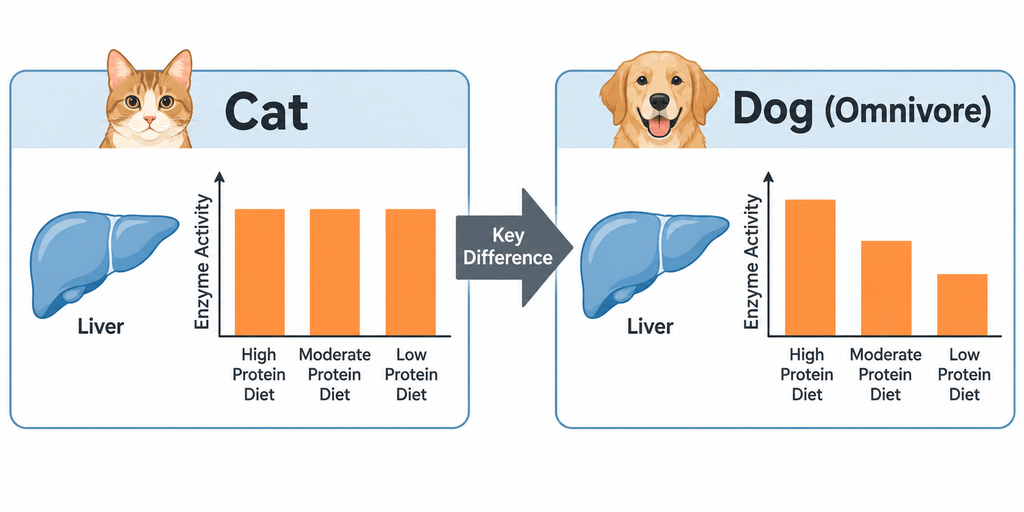
This diagram explains a key nutritional difference between cats and dogs:
Cats: Their liver keeps protein-processing enzyme activity consistently high, even when dietary protein drops. This reflects their adaptation as obligate carnivores.
Dogs: Their liver can adjust enzyme activity according to protein intake—higher with a high-protein diet and lower when dietary protein decreases.
Key takeaway: Cats are metabolically adapted to a consistently protein-rich diet and have less ability than dogs to down-regulate protein metabolism when protein intake falls.
So, visually: Cat = constant protein metabolism → Dog = adaptable protein metabolism.
Why Do Cats Need Dietary Protein?
Cats evolved as obligate carnivores, and their nutritional requirements reflect a long evolutionary history of consuming animal tissue. Veterinary nutrition research has linked this history with several distinctive feline metabolic traits, including relatively high protein requirements and dietary requirements for certain nutrients that other mammals can synthesize more readily.
You may have read that cats need more protein than dogs, without knowing exactly why. Evolution provides part of the explanation, although it does not account for every difference by itself.
Animal prey supplies protein and essential amino acids alongside other nutrients. Over evolutionary time, feline physiology developed around this type of food supply. Researchers have proposed that these dietary pressures contributed to the metabolic characteristics seen in modern domestic cats.
A review by James G. Morris, published in Nutrition Research Reviews, discusses the possibility that several distinctive feline nutrient requirements developed as evolutionary adaptations to a prey-based diet.
This is an important scientific interpretation, but it should not be presented as proof that cats never encountered low-protein food or that evolution gave them no ability to respond to changes in nutrient availability.
Instead, the evidence supports a more measured conclusion: feline metabolism reflects adaptations associated with a carnivorous diet, and these adaptations help explain why cats have nutritional requirements that differ from those of many other mammals.
The term obligate carnivore describes this distinctive nutritional biology. It does not mean that every cat must eat a particular commercial food format. The goal is a complete diet that provides the nutrients a cat needs in appropriate amounts.
Understanding this evolutionary background makes it easier to see why human and dog nutrition advice cannot simply be applied to cats.
EEAT Source Note: Evolutionary Basis of Feline Nutritional Requirements
Veterinary nutrition research describes several distinctive feline nutritional requirements, including relatively high protein needs and dietary requirements for nutrients such as taurine and preformed vitamin A. These differences are associated with the evolution of feline metabolism around a prey-based diet.
Reference: Morris, J. G. (2002). Idiosyncratic nutrient requirements of cats appear to be diet-induced evolutionary adaptations. Nutrition Research Reviews, 15(1), 153–168.
Editorial context: This review provides a scientific framework for understanding feline nutritional differences. Its evolutionary explanation is an interpretation of the evidence, not direct proof that a specific dietary pressure caused every metabolic trait.
How Does Cat Protein Metabolism Compare With Humans?
Humans and cats both need dietary protein to obtain essential amino acids, but their nutritional requirements and metabolic responses differ. Human nutrition guidance therefore cannot be used to determine an appropriate diet for a cat.
Humans can adjust some aspects of protein metabolism when dietary intake changes. The body regulates amino acid use and breakdown according to nutrient availability and physiological needs. Cats, meanwhile, maintain relatively high baseline activity of certain amino-acid-catabolizing pathways.
This difference helps explain why cats require a diet formulated around their own protein and essential amino acid needs. It does not mean that humans can safely follow every low-protein diet or that cats are incapable of any metabolic adjustment.
Questions such as how are cats different from humans in protein needs? highlight an important principle: the nutritional requirements of one species should not be assumed to apply to another.
For cats, a suitable diet must provide enough protein and the correct balance of essential amino acids, alongside other required nutrients. The amount needed by an individual cat can vary with life stage, energy needs, and health status.
If a cat has a medical condition that affects dietary management, protein intake should be discussed with a veterinarian rather than adjusted using general human nutrition advice.
Understanding these differences provides the background for the next section, which looks more closely at the liver enzymes involved in amino acid metabolism.
Vet Conversation Guide: Questions About Your Cat’s Protein Needs
Because feline protein requirements differ from those of humans and dogs, it is worth discussing your cat’s diet with a veterinarian if you have concerns about weight, muscle condition, appetite, or nutritional adequacy.
These questions can help guide the conversation:
- Is my cat getting enough protein for their life stage? Ask whether the current food is appropriate for your cat’s age and physiological needs.
- Does the food provide the essential amino acids cats require? A high crude protein percentage alone does not establish nutritional adequacy.
- Could my cat’s weight or muscle changes indicate a nutritional or medical concern? Ask whether body condition and muscle condition should be assessed separately.
- Does my cat have a health condition that affects dietary needs? Any dietary changes should take the cat’s overall health into account.
- Is the amount I feed each day appropriate? Discuss the daily feeding amount, treats, and any changes in appetite.
- Would a different food be more appropriate? Ask about nutritional adequacy rather than choosing a food based only on its protein percentage.
- Are supplements necessary? Do not add supplements solely because a cat appears thin or has lost muscle; discuss whether they are appropriate with your veterinarian.
- How should we monitor changes? Ask whether tracking weight, appetite, and muscle condition would be useful and when to arrange a follow-up.
Before the appointment: Bring the food label, feeding amounts, treat and supplement details, and any recent weight records. Notes about changes in appetite, activity, or body shape can also help.
Remember: More protein is not automatically better for every cat. The goal is a complete, balanced diet that meets the individual cat’s needs, with veterinary guidance when health concerns affect nutritional decisions.
Protein Metabolism in Cats Affects Muscle Maintenance
Having compared cats with other animals, this section looks more closely at the biological mechanism behind their distinctive protein metabolism. The focus is on liver enzymes, amino acid processing, and how these pathways respond when dietary protein changes.
The key distinction is that some enzymes involved in feline protein metabolism remain relatively active, but the body’s actual rate of protein breakdown and oxidation can still change. Understanding this difference helps connect the physical changes discussed in H2-1 with the comparative biology explained in H2-2.
Why Do Certain Cat Liver Enzymes Stay Active?
Cats have relatively high baseline activity of certain liver enzymes involved in amino-acid breakdown and the urea cycle. Compared with many omnivorous species, they have a more limited ability to reduce the activity of these enzymes when dietary protein intake falls.
The phrase “cat liver enzymes stay active all the time” is a simplified description of this biological pattern, but it can be misleading if taken literally. Enzyme activity is not identical to the amount of protein the body breaks down or uses for energy at a given moment.
Three terms help explain the mechanism:
- Aminotransferases are enzymes that help process amino acids by transferring their amino groups.
- Urea-cycle enzymes help the body convert excess nitrogen, produced during amino-acid breakdown, into urea for excretion.
- Gluconeogenic enzymes help produce glucose from non-carbohydrate sources. Some amino acids can contribute to this process, but glucose production does not mean that every glucose molecule comes from muscle tissue.
A 2023 review in the Journal of Animal Science and Biotechnology explains that cats maintain relatively high baseline activity of certain amino-acid-catabolizing and urea-cycle enzymes. However, it also notes that actual metabolic activity through these pathways can decrease under low-protein conditions as the body responds to changes in amino-acid availability.
This distinction matters. The phrase “feline liver enzymes work at a constant rate” is too absolute. A more accurate explanation is that some enzyme activities show less dietary regulation in cats, even though the overall flow of amino acids through metabolic pathways can change.
Researchers sometimes describe this limited ability to regulate certain pathways as metabolic inflexibility. In this context, the term refers to the relatively limited adjustment of particular enzyme systems—not a complete inability to adapt protein metabolism.
A study published in the Journal of Nutrition in 2008 adds an important qualification. In a controlled feeding study involving nine adult cats, protein oxidation changed across diets containing different amounts of protein. The researchers concluded that cats could adapt protein oxidation to a range of dietary protein intakes when their minimum protein requirement was met. The lowest-protein diet, which fell below that requirement, was associated with net protein loss.
Together, these findings show why it is inaccurate to say that cats always break down the same amount of protein regardless of what they eat. Their enzyme regulation differs from that of many other species, but their overall protein metabolism is not completely fixed.
This mechanism helps explain why adequate dietary protein matters for cats. However, it cannot tell us by itself whether a particular cat is losing muscle or whether low protein intake is the cause. Changes in muscle condition can have several possible explanations, and a veterinarian can assess them in context.
What Happens When Dietary Protein Drops?
When a cat’s diet does not provide enough protein to meet its needs, the body still requires amino acids to maintain tissues and carry out essential functions. Amino acids are used for many purposes, including building and repairing proteins, producing important compounds, and supporting normal metabolism.
The body can also obtain amino acids by breaking down its own proteins. If dietary supply remains inadequate, this internal source can contribute to a negative protein balance, in which protein losses exceed protein gains.
This helps explain the concern behind the question, “What happens when a cat doesn’t get enough protein?” If the shortfall is substantial or prolonged, the cat may not be able to maintain all of its body protein. Muscle tissue can be affected, although the extent and timing depend on the overall diet, energy intake, health, and other individual factors.
It is important not to confuse this outcome with a rule that every low-protein meal causes muscle loss. The body responds to the amount of protein and energy available over time, and the research on feline protein oxidation shows that cats can adjust some aspects of their metabolism. The concern is greater when the diet consistently fails to meet the cat’s nutritional requirements.
It is also important to avoid assuming that visible muscle loss automatically means a cat is eating too little protein. Illness, age-related changes, reduced calorie intake, and other health problems may contribute to changes in muscle condition. A cat that appears thinner or develops a more prominent spine should be assessed by a veterinarian rather than being given a protein supplement based on appearance alone.
The practical takeaway is that cats need a complete and balanced diet that supplies adequate protein and energy for their individual needs. If you notice unexplained muscle loss, weight change, or a persistent change in appetite, discuss it with your veterinarian before making major dietary changes.
This leads to the next question: if dietary protein does not supply enough amino acids, where can the body obtain them instead?
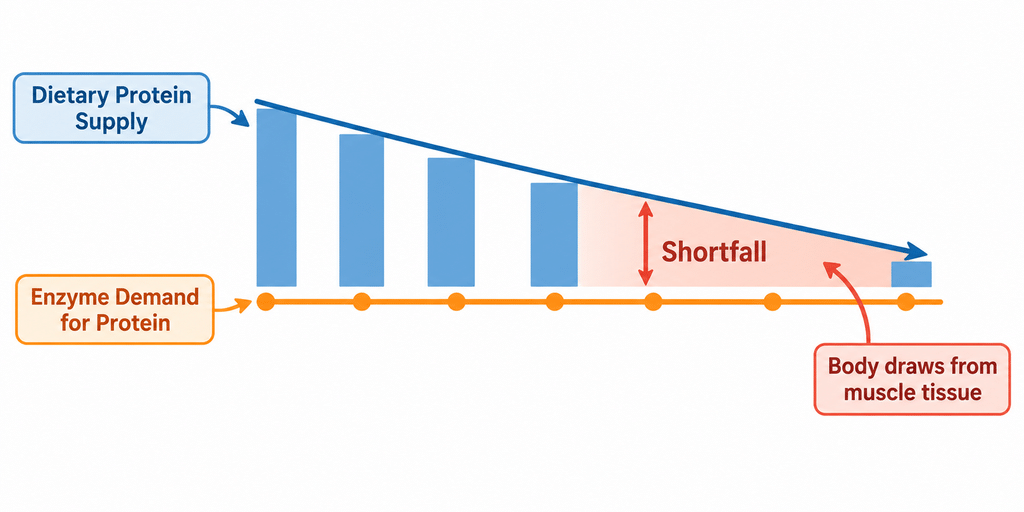
This diagram explains what can happen when dietary protein intake falls, but the body’s protein-processing demand remains high:
- Dietary protein supply decreases, while enzyme demand stays consistently high.
- This creates an increasing protein shortfall.
- To compensate for inadequate dietary protein, the body may begin using amino acids from its own tissues, including muscle.
- Over time, inadequate protein intake can therefore contribute to loss of lean muscle mass.
In simple terms:
Less protein from food → demand remains high → protein shortfall → body may use muscle protein.
Where Do Cats Get Protein?
When dietary protein does not provide enough amino acids to meet a cat’s needs, the body can draw on its own proteins to help maintain essential functions. Skeletal muscle is one source, although the extent of muscle loss depends on the severity and duration of the nutritional shortfall, energy intake, and the cat’s overall health.
This is the biological link between inadequate nutrition and the muscle changes discussed earlier in H2-1. However, fixed liver enzyme activity does not automatically mean that a cat will lose muscle. The risk increases when the body cannot obtain enough usable amino acids and energy to meet its needs over time.
Veterinary nutrition references describe how inadequate protein or calorie intake can lead to the breakdown of body tissues. If a cat does not eat enough total food, even a diet with a suitable protein concentration may fail to provide enough protein and energy in practice.
The question “Where does a cat’s body get protein from when food is low?” therefore has more than one part to the answer. Dietary protein normally supplies amino acids. The body also continually breaks down and rebuilds its own proteins. When protein intake is inadequate, or when energy needs are not met, the balance can shift toward the loss of body protein.
For example, imagine an owner notices that their cat’s hindquarters look less muscular over time. This observation alone cannot establish whether the cause is inadequate protein, insufficient calories, illness, or another problem. A veterinary assessment can help determine whether muscle loss is present and what may be contributing to it.
Where Protein Comes From: Normal Intake vs. Nutritional Shortfall
| Source or process | When nutrition is adequate | When protein or energy intake is inadequate |
|---|---|---|
| Dietary protein | Supplies amino acids for tissue maintenance, enzymes, and other essential functions. | May not provide enough amino acids to meet the body’s needs. |
| Amino-acid pool | Amino acids from food and normal protein turnover are available for building and maintaining body proteins and other compounds. | The available supply may become insufficient to support all needs. |
| Skeletal muscle protein | Continually undergoes normal breakdown and rebuilding, with overall muscle mass maintained when conditions are suitable. | May be broken down to release amino acids if the body cannot meet its needs through other sources. |
| Other body proteins | Proteins in organs and other tissues undergo normal turnover. | Protein balance in other tissues may also be affected by prolonged or severe nutritional shortfalls or illness. |
| Dietary energy | Fat and other usable energy sources help meet energy needs, allowing dietary amino acids to support their many functions. | If energy intake is too low, the body may use more amino acids for energy, making it harder to maintain body protein. |
Key point: Cats do not have a dedicated protein reserve equivalent to stored body fat. Their tissues contain proteins that are continually renewed, but ongoing or severe nutritional shortfalls can shift the balance toward tissue loss.
Visible muscle loss does not prove that a cat’s diet is too low in protein. If your cat develops a more prominent spine, thinner hindquarters, unexplained weight change, or other persistent physical changes, arrange a veterinary assessment rather than changing the diet or adding supplements based on appearance alone.
What Happens When Cats Break Down Protein?
When the body breaks down amino acids, it uses their components for different functions and must process the nitrogen released during this process. This is a normal part of protein metabolism.
Amino acid catabolism is the process of breaking down amino acids. When their nitrogen-containing groups are removed, ammonia can be produced. Because ammonia is toxic at elevated levels, the liver converts much of this nitrogen into urea, which travels through the bloodstream to the kidneys and is normally eliminated in urine.
This process is part of the body’s normal handling of dietary protein and the breakdown of its own proteins. It does not, by itself, mean that a cat’s kidneys are being damaged.
Owners sometimes ask whether constant protein breakdown affects cat kidneys. Protein metabolism and kidney function are related because the kidneys help remove waste products such as urea. However, the amount of protein a cat eats does not, by itself, establish whether kidney disease is present or whether a particular diet is appropriate. Cats with diagnosed kidney disease may need a carefully selected therapeutic diet, so dietary changes should be guided by a veterinarian.
Hydration also plays a role in normal waste elimination. Cats should have ongoing access to fresh water, and their total water intake is influenced by factors such as food moisture, diet composition, and individual needs. Some studies have found greater water intake and urine volume in cats fed higher-protein diets, but this does not mean every cat eating more protein needs a specific increase in drinking water.
Understanding these processes helps explain why adequate nutrition and access to water matter in everyday feline care. It is not a reason to reduce protein automatically because metabolism produces waste. The aim is to provide a complete and balanced diet that meets the individual cat’s nutritional needs.
Protein Metabolism and Waste Products: Quick Reference
| Substance or process | What it does | What cat owners should understand |
|---|---|---|
| Ammonia | Can form when amino acids are broken down and their nitrogen is removed. | The body must process ammonia because elevated levels can be toxic. |
| Urea | A major nitrogen-containing waste product made by the liver and normally eliminated through the kidneys. | Urea is a normal product of nitrogen metabolism; its measurement may form part of a veterinary assessment. |
| Creatinine | Forms mainly from normal muscle energy metabolism. | Veterinarians may measure blood creatinine when assessing kidney function, but it is not a direct measure of protein breakdown. |
| Water | Supports circulation, fluid balance, and urine production. | Water is essential for normal body function, but it is not a protein-breakdown byproduct. |
| Electrolytes | Minerals such as sodium and potassium help regulate fluid balance and cell function. | They are important for normal health, but they are not all products of protein metabolism. |
| Urine | Carries urea and other waste products out of the body. | Changes in urination or drinking can have several causes and should be assessed when persistent or unusual. |
Key takeaway: Protein metabolism naturally produces nitrogen-containing waste, and the body processes and eliminates it through several organs, including the liver and kidneys. Adequate hydration supports normal body function, but more water does not automatically make protein metabolism healthier.
Do not reduce protein simply because protein metabolism produces waste. If your cat has diagnosed kidney disease or another condition that affects nutrition, discuss the appropriate diet with your veterinarian.
Adequate Protein Intake Supports Feline Health
Now that the mechanism is clearer, this section turns to everyday feeding. The goal is to provide adequate, reliable nutrition rather than follow a particular meal schedule or choose food based on protein percentage alone.
Cats need sufficient dietary protein and essential amino acids to maintain body tissues and support normal functions. However, feeding frequency by itself does not determine whether a cat maintains muscle. Total food intake, diet quality, life stage, and overall health also matter.
Your veterinarian can help determine the appropriate diet, portions, and feeding routine for your individual cat. The following guidance focuses on practical ways to monitor intake, understand food labels, and recognize changes that deserve attention.
Why Does a Consistent Feeding Routine Matter?
A predictable feeding routine can make it easier to monitor how much your cat eats each day. It can also help you notice appetite changes, food refusal, or changes in body condition before they become harder to track.
Cats have ongoing needs for amino acids, but this does not mean they must receive an identical amount of protein at every meal. Nor does it mean that a longer interval between meals automatically causes muscle breakdown. Research in healthy adult cats has found differences between feeding schedules, but it has not established that more frequent meals universally prevent muscle loss.
The practical goal is to provide enough complete and balanced food over time to meet your cat’s needs. Consistent feeding helps support nutritional adequacy and makes changes in appetite easier to spot; it is not a guarantee against muscle loss.
The best feeding schedule depends on your cat’s age, health, food intake, and household routine. Kittens, cats with certain medical conditions, and cats following a prescribed feeding plan may need specific meal timing. Your veterinarian can advise you if there is a medical reason to adjust the schedule.
If you are concerned that your cat is losing muscle despite eating normally, do not assume that changing meal frequency will solve the problem. Muscle loss can have several causes, including illness and age-related changes, and may need a veterinary assessment.
If you want to understand how protein needs vary with age and other factors, see the related article on protein requirements by life stage.
Consistent Feeding Habits Checklist
A routine can help you keep track of your cat’s actual intake and notice changes over time.
- Set a practical feeding schedule: Offer meals at times that suit your cat’s needs and your household routine.
- Measure the amount offered: Use a consistent method so you can compare intake from day to day.
- Check what your cat actually eats: Leftovers can reveal changes that are easy to miss when you only measure what you serve.
- Review the daily food allowance: Make portion changes deliberately, based on your cat’s needs or veterinary advice.
- Track treats and toppers: Extras contribute to total intake and should not routinely displace too much of a complete and balanced main diet.
- Provide fresh drinking water: Keep clean water available at all times.
- Monitor appetite and body condition: Note persistent changes in eating, weight, muscle fullness, or activity.
- Introduce food changes thoughtfully: Follow veterinary advice when changing diets, particularly if your cat has a medical condition or a history of digestive problems.
- Follow prescribed feeding instructions: If your veterinarian recommends a specific diet, portion, or schedule, follow that plan.
Quick Appetite Warning: When to Pay Attention
A change in appetite can be an early sign of a health problem. It should not automatically be attributed to feeding times or protein metabolism.
Watch for patterns such as:
- Repeatedly skipping meals: Your cat refuses food or eats much less than usual.
- Sudden appetite loss: Your cat unexpectedly stops eating, particularly if they normally have a strong appetite.
- Gradually eating less: Portions remain unfinished or daily intake declines over several days.
- Appetite changes with weight or muscle loss: Your cat eats less and appears thinner or less muscular.
- Appetite changes with other symptoms: Reduced eating occurs alongside vomiting, diarrhea, unusual tiredness, or changes in drinking.
- Complete food refusal: Your cat stops eating altogether.
Contact your veterinarian promptly if your cat refuses food or eats substantially less than usual, especially if the change is sudden or accompanied by other symptoms. If your cat has eaten nothing for around 24 hours, seek prompt veterinary assessment rather than waiting for muscle loss to become visible. Kittens, overweight cats, and cats with existing medical conditions may need help sooner. Very young kittens can deteriorate particularly quickly.
Seek urgent veterinary care if appetite loss occurs with severe weakness, repeated vomiting, breathing difficulty, collapse, or other serious signs.
How Much Protein Do Cats Need Daily?
The amount of protein listed on a food label is only one part of the picture. To meet a cat’s needs, the diet must provide appropriate amounts of protein and essential amino acids, and the cat must eat enough of it.
A food with a high crude protein percentage is not automatically the best choice. The food’s overall nutritional adequacy, energy content, intended life stage, and the amount your cat actually consumes all matter.
Reliable protein intake means providing an appropriate diet consistently over time not ensuring that every meal contains exactly the same amount of protein.
Questions such as “How can I help my cat maintain muscle?” are best approached by looking at the whole picture:
- Is the food complete and balanced for the cat’s life stage?
- Is the cat eating enough of the food offered?
- Has the cat’s weight or muscle condition changed?
- Are there signs of illness, pain, digestive problems, or reduced appetite?
- Does the cat have a medical condition that affects nutritional needs?
If your cat is losing muscle, increasing protein or changing the feeding schedule may not address the underlying cause. A veterinarian can assess the change and determine whether a dietary adjustment, further testing, or another intervention is appropriate.
The question “How much protein does a cat need daily?” cannot be answered with one target for every cat. Needs vary with life stage and individual circumstances, and the amount of food consumed affects total nutrient intake.
For more detail, see the related article on daily protein requirements by life stage.
Reliable nutrition is particularly important when a cat’s appetite changes or meals are repeatedly missed. The next section explains why food refusal deserves attention and when to seek veterinary help.
Label Reading Guide: Understanding Protein Consistency
A cat food label can help you compare foods, but crude protein percentage alone cannot establish whether a food meets every nutritional need.
Use these steps to review the label more carefully.
1. Find the Guaranteed Analysis.
Locate the “Crude Protein” percentage. This is the minimum crude protein guaranteed in the food as sold, not the exact amount your cat absorbs or uses.
2. Check the nutritional adequacy statement.
Look for a statement that the food is complete and balanced for the intended life stage, such as growth, adult maintenance, or all life stages. A high protein percentage does not, by itself, prove that a food is nutritionally complete.
3. Identify the food format.
Note whether the food is dry, wet, or another format. Moisture content can make direct comparisons of the protein percentages on the label misleading.
4. Compare moisture levels.
Wet food generally contains much more water than dry food. As a result, its protein percentage as sold may look lower even when the protein concentration is similar or higher after the water is excluded.
5. Calculate dry-matter protein when comparing food formats.
Use this formula:
\frac{\text{Crude protein %}}{100-\text{Moisture %}}
\times 100
]
For example, a food containing 10% crude protein and 78% moisture has approximately 45.5% protein on a dry-matter basis.
This calculation makes protein concentrations easier to compare across foods with different moisture levels. It does not tell you whether a food is more digestible, provides a better amino-acid balance, or is more suitable for your individual cat.
6. Read the ingredient list in context.
Look for protein-containing ingredients such as named meats, poultry, fish, eggs, or animal meals. Ingredient order reflects ingredient weight when added; it does not independently establish digestibility, overall food quality, or essential amino-acid adequacy.
7. Check feeding directions and actual daily intake.
Total protein intake depends on both the food’s composition and how much your cat eats. Record the amount offered and the amount consumed if you are concerned about intake.
8. Ask the manufacturer for more detail if needed.
If you need information about amino-acid levels, digestibility, or typical nutrient content, ask the manufacturer for a more detailed nutrient analysis. Crude protein alone does not show whether every essential amino acid is present in an appropriate amount.
Quick takeaway: Start with the nutritional adequacy statement. When comparing wet and dry foods, consider moisture content and dry-matter protein, then look at how much your cat actually eats.
Protein percentage is one useful piece of information, not a complete measure of diet quality.
What Happens When Cats Skip Meals?
A missed meal does not automatically cause muscle loss, and cats do not all respond to a missed meal in the same way. However, a persistent reduction in food intake can become a serious health concern.
Cats need adequate energy and nutrients to maintain normal body functions. When a cat eats too little for an extended period, the body may use stored energy and body tissues to help meet its needs. The consequences depend on the duration and degree of reduced intake, the cat’s body condition, and any underlying illness.
It is therefore inaccurate to say that every missed meal immediately causes muscle breakdown or that cats can never tolerate a gap between meals. The more important warning sign is a sustained change in appetite or an inability to eat enough.
If your cat skips a meal, pay attention to whether they eat at the next opportunity and whether their behavior remains normal. If food refusal continues, contact your veterinarian rather than assuming the problem is simply hunger or a feeding-schedule issue.
The question “Is it dangerous for a cat to skip a meal?” depends on the circumstances. One isolated missed meal is not the same as repeated food refusal, but a cat that stops eating should be monitored closely and assessed promptly if the problem persists.
A cat that has eaten nothing for around 24 hours needs prompt veterinary assessment. Contact a veterinarian sooner if your cat is very young, overweight, medically unwell, or showing other concerning signs. Do not wait for visible muscle loss before seeking help.
If your cat regularly skips meals, note when the change began, how much food is being eaten, and whether other symptoms are present. This information can help your veterinarian decide what evaluation is needed.
You do not need to overhaul your cat’s diet simply because one meal was missed. Focus on adequate overall intake, observe changes, and seek advice when appetite loss is persistent or unexplained.
Signs to Record After a Missed Meal
One missed meal does not affect every cat in the same way. The observations below can help you describe changes to your veterinarian, but they cannot show on their own that a cat is experiencing protein deficiency or muscle breakdown.
- Unusual food-seeking: Your cat repeatedly approaches the feeding area or checks the food bowl.
- Increased vocalization: Your cat meows around usual mealtimes more than normal.
- Restlessness: Your cat seems unsettled around the time they usually eat.
- Reduced energy: Your cat is less playful or active than usual.
- Hiding or withdrawal: Your cat spends more time hiding or avoids normal interaction.
- Reduced interest in usual activities: Your cat shows less interest in familiar routines.
- Nausea-like behavior: Your cat repeatedly lip-licks, drools, swallows, or approaches food and then turns away.
- Vomiting or retching: Record any episode, especially if it repeats or occurs alongside reduced appetite.
- Changes in drinking: Your cat drinks noticeably more or less than usual.
- Refusal of the next meal: Your cat continues eating less or refuses food again.
Safety note: Do not assume that lethargy, vomiting, hiding, or food refusal is simply hunger. Contact your veterinarian promptly if your cat continues refusing food or has other concerning symptoms. If your cat has eaten nothing for around 24 hours, seek prompt veterinary assessment. Kittens and cats with existing health problems may need help sooner.
Severe weakness, repeated vomiting, breathing difficulty, or collapse warrants urgent veterinary care.
Suspected Muscle Loss Needs Veterinary Assessment
This final section moves from understanding the biology to practical next steps. The priority is to identify what may be causing the change and determine whether your cat needs dietary adjustments, further testing, or other care.
Muscle loss does not automatically mean a cat is eating too little protein. Illness, aging, inadequate calorie intake, and other health problems can also affect muscle condition. The safest approach is to record what you have noticed and discuss it with your veterinarian.
What Diet Changes Should You Discuss With Your Vet?
If you notice changes in your cat’s muscle condition, discuss the current diet and feeding routine with your veterinarian before making major changes.
What to feed a cat losing muscle depends on the reason for the muscle loss, the cat’s health, and its current nutritional intake. A higher-protein food may be appropriate in some situations, but it is not the right solution for every cat.
Rather than immediately switching foods or adding supplements, prepare to discuss:
- The food your cat currently eats and whether it is complete and balanced for the appropriate life stage.
- How much food your cat is offered and how much is actually consumed.
- Treats, toppers, supplements, and any homemade or raw food.
- Changes in appetite, weight, activity, or muscle condition.
- Existing medical conditions that could affect nutritional needs.
Your veterinarian can use this information to decide whether the diet needs to change and whether further investigation is appropriate. A veterinary nutritionist may also help when a cat has complex nutritional needs or requires a specially formulated diet.
If you want to understand protein needs across different life stages, see the related article on protein requirements by life stage.
Diet Discussion Topics by Concern
Changes in appetite, body condition, energy, or coat can have several possible causes. The table below helps you prepare useful questions for your veterinarian; it is not a diagnostic guide.
| Observed concern | Related diet topic | What to discuss with your veterinarian |
|---|---|---|
| Your cat regularly leaves food uneaten | Daily food intake and food acceptance | Is my cat eating enough overall, and could an underlying health issue be affecting appetite? |
| Your cat seems hungry but is losing weight | Calorie intake, nutrient absorption, and health | Can we review how much my cat eats and investigate the weight loss? |
| Your cat’s spine or hips appear more prominent | Body condition and muscle condition | Could you assess my cat’s muscle condition and help identify possible causes? |
| Your cat’s coat has become dull or flaky | Overall nutrition and skin health | Could this relate to diet, or should we investigate another cause? |
| Your cat eats a homemade or raw diet | Nutritional completeness and balance | Does this diet meet all feline nutrient requirements, including essential amino acids, vitamins, minerals, and fatty acids? |
| You are considering a protein supplement | Protein adequacy and amino-acid balance | Does my cat need additional protein, or is another issue more likely? |
| You are considering adding oils or animal fats | Essential fatty acids and total calorie intake | Is there an identified nutritional need, and could adding this ingredient unbalance the diet? |
| Your cat eats treats instead of its main food | Treat intake and complete nutrition | Could treats be displacing too much of the balanced diet? |
| Your cat’s appetite has changed suddenly | Appetite loss and possible illness | Should we investigate a medical cause before changing the food? |
| Your cat has a diagnosed medical condition | Condition-specific nutritional needs | Does this condition affect the diet or monitoring my cat needs? |
Before the appointment: Bring the food packaging or label, daily feeding amounts, treat and supplement details, recent weight measurements, and notes about when the changes began.
If your cat stops eating or eats much less than usual, contact your veterinarian promptly rather than waiting for a routine nutrition appointment. Persistent appetite loss can be associated with a range of health problems and needs appropriate assessment.
When Does Muscle Loss Need a Vet Visit?
Ongoing, unexplained, or worsening muscle loss warrants a veterinary assessment. A veterinarian can examine your cat, assess muscle and body condition, review its diet and medical history, and decide whether additional tests are needed.
If a veterinarian has mentioned abnormal liver enzymes or concerns about protein metabolism, ask what the findings mean in your cat’s specific case. An enzyme result alone does not establish that the body is breaking down muscle too quickly.
The next steps depend on what the assessment shows. Your veterinarian may recommend a dietary review, monitoring, further testing, treatment of an underlying condition, or referral to a veterinary nutritionist.
Useful questions to ask include:
- Has my cat lost muscle, body fat, overall weight, or a combination?
- Could inadequate food intake or an unbalanced diet be contributing?
- Are there signs of an underlying medical condition that need investigation?
- Would any changes to the diet be appropriate?
- Does my cat need blood tests or other diagnostic tests?
- How should I monitor weight and muscle condition at home?
- When should we reassess the situation?
There is no single test that proves a cat is breaking down muscle specifically because dietary protein is low. The veterinarian will select any tests based on the examination, history, and possible causes.
Bring a record of what you have noticed. Include when the changes started, whether they are progressing, how much your cat eats, and whether appetite, drinking, activity, vomiting, or bowel habits have changed.
Muscle loss can have several causes. Investigating the underlying reason is more useful than assuming that a higher-protein diet will solve the problem.
Conclusion
Cats have distinctive protein metabolism, including relatively high baseline activity of certain enzymes involved in amino-acid processing. However, their metabolism is not completely fixed, and the amount of protein the body uses can change with dietary conditions.
When protein or overall energy intake remains inadequate, the body may lose protein from its own tissues, including skeletal muscle. But muscle loss does not automatically mean dietary protein is the cause. Illness, aging, inadequate calorie intake, and other factors can also contribute.
Providing a complete and balanced diet in appropriate amounts helps support normal nutrition. Tracking how much your cat eats and noticing changes in weight or muscle condition can also help you recognize when something may need attention.
If you notice ongoing or worsening muscle loss, speak with your veterinarian rather than trying to correct it with a high-protein food or supplements on your own. A proper assessment can help identify the cause and determine the most suitable next steps.
What to Watch For
- Whether your cat’s spine, shoulder blades, or hips appear more prominent than before.
- Whether muscle along the back or hindquarters appears to be decreasing, even if body weight seems stable.
- Whether your cat’s appetite or daily food intake has changed.
- Whether there have been changes to the food, portion sizes, treats, supplements, or feeding routine.
- How long the changes have been present and whether they are progressing.
- Whether other changes, such as vomiting, diarrhea, unusual tiredness, or changes in drinking, have appeared.
Record your observations and share them with your veterinarian. These notes can help guide an assessment, but they cannot determine the cause of muscle loss on their own.
FAQ
Can a cat’s body adapt to a low-protein diet over time?
Cats can adjust some aspects of protein metabolism, but their ability to regulate certain amino-acid-processing pathways differs from that of many other species. Research suggests that some adaptation in protein oxidation can occur when dietary protein requirements are met.
This does not mean a persistently inadequate diet becomes safe simply because a cat has time to adapt. A diet should provide sufficient protein, essential amino acids, energy, and other nutrients for the cat’s needs.
Does canned or wet food affect this process differently from dry food?
The basic mechanisms of protein metabolism do not depend on whether food is wet or dry. However, foods can differ in protein concentration, moisture, energy content, digestibility, and overall nutrient composition.
When comparing products, consider their nutritional adequacy and the amount your cat actually eats, not just the crude protein percentage printed on the label. Your veterinarian can help assess whether a particular food meets your cat’s needs.
Is this the same as sarcopenia in senior cats?
No. Sarcopenia refers to age-associated loss of muscle mass and function. Muscle loss can also occur because of illness, inadequate nutrition, pain, reduced activity, or other factors.
These problems can overlap, and age alone should not be assumed to explain a noticeable change in muscle condition. A veterinarian can assess the possible causes and recommend appropriate care.
Can supplements replace adequate dietary protein?
No supplement should be assumed to replace a nutritionally appropriate diet. Cats need sufficient protein and essential amino acids as part of their overall nutrition.
Whether a supplement is useful depends on the cat’s diet and health. Ask your veterinarian or a veterinary nutritionist before adding supplements, especially if your cat has a medical condition.
How long does it take to reverse muscle loss once the diet is corrected?
There is no single recovery timeline. Progress depends on the underlying cause, the severity of muscle loss, the cat’s overall health, and whether the contributing problem can be addressed.
Your veterinarian can recommend a monitoring plan and give a more realistic expectation after assessing your cat. If muscle loss continues despite a dietary change, the cause may need further investigation.
What are the signs of protein deficiency in cats?
There is no single visible sign that confirms protein deficiency. A cat may develop reduced muscle mass or other changes when its nutritional needs are not met, but similar findings can occur with illness and other conditions.
A more prominent spine, thinner hindquarters, or unexplained weight changes should prompt an assessment rather than an assumption that protein is the cause. A veterinarian can review the diet, assess muscle condition, and determine whether testing is appropriate.
Why do cats have different dietary requirements from dogs, including when considering vegetarian or vegan diets?
Cats are obligate carnivores with specific requirements for nutrients such as taurine and certain other essential nutrients. Dogs have different nutritional requirements, so a diet designed for a dog should not be assumed to meet a cat’s needs.
The important issue is whether a cat’s diet provides every required nutrient in appropriate amounts and proportions. Do not assume a vegetarian or vegan diet is adequate for a cat based on its protein percentage alone. Discuss any such diet with a veterinarian or a qualified veterinary nutritionist.
Disclaimer: This article is for educational purposes only and does not replace professional veterinary advice, diagnosis, or treatment. If your cat is losing muscle, eating less, or showing changes in weight or activity, consult a veterinarian to identify the underlying cause and discuss appropriate nutritional support.
References and Further Reading
- Li, P., & Wu, G. (2023). Amino acid nutrition and metabolism in domestic cats and dogs. Journal of Animal Science and Biotechnology, 14, 19.
Reviews feline amino acid requirements, amino-acid catabolism, liver enzyme activity, gluconeogenesis, and differences between cat and dog metabolism.
https://pmc.ncbi.nlm.nih.gov/articles/PMC9942351/ - Green, A. S., et al. (2008). Cats are able to adapt protein oxidation to protein intake provided their requirement for dietary protein is met. Journal of Nutrition.
Examines how cats adjust protein oxidation across diets with different protein levels, including a diet below the estimated protein requirement. The findings help explain why enzyme activity alone does not determine the actual rate of protein breakdown.
https://pubmed.ncbi.nlm.nih.gov/18492833/ - Russell, K., Murgatroyd, P. R., & Batt, R. M. (2002). Net protein oxidation is adapted to dietary protein intake in domestic cats (Felis silvestris catus). Journal of Nutrition, 132(3), 456–460.
Investigates the relationship between dietary protein intake and protein oxidation in domestic cats.
https://pubmed.ncbi.nlm.nih.gov/11880571/ - World Small Animal Veterinary Association (WSAVA). Nutritional Assessment Guidelines.
Provides guidance on evaluating a cat’s diet, appetite, body weight, body condition score, and muscle condition score. It also explains why muscle loss may require further nutritional and medical assessment, even when a cat is overweight.
https://pmc.ncbi.nlm.nih.gov/articles/PMC11107980/ - American Association of Feline Practitioners (AAFP). (2021). 2021 AAFP Feline Senior Care Guidelines. Journal of Feline Medicine and Surgery, 23(7), 613–638.
Discusses age-related muscle loss (sarcopenia), changes in strength and mobility, monitoring body composition, and investigating unexplained changes in senior cats.
https://pmc.ncbi.nlm.nih.gov/articles/PMC10812122/ - MSD Veterinary Manual. Nutritional Requirements of Small Animals.
Explains species-specific nutrient requirements, feline protein and amino-acid needs, energy requirements, gluconeogenesis, and nutritional risks associated with unbalanced diets.
https://www.msdvetmanual.com/management-and-nutrition/nutrition-small-animals/nutritional-requirements-of-small-animals - Cornell University College of Veterinary Medicine. Anorexia. Cornell Feline Health Center.
Explains why persistent appetite loss in cats can signal an underlying health problem and why veterinary assessment is important when a cat stops eating.
https://www.vet.cornell.edu/departments-centers-and-institutes/cornell-feline-health-center/health-information/feline-health-topics/anorexia - Association of American Feed Control Officials (AAFCO). Reading Labels.
Explains how to interpret pet food labels, including the guaranteed analysis, ingredient list, feeding directions, and nutritional adequacy statement.
https://www.aafco.org/consumers/understanding-pet-food/reading-labels/ - Camara, A., et al. (2020). The daytime feeding frequency affects appetite-regulating hormones, amino acids, physical activity, and respiratory quotient, but not energy expenditure, in adult cats fed regimens for 21 days. PLOS ONE, 15(9), e0238522.
Examines the effects of feeding frequency in healthy adult cats. It provides context for discussing meal schedules without assuming that more frequent meals have been proven to prevent muscle loss.
https://doi.org/10.1371/journal.pone.0238522
These references are provided for educational purposes. They do not replace an individual veterinary examination, diagnosis, or nutrition plan.

Saloni Nagar is the founder and lead content creator of Bark & Meow Tales. As a dedicated cat parent and researcher, she transitioned from personal loss to pet health advocacy, focusing on early warning signs and preventive care. Saloni specializes in translating complex veterinary concepts into actionable guidance for pet parents. Her work is driven by a commitment to helping others interpret subtle feline health signals before they escalate, ensuring that every cat has a voice through informed, compassionate care.