
By Saloni Nagar, Medically Reviewed by Dr. Jimisha Shah, B.V.Sc & A.H., PGDAW
7-dehydrocholesterol is the compound humans and dogs use to convert UV light into vitamin D3. Cats do not rely on sun exposure for this process. Instead, they must get vitamin D directly from their food. This is a basic biological difference, not a matter of how much time a cat spends outdoors.
Many cat owners see their cats basking on sunny windowsills for hours. It is natural to assume this helps maintain their vitamin D levels, just as it does in people. Others know that cats have different nutritional needs and want to understand why before choosing a food or supplement.
This difference matters because it changes what keeps a cat’s vitamin D levels adequate. Sunlight does not provide the vitamin D cats need, but their diet does. Understanding this species difference also helps clear up confusing pet-care advice online, where sunlight and vitamin D are often incorrectly linked in cats and people.
Below, we will look at the signs of inadequate vitamin D intake and the biological reason behind this difference. We will also explain why cats still sunbathe and what to check in their diet to make sure this essential nutrient is covered.
Signs Your Cat Isn’t Getting Enough Vitamin D
Some owners worry their cat isn’t getting “enough sun” because that is how vitamin D is often discussed in people. And that instinct to want to “fix” something before you even know it’s broken is completely understandable. This section starts with the most common misconception, then looks at indoor cats and the signs that may need a vet’s attention. Each part leads to the same point: sunlight exposure and vitamin D status are not connected in cats.
Does Sunbathing Give Cats Vitamin D?
A cat basking in a sunny spot every day is not proof that she is getting enough vitamin D. This behavior is common, but it is not linked to her vitamin D status.
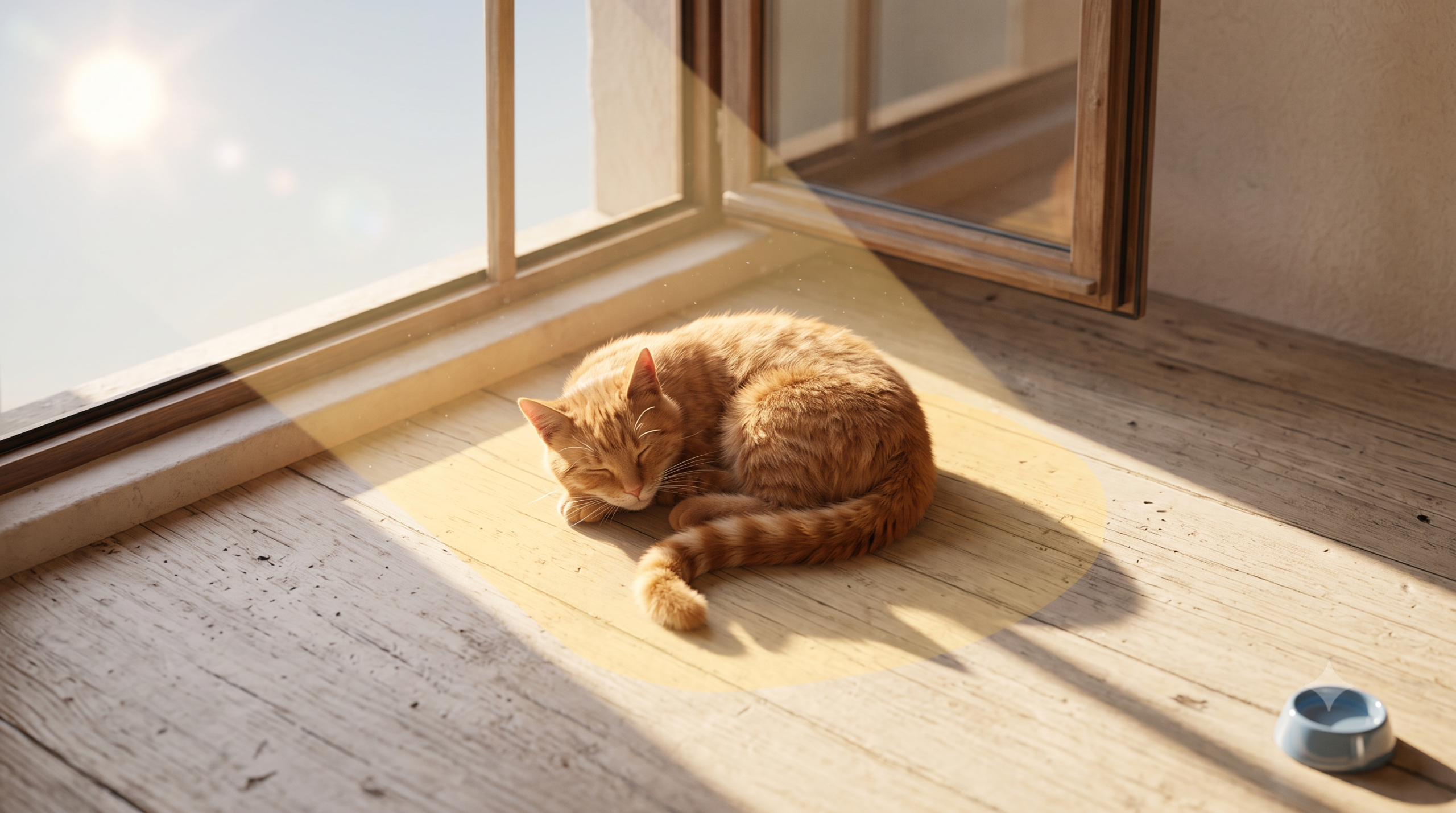
She stretches out in the same sunny spot every afternoon, and you might notice her following the sun around the house all day as the light moves across the floor. It is a familiar sight for many cat owners. It is easy to assume that time in direct sunlight provides a nutritional benefit, just as it does for people. However, feline nutrition guidance shows that this assumption does not apply to cats. Even so, sunbathing is good for cats in other ways, such as comfort and warmth.
In simple terms, you may wonder, “Is my cat vitamin D deficient if she sunbathes all day?” Her sunbathing habits alone cannot tell you her vitamin D level. The same applies if you wonder whether you should worry about her vitamin D because she loves sunbathing. Sun exposure is simply not the relevant factor here. Some owners may notice their cat sits in the sun a lot and wonder what it means. The honest answer is that it tells you very little about her vitamin D status. What matters instead is her diet, which we cover later in this article.
Do Indoor Cats Need More Vitamin D?
Whether a cat lives strictly indoors or has some outdoor access does not change her vitamin D status. Cats cannot produce vitamin D through their skin, so outdoor time does not provide an advantage.
An indoor cat who never sets a paw outside is not at a special disadvantage compared with a cat who spends afternoons in the yard. The same is true for a cat who’s always been an indoor-only pet. Because cats cannot use skin synthesis to make vitamin D, indoor and outdoor lifestyles do not change vitamin D status.
This is not an emergency-level concern. The key question is not whether your cat gets enough sunlight, but whether she gets enough vitamin D from her food. If you are wondering whether indoor cats can get vitamin D deficiency, the answer is yes, but staying indoors itself does not cause the deficiency. It depends on the diet.
For owners asking whether an indoor cat could be deficient, the same principle applies. Lack of outdoor time is not the cause. What matters is what your cat eats and whether her diet provides enough vitamin D.
Indoor vs. Outdoor Exposure Comparison
Seeing indoor and outdoor cats laid out side by side makes it easier to spot exactly where the real difference does and doesn’t show up.
| Lifestyle | Skin Synthesis Possible | Vitamin D Source | Relevant Risk Factor |
|---|---|---|---|
| Indoor-only cat | No meaningful vitamin D synthesis from sunlight | Diet | Risk depends mainly on whether the diet provides adequate vitamin D |
| Outdoor-access cat | No meaningful vitamin D synthesis from sunlight | Diet | Outdoor exposure does not reliably compensate for inadequate dietary vitamin D |
| Strictly outdoor cat | No meaningful vitamin D synthesis from sunlight | Diet | Outdoor lifestyle does not make sunlight a dependable vitamin D source |
Signs of Low Vitamin D in Cats?
A handful of general, non-specific signs can occur with inadequate nutrient intake. These may include changes in appetite, coat quality, or activity level. However, these signs are not unique to vitamin D deficiency and should always be evaluated by a vet, not guessed at at home.
Many pet parents notice a slightly dull coat or a bit less energy than usual and wonder if their cat’s diet is missing something. Henry’s Siamese, a middle-aged cat around six years old, seemed a little quieter during evening playtime. At her annual vet visit, the vet reviewed her food label and suggested a fresher, complete diet. Within a few weeks, Henry noticed her energy return to normal.
According to nutritional guidelines established by veterinary nutrition organizations, deficiency is rare when a cat eats a complete, properly formulated commercial diet. So, when these general signs appear, they usually point to something other than a vitamin D-specific problem. Broadly, most owners want reassurance that cats need vitamin D in reasonable amounts and that a normal diet already provides it.
If you’re searching for “signs my cat isn’t getting enough vitamin D from diet” or “cat vitamin D deficiency symptoms”, there is no single symptom that points specifically to vitamin D deficiency. The broader question, “Is a cat vitamin D deficient?”, often comes from general concern rather than one clear sign.
Questions such as “signs of vitamin D deficiency in cats”, “what happens if a cat doesn’t get enough vitamin D”, and “how do I know if my cat’s diet has enough vitamin D” are best discussed with a vet. These general signs can overlap with many unrelated conditions.
Noticing that she seems just as playful and alert as always is reassuring. Still, mention any lasting change at her next visit. Keeping an eye on her appetite and energy over time is a simple way to stay informed without trying to diagnose her yourself.
Understanding that sunlight and lifestyle are not the deciding factors makes the biology easier to understand. The next section explores why this difference exists.
General Wellness Observation Checklist
Use this checklist to track specific changes you can actually observe at home. These details can be useful to mention during a veterinary visit.
| ✓ | What to Observe | Specific Observable Behavior |
|---|---|---|
| ☐ | Appetite | Eating noticeably less, skipping meals, or suddenly becoming much more interested in food |
| ☐ | Drinking | Spending more time at the water bowl or repeatedly seeking water from unusual places |
| ☐ | Coat condition | Coat looks dull, greasy, matted, or less well-groomed than usual |
| ☐ | Grooming | Grooming noticeably less, leaving areas of the coat ungroomed |
| ☐ | Energy level | Spending more time sleeping or resting and showing less interest in normal activities |
| ☐ | Activity | Playing less, moving around the home less, or stopping activities they normally enjoy |
| ☐ | Jumping & climbing | Hesitating before jumping onto familiar surfaces or avoiding usual climbing spots |
| ☐ | Weight or body shape | Looking noticeably thinner, heavier, or different around the ribs, spine, or hips |
| ☐ | Social behavior | Seeking noticeably more isolation or becoming less interested in normal interaction |
| ☐ | Daily routine | A familiar pattern—such as meal times, sleeping locations, play, or litter-box visits—changes noticeably |
| ☐ | Movement | Walking differently, moving more cautiously, or appearing less comfortable during normal movement |
| ☐ | Overall behavior | Acting noticeably different from their usual personality or routine for several days |
Tip for cat parents: Instead of saying “My cat seems off,” note what actually changed, when you first noticed it, and whether it is getting better, worse, or staying the same. A short video or photo can also help your veterinarian understand a change in behavior or movement.
The Biological Reason Cats Can’t Get Vitamin D From the Sun
Some owners find themselves wondering if something they read online applies to their own cat, especially because cat vitamin D metabolism is different from that of humans. This section explains the process in simple terms. It first looks at how vitamin D production works in species that can use sunlight, then explains what is different in cats.
The next section builds on this biology and explains the evolutionary reason behind that difference. When a cat processes nutrients differently from a human or dog, it reflects species-specific metabolism (the way an animal’s body processes nutrients based on its evolutionary biology).
How Do Dogs Get Vitamin D From Sunlight?
In humans, and to a limited extent in dogs, UV-B light triggers a chemical reaction in the skin that helps convert a precursor into usable vitamin D3. This conversion process happens just beneath the surface of the skin, using a compound in the skin that reacts to UV light. This compound is known as a nutrient precursor, or a raw material that the body can convert into a usable nutrient. The important point is what this process does, not the technical term.
Veterinary guidance from small-animal nutrition literature indicates that dogs have only limited skin synthesis, and it is far less efficient than in humans. People sometimes describe this as cats absorbing vitamin D through their skin, but that wording is not accurate for cats. For humans, this pathway is much more active and is known as cutaneous synthesis, or the process of making vitamin D through the skin.
If you’ve searched “can cats get vitamin D from sunlight”, “dogs get vitamin D from sunlight but cats don’t”, or “why do dogs get vitamin D from the sun but cats don’t”, this is the starting point. The pathway works to different degrees across species and is essentially absent in cats.
A quick visual side-by-side makes this three-way comparison click faster than any explanation in words alone.
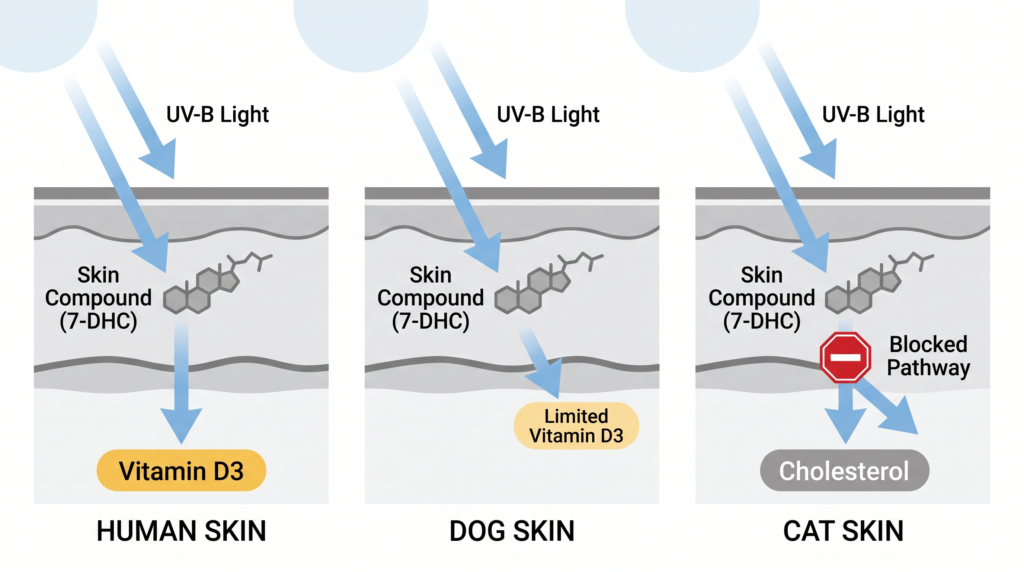
For those asking more broadly, “how cats get vitamin D if not from the sun at all, cats sit at the far end of that spectrum, which the next section explains in more detail.
Why Can’t Cat Skin Make Vitamin D?
Feline skin contains too little 7-dehydrocholesterol, a compound in the skin that reacts to sunlight to start vitamin D production. As a result, sunlight cannot trigger the vitamin D production pathway in cats, no matter how long they spend in the sun.
Cats simply don’t carry enough of this compound to make the process work, and no amount of sun exposure changes this. Research on feline skin biology shows that an enzyme called 7-dehydrocholesterol-Δ7-reductase is especially active in cats. This enzyme redirects the raw material toward cholesterol before it can become vitamin D. This is a fixed trait across the species, not something that varies cat to cat. It is not about one cat having unusually sensitive skin. It also explains why 7-dehydrocholesterol in cats is low compared with other species and why cat skin is different from dog skin in this specific way.
This helps explain several common concerns about feline vitamin D. The questions behind why cats can’t make vitamin D from sunlight and whether outdoor cats get vitamin D from the sun all come back to the same enzyme-driven block. The same biology explains whether it is true that cats can’t make vitamin D like humans and why my cat’s skin is different from dogs’ for vitamin D. In each case, the answer comes back to the same structural difference in feline skin.
The same explanation applies when owners ask what 7-dehydrocholesterol is in cat skin or wonder why cats don’t have enough 7-dehydrocholesterol for vitamin D. These concerns point to the same basic biology. Looking at how cat skin is different from human skin for vitamin D also helps explain why sunlight cannot provide cats with vitamin D. This is a structural limitation, not a lifestyle issue, and it remains consistent across the species.
Cats vs. Dogs vs. Humans — Vitamin D Synthesis Comparison
This table pulls together the exact numbers behind what’s happening beneath the surface, so you can see where cats land compared to other species.
| Species | 7-DHC Level | Enzyme Activity | Synthesis Outcome |
|---|---|---|---|
| Humans | Present in skin | 7-dehydrocholesterol reductase (DHCR7) converts 7-DHC to cholesterol | 7-DHC is available as a precursor for vitamin D₃ production when skin is exposed to UVB |
| Dogs | Very low in skin | DHCR7 activity is high, limiting the amount of 7-DHC available for cutaneous vitamin D₃ synthesis | Little to no meaningful vitamin D₃ synthesis through the skin |
| Cats | Very low/limited in skin | DHCR7 activity is high, leaving little 7-DHC available for UVB conversion | Little to no meaningful vitamin D₃ synthesis through the skin |
Key takeaway: The important difference is not simply whether an animal has skin or is exposed to sunlight. The amount of 7-DHC available in the skin and the activity of the DHCR7 enzyme determine how much substrate is available for UVB-driven vitamin D₃ production. For cats, dietary vitamin D remains the relevant source.
Why Have Cats Never Evolved to Use Sunlight?
Cats are obligate carnivores (animals whose bodies rely mainly on nutrients from animal-based foods). Their ancestral whole-prey diet already supplied enough vitamin D. Because this source was reliable, cats had little evolutionary pressure to develop a strong skin-synthesis pathway.
This reflects a biological trait tied to their evolutionary diet. Whole prey already supplied what the body needed, so there was never a survival advantage to developing this pathway as other species may have. In simple terms, cats did not need to develop this pathway because their diet already provided the nutrient. This is an expected result of how cats evolved as strict, whole-prey hunters, rather than a deficiency or flaw in the species.
This evolutionary background also explains why dietary vitamin D remains important for cats. It helps connect the biology to the broader question of why dietary vitamin D is non-negotiable for cats. Understanding why cats never developed this pathway also makes it easier to understand why they still enjoy sunny spots, even though sunlight does not provide them with vitamin D. That behavior is what the next section explores.
Sunbathing Habits in Cats, Explained
Understanding that cats can’t produce vitamin D from sunlight naturally raises a follow-up question: if it serves no nutritional purpose, why do they still seek it out so eagerly?
This section separates the behavior from the biology, explaining what sunbathing is actually doing for a cat. From there, the article shifts fully into what matters is diet.
Do Cats Sunbathe for Warmth, Not Vitamins?
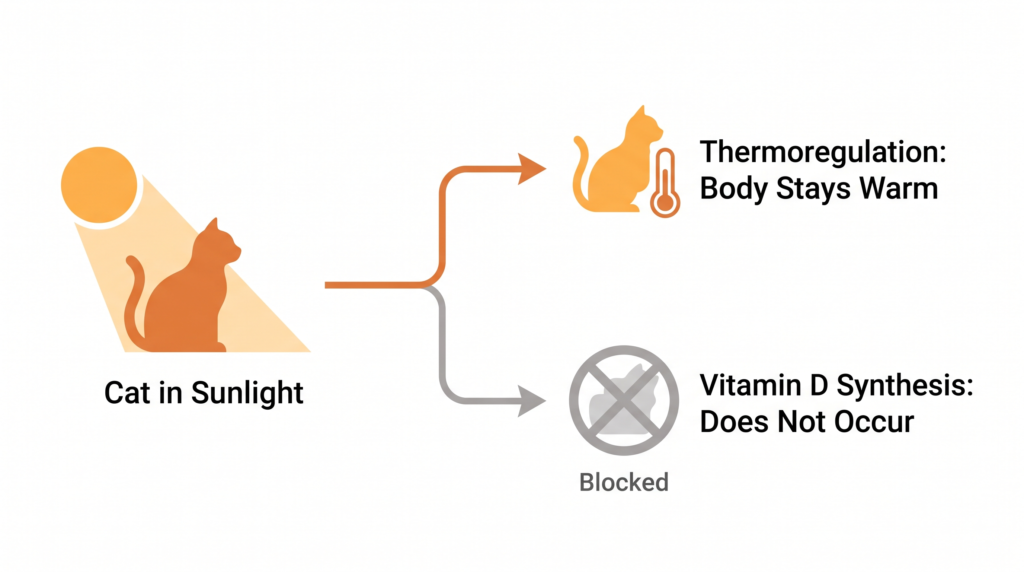
A cat basking in sunlight is engaging in thermoregulation (the body’s way of staying warm), not nutrient production. This behavior is instinctive and driven by comfort. It happens whether or not the cat is getting enough vitamin D from her diet.
He presses himself right up against the window glass when the sun hits it, and a cat curled up on a warm windowsill looks perfectly content. Both behaviors show the body seeking warmth. Sunbathing activates a completely separate system in the body tied to temperature regulation, and the body prioritizes staying warm, not producing nutrients. That golden spot on the carpet where the sun lands every morning feels good for the same reason a heated blanket feels good to a person. It provides warmth, not a nutritional benefit.
Emma’s Bengal, a young adult around two years old, spent most afternoons beside the sunniest window in the apartment. One evening, Emma checked the food label and noticed it lacked a clear “complete and balanced” statement. She switched brands, but her cat kept sunbathing just as happily as before.
Watching her nap in a sunbeam for hours at a time is completely normal. So is a cat who gravitates toward the warmest spot in the room, sun or not. Both behaviors simply reflect a cat’s natural drive to stay comfortable and warm. If you’ve wondered why my cat lies in the sun, if she can’t absorb vitamin D from it, warmth is the simple explanation. This is also why the idea of the cat sunbathing vitamin D myth does not hold up: cats sunbathe for warmth, not vitamins.
The same applies to the question of how much sun exposure a cat needs for vitamin D. Cats do not need sunlight to obtain vitamin D, so the windowsill does not provide a nutritional source of this vitamin. This also explains why vets say cats can’t get vitamin D from windowsills. The windowsill can support comfort and warmth, but it does not provide vitamin D.
It’s worth remembering that cats like to sunbathe even without getting vitamin D from it, and this behavior is normal. There is no reason to discourage it simply because sunlight does not produce vitamin D in cats. However, direct sunlight is bad for cats only when it creates separate risks such as overheating or sunburn, especially in light-colored or hairless cats. Most cats can still enjoy lying in sunny spots around the house without this affecting their vitamin D status.
Seeing these two pathways drawn out separately makes it obvious why one happens every time, and the other doesn’t happen at all.
Diet Is the Only Vitamin D Source for Cats
With sunlight fully ruled out as a factor, the natural next question is what provides vitamin D for a cat. This section positions diet as the single reliable source, comparing cats briefly to dogs to underscore just how absolute this dependence is. This sets up the more detailed, practical guidance that follows in the next section.
Comparing Cats vs. Dogs: Vitamin D Needs
Cats get all of their vitamin D from food because their skin cannot produce it from sunlight. Dogs, by contrast, have some limited skin synthesis as a backup, even though diet is also their main source.
This is why cats need vitamin D in their food as a non-negotiable part of their diet. Dietary vitamin D is absorbed through the digestive tract instead of the skin. So, meeting this requirement depends on what’s in the bowl each day.
Understanding vitamin D in cat food vs dog food also helps explain why feline diets need careful formulation. Cat food is not simply “dog food with different flavoring.”
If you’ve wondered whether cats need vitamin D from food or sunlight, the answer is food. The same applies to the broader question of why cats need vitamin D in their food and whether vitamin D is essential for cats. Both come back to the same biological fact: cats do not have skin synthesis as an alternative source.
This also explains why cats need a certain amount of vitamin D in their diet and why cats don’t get vitamin D in their food unless manufacturers deliberately include it. Their vitamin D supply depends on their diet rather than sunlight.
This complete dependence on diet is why the practical side matters. The next section looks at what to check in your cat’s food.
Feline vs. Canine Vitamin D Dependence Matrix
For anyone with both a cat and a dog at home, this side-by-side makes it clear why their nutritional needs aren’t quite the same.
| Species | Skin Synthesis Backup | Primary Source | Dietary Dependence Level | Practical Implication |
|---|---|---|---|---|
| Cat | ❌ No meaningful backup from sunlight | Dietary vitamin D | High | Sun exposure should not be relied on to compensate for inadequate dietary vitamin D. |
| Dog | ❌ No meaningful backup from sunlight | Dietary vitamin D | High | Outdoor access does not provide a dependable alternative to dietary vitamin D. |
Bottom line: Both cats and dogs are considered diet-dependent for vitamin D. Unlike humans, simply spending more time in sunlight should not be treated as a reliable way to meet their vitamin D needs.
Choose a Cat Food That Contains Vitamin D
Now that diet carries the full responsibility for meeting a cat’s vitamin D needs, it’s time to look at the practical side. This section covers what to look for on a food label, which natural food sources contain vitamin D, and where homemade diets can fall short.
You don’t need to become a nutrition expert to understand these basics. Each part will help you know what to check and make more informed choices about your cat’s food.
What to Check on a Cat Food Label?
Complete-and-balanced commercial cat foods that meet AAFCO standards are already formulated to provide adequate dietary vitamin D. For most cats eating one of these diets, no extra action is needed beyond checking the label.
Veterinary guidance from AAFCO-aligned nutritional standards suggests that commercial diets are formulated to close this exact gap created by the absence of skin synthesis. This is reassuring for most owners. It is also what a complete and balanced formulation means: a diet made to meet a cat’s known nutritional needs in the right amounts.
Vitamin D is a fat-soluble vitamin, meaning the body stores it in fat tissue instead of removing it quickly. That is one reason the right amount matters in a properly formulated diet.
Checking the ingredient list before buying a new bag of food and flipping the bag over to check for “complete and balanced” on the label are simple habits. It’s worth a quick check next time you’re buying food, especially when comparing brands. Double-checking the label the next time you’re at the pet store also takes only a moment.
If you’ve searched for a cat food label that shows vitamin D content or wondered whether cat food is complete and balanced, the label is the right place to start. You may also see people searching for the best food with added vitamin D for indoor cats or the best food for vitamin D deficiency in cats. The “indoor” part is not the key factor here. Instead, focus on the vitamin D cat food requirements built into a properly formulated commercial diet.
Label-Reading Checklist for Vitamin D
Use this checklist in order when evaluating a cat food label. The goal is to confirm that the food is nutritionally appropriate rather than judging it from one ingredient alone.
| ✓ | Step | Label Element to Check | What to Look For |
|---|---|---|---|
| ☐ | 1 | AAFCO nutritional adequacy statement | Look for a statement showing the food is formulated to meet an AAFCO Cat Food Nutrient Profile or has passed an AAFCO feeding trial, where applicable. |
| ☐ | 2 | “Complete and balanced” wording | Confirm the food is identified as complete and balanced for its intended use rather than being labeled only as a treat, topper, or supplemental food. |
| ☐ | 3 | Life-stage match | Check whether the adequacy statement matches your cat’s stage, such as growth, maintenance, reproduction, or all life stages. |
| ☐ | 4 | Vitamin D listing | Look in the guaranteed analysis or nutritional information for vitamin D and note the stated amount when provided. |
| ☐ | 5 | Vitamin D3 vs. D2 | If the ingredient or supplemental vitamin is specifically identified, note whether it lists vitamin D3 (cholecalciferol) or vitamin D2 (ergocalciferol). Don’t assume the form from the word “vitamin D” alone. |
| ☐ | 6 | Ingredient list | Check where vitamin/mineral supplements appear and remember that ingredient order does not tell you the total vitamin D concentration. |
| ☐ | 7 | Food type and intended use | Determine whether it is a complete food, complementary food, treat, topper, or supplement before interpreting its vitamin D information. |
| ☐ | 8 | Feeding directions | Check the recommended daily feeding amount and whether the directions correspond to your cat’s weight and life stage. |
Important: Ingredient order is useful for understanding what a food contains, but it cannot be used to calculate whether the food provides an adequate amount of vitamin D. For that, the nutritional adequacy statement and the manufacturer’s nutrient information are more useful.
Which Foods That Naturally Have Vitamin D?
Certain whole foods naturally contain vitamin D that is relevant to feline diets, including fish, egg yolk, and liver. This is general nutrition information, not a feeding plan. Commercial diets already account for these needs.
Many owners wonder what foods give cats vitamin D naturally. Knowing the answer can help explain why certain ingredients appear on cat food labels. A common question is whether fish is good for vitamin D in cats. Fish, along with egg yolk and liver, naturally contain this nutrient and may be used in commercial formulations.
Looking at foods that are high in vitamin D for cats can also help you understand ingredient lists. However, this does not mean you need to build a diet from scratch at home.
Natural Vitamin D Food Source Reference
Knowing where these ingredients typically come from also helps explain why they show up so often on food labels in the first place.
| Food Source | Vitamin D Form | Relative Contribution | Common Use in Commercial Food |
|---|---|---|---|
| Fatty fish | Primarily vitamin D₃ (cholecalciferol) | Higher natural contribution compared with most animal foods; levels vary considerably by species and preparation | Used as a whole-food ingredient, fish meal, or fish oil in some commercial pet foods |
| Egg yolk | Primarily vitamin D₃, with smaller amounts of other vitamin D metabolites | Moderate to low contribution; depends on the egg and amount fed | May be included as an animal-derived ingredient in some foods or used as an occasional whole-food addition |
| Liver | Mainly vitamin D₃, but amounts vary substantially by animal species and liver source | Variable; generally not a dependable sole source | Used in some meat-based formulas, organ-meat ingredients, or palatability-focused recipes |
Practical note: Natural ingredients can contribute vitamin D, but their vitamin D content can vary substantially. For a complete and balanced cat food, don’t assume that seeing fish, egg yolk, or liver in the ingredient list means the food necessarily provides an appropriate amount of vitamin D.
Do Homemade Diets Lack Vitamin D?
Homemade or raw diets that have not been formulated by a veterinary nutritionist can fall short on vitamin D. This can happen because owners may underestimate the nutrient without the fortification used in commercial foods.
Feeling unsure whether a raw or homemade diet is missing something important is a reasonable concern, especially after switching to a homemade diet after reading about it online. Homemade cat food is missing vitamin D more often than owners expect. Also, raw cat food is nutritionally complete less consistently than commercial diets. Without professional guidance, it can be difficult to match the precise nutrient levels found in formulated foods.
Jennifer’s Norwegian Forest Cat lived in a multi-cat household and had recently switched to a homemade diet. Jennifer had found the recipe online. During a routine vet visit, the vet noted that a nutritionist had not reviewed the recipe. The vet recommended a fortified commercial food instead. At the follow-up visit, Jennifer felt reassured after the vet confirmed that things looked good.
This is something to flag if you’re feeding a homemade or raw diet. It is not a reason for alarm, but it is a genuine nutritional gap worth addressing. If you’re asking whether homemade cat food can cause vitamin D deficiency, the possibility is real without proper formulation.
Questions about how much dietary vitamin D a cat needs are best answered by a veterinary nutritionist. They can review your specific recipe instead of relying on general guidance alone. Consulting one before feeding a homemade diet long-term is a worthwhile step.
Vet Conversation Guide: Homemade or Raw Diets
Before feeding a homemade or raw recipe long-term, bring the exact recipe and ingredient quantities to your veterinarian or a board-certified veterinary nutritionist and ask:
- Is this recipe complete and balanced for my cat’s life stage?
- Does it provide enough vitamin D without creating excess?
- Are the calcium and phosphorus amounts appropriate?
- Does the recipe provide enough taurine and other essential nutrients?
- Are any vitamin or mineral supplements required, and what exact amounts should be used?
- Could any ingredient create a nutritional imbalance if fed every day?
- If I substitute an ingredient, which substitutions are nutritionally safe?
- Is this recipe appropriate for my cat’s current weight and body condition?
- How should the recipe be adjusted as my cat ages or their nutritional needs change?
- What bloodwork or other monitoring would you recommend if this diet is fed long-term?
- Are there food-safety concerns with this particular raw or homemade preparation?
- How often should the recipe be reassessed to make sure it remains appropriate?
Bring with you: the complete recipe, exact ingredient weights, supplement labels, preparation method, feeding amount, and your cat’s current weight and age. This gives the veterinary professional enough information to evaluate the actual diet rather than just the ingredient list.
Vitamin D3 vs. D2 in Cat Food
Cats use animal-derived vitamin D3 more efficiently than plant-derived vitamin D2. This difference is useful to know when comparing ingredient labels. Most commercial cat foods already account for it.
The two forms behave differently once inside the body, and animal-derived sources tend to be used more efficiently. This is largely related to bioavailability (how well the body can use a nutrient). As a practical takeaway, a label that specifically lists vitamin D3 can be useful when comparing cat foods.
If you’ve seen that vitamin D2 and D3 are different for cats, the difference is worth understanding. You may also wonder whether vitamin D3 is better than D2 for cats. The short answer is yes. D3, also called cholecalciferol, is generally the preferred and more usable form in feline diets. It’s a small detail, but it can help when you’re reading a food label.
D2 vs. D3 Bioavailability Comparison in Cats
Set side by side, the difference between these two forms becomes a lot easier to spot the next time you’re comparing labels.
| Form | Source Type | Relative Bioavailability in Cats | What to Look for on a Label |
|---|---|---|---|
| Vitamin D₂ (ergocalciferol) | Primarily plant/fungal-derived sources or supplemental ingredients | Less well established in cats; do not assume it is interchangeable with D₃ | Look for “ergocalciferol” or “vitamin D₂” if the form is specifically declared |
| Vitamin D₃ (cholecalciferol) | Primarily animal-derived sources or supplemental ingredients | Better established as the relevant dietary form for cats | Look for “cholecalciferol” or “vitamin D₃” when the specific form is listed |
Important: The label may simply state “vitamin D” without specifying D₂ or D₃. In that situation, the ingredient list alone may not tell you the complete vitamin D contribution. For a complete and balanced cat food, the nutritional adequacy statement and the manufacturer
Vitamin D Supplements and Vet
With diet as the main reliable source of vitamin D for cats, the next question is whether a supplement is ever needed. This section looks at when supplements aren’t usually necessary, what to do if the cat won’t eat her food, and what may be worth discussing during a vet visit. It also explains why human vitamin supplements should not be used as a substitute.
Complete and balanced commercial diets are formulated to provide the nutrients cats need, and supplementation should be used only for a specific reason and under veterinary guidance.
Do Cats Need a Vitamin D Supplement?
Cats eating a complete, properly formulated commercial diet typically do not need extra vitamin D supplements. Any decision to add supplements beyond a normally fortified diet is best discussed with your vet before making any changes.
Most cats on a complete commercial diet won’t need anything extra, which can reassure most owners who come across this topic. Veterinary guidance from Cornell College of Veterinary Medicine’s feline nutrition resources suggests that vitamin and mineral supplements are usually unnecessary with a balanced commercial diet. Supplements can also be harmful without professional guidance. More is not automatically better here.
If you’re asking whether cats need vitamin D supplements in general, or whether my cat needs a vitamin D supplement if she’s indoor-only, the answer is no for most cats on a complete diet. The same applies to do I need to give my cat vitamin D supplements since she can’t get it from the sun? A properly formulated food already accounts for the lack of vitamin D synthesis from sunlight. So, a separate supplement is typically not needed. Even so, vitamin D supplements are safe for cats only when a vet recommends and guides their use, since dosing errors can carry real risks. This is best discussed with your vet before making any changes rather than deciding on your own.
What To Do When Your Cat Refuses Fortified Food?
If a cat won’t eat her regular fortified food, the better approach is to discuss alternative complete-diet brands or formulations with a vet. This helps keep her nutrition balanced without introducing dosing guesswork.
Picky eaters who turn their nose up at a new food are a common frustration. If your cat won’t eat her food, it’s understandable to look for a quick fix. It’s worth asking if your cat suddenly stops eating her usual food, and that’s a good instinct. However, the answer usually involves switching to a different complete-diet product, not adding supplements to a diet she’s already avoiding.
If you’re wondering what to feed your cat if she’s vitamin D deficient, or you’re facing the question, ” My cat won’t eat her vitamin D fortified food, what do I do, a vet can help. They can identify a different complete and balanced option that she’ll actually eat. This keeps her overall nutrition on track without adding unnecessary supplements.
What to Ask Your Vet About Vitamin D?
A useful vet visit should include a review of your cat’s current diet, whether supplementation is appropriate, and whether testing may be needed. These are discussion points, not decisions to make on your own.
Bringing it up at her next wellness visit is an easy way to make sure nothing has been missed. It’s also a good topic to bring up at your cat’s next checkup, even when nothing seems wrong. Often, something your vet can confirm with a quick conversation is enough to give you peace of mind.
Questions such as how to treat vitamin D deficiency in cats or what to do if my vet says my cat is vitamin D deficient are best handled with your veterinarian. They are not something to plan around in advance. Likewise, the cat vitamin D supplement dosage and how often I should check my cat’s vitamin D levels are best answered by your vet. The right advice depends on your individual cat’s situation.
If you want a simple starting point, a reasonable question to bring to your next vet visit is whether your current food meets her needs. A vet visit should cover a cat’s diet as part of a normal wellness check. Some owners may also wonder whether cats should be checked for vitamin D levels regularly, but routine testing is not needed for every healthy cat.
Is Human Vitamin D Safe for Cats?
Human vitamin D supplements and fortified foods are made for the human body’s weight and nutritional needs. This makes them inappropriate and potentially dangerous for cats. A dose that is safe for a person can be a serious overdose for a cat because of their much smaller size.
A well-meaning friend suggesting a human vitamin supplement is a situation more owners may encounter than expected. However, this is genuinely not something to guess at on your own. If you’re wondering whether human vitamin D is safe to give cats, the answer is no. Human vitamin D is toxic to cats at doses that may seem normal for a person. This is because cats have a much smaller body size and a different metabolism. This is also best discussed with your vet before making any changes, especially if your cat has already received a supplement or fortified product.
Before you consider adding anything to your cat’s diet, a simple way to check if her current diet is covering the basics is to look at the food label and how the diet is formulated.
Quick Self-Check: 3 Questions About Your Cat’s Current Diet
If I feed homemade or raw, has a vet or veterinary nutritionist reviewed the recipe?
Is my cat’s food labeled “complete and balanced”?
Does the label specify vitamin D3, not just “vitamin D”?
Human vs. Feline Vitamin D Dosing Risk Reference
Laid out side by side, it’s easier to see exactly why a product made for a 150-pound adult doesn’t translate safely to an eight-pound cat.
| Product Type | Formulated For | Risk Level to Cats | Why |
|---|---|---|---|
| Human vitamin D supplement | Humans | 🔴 High risk if given without veterinary guidance | Human products can provide concentrated vitamin D amounts that are inappropriate for a cat. Accidental ingestion or deliberate supplementation can result in excessive vitamin D intake. |
| Fortified milk | Humans | 🟠 Not a suitable vitamin D supplement for cats | Milk is not formulated to meet feline nutrient requirements, and many cats also have difficulty digesting significant amounts of lactose. Vitamin D content should not be used as a reason to offer milk as supplementation. |
| Cat-specific vitamin/mineral product | Cats | 🟡 Lower risk when used as directed | These products are designed for feline use, but the dose still matters. Combining them with a complete and balanced food can unnecessarily increase nutrient intake. |
| Veterinary-prescribed supplement | Individual cat | 🟢 Use only as directed | A veterinarian can determine whether supplementation is appropriate and select a product and amount based on the cat’s diet and individual circumstances. |
Safety rule: Never calculate a cat’s vitamin D dose by simply converting a human supplement dose according to body weight. Vitamin D is fat-soluble, so excessive intake can be harmful. If a cat has accidentally consumed a human vitamin D product, contact a veterinarian promptly rather than waiting for symptoms.
Conclusion
Cats process vitamin D differently from humans and dogs for one clear biological reason: their skin doesn’t contain enough 7-dehydrocholesterol to convert sunlight into vitamin D, no matter how much time they spend basking in a sunny window. That sunbathing is comfort-seeking, not nutrient-building. Because of this, diet is the only source that matters for feline vitamin D, which is exactly why complete, properly formulated cat food is so important and why homemade or raw diets need extra care. Most cats eating a balanced commercial diet are already covered without any additional supplementation. Feeling reassured once you understand what’s actually going on is often the most common reaction once owners see the full picture. If you’re ever unsure whether your cat’s diet is meeting her needs, or you’re considering a homemade diet or supplement, a quick conversation with your veterinarian is the safest next step to confirm everything is on track.
Frequently Asked Questions
Do dogs get all their vitamin D from sunlight, or do they need it in food too?
Dogs have a limited ability to make vitamin D through their skin. However, this process is far less efficient than it is in humans. Diet remains their primary source of vitamin D. So, dogs get vitamin D from sunlight but cats don’t rely on sunlight for their vitamin D. If you’re comparing your cat’s and dog’s nutritional needs, your vet can explain the differences in more detail.
Can a cat get too much vitamin D from sunlight exposure?
No. Because cats can’t make vitamin D from sunlight, sun exposure does not raise or lower their vitamin D levels. Excess vitamin D comes from dietary or accidental sources instead. These can include over-fortified food or a supplement not meant for cats. If you’re concerned about accidental ingestion, contact your veterinarian promptly.
Is vitamin D deficiency common in cats fed commercial food?
Deficiency is rare in cats eating a complete and balanced commercial diet. These foods are formulated to meet their vitamin D needs. It becomes more of a concern with homemade or raw diets that have not been professionally reviewed. Your vet can help assess whether your cat’s diet meets her needs.
What’s the difference between vitamin D2 and D3 for cats?
Vitamin D2 and D3 are different for cats, and cats use vitamin D3 more efficiently. Vitamin D3 comes from animal sources, while D2 comes from plant sources. The two forms behave differently once inside the body. This is why many quality cat foods list D3 instead of a generic “vitamin D” on the label. If you have questions about a specific product, your vet or the manufacturer can clarify.
Why do vets say cats can’t get vitamin D from windowsill sunbathing?
Cat skin lacks enough of the compound needed to convert sunlight into vitamin D. This limitation applies no matter how much time a cat spends in a sunny window. This is a structural limitation, not a lifestyle issue and applies across the species. Sunbathing still provides warmth and comfort, but it does not provide this nutritional benefit.
Who discovered that cats can’t make vitamin D from sunlight?
Research into this difference dates back to comparative studies in the late twentieth century. Those studies found no meaningful vitamin D production after UV exposure in cat and dog skin. Later research supported the role of a specific enzyme in this process. The finding remains a well-established point in veterinary nutrition today.
Disclaimer: This article is written for educational purposes only and does not replace professional veterinary advice. Always consult a licensed veterinarian before making changes to your cat’s diet or health management.
References
- Zafalon, R. V. A., Ruberti, B., Rentas, M. F., Amaral, A. R., Vendramini, T. H. A., Chacar, F. C., Kogika, M. M., & Brunetto, M. A. (2020). The Role of Vitamin D in Small Animal Bone Metabolism. Metabolites, 10(12), 496. https://doi.org/10.3390/metabo10120496
- Zafalon, R. V. A., et al. (2020). Vitamin D metabolism in dogs and cats and its relation to diseases not associated with bone metabolism. Journal of Animal Physiology and Animal Nutrition. https://onlinelibrary.wiley.com/doi/10.1111/jpn.13259
- Zafalon, R. V. A., et al. (2020). Vitamin D Metabolism and Its Role in Mineral and Bone Disorders in Chronic Kidney Disease in Humans, Dogs and Cats. Metabolites, 10(12), 499. https://doi.org/10.3390/metabo10120499
- Cornell University College of Veterinary Medicine, Cornell Feline Health Center. Feeding Your Cat. https://www.vet.cornell.edu/departments-centers-and-institutes/cornell-feline-health-center/health-information/feline-health-topics/feeding-your-cat

Saloni Nagar is the founder and lead content creator of Bark & Meow Tales. As a dedicated cat parent and researcher, she transitioned from personal loss to pet health advocacy, focusing on early warning signs and preventive care. Saloni specializes in translating complex veterinary concepts into actionable guidance for pet parents. Her work is driven by a commitment to helping others interpret subtle feline health signals before they escalate, ensuring that every cat has a voice through informed, compassionate care.