
By Saloni Nagar, Medically Reviewed by Dr. Jimisha Shah, B.V.Sc & A.H., PGDAW
When something feels wrong with your cat, you want to know what to do next. Maybe she is losing weight even though she eats well. Maybe she seems restless at night, or her coat looks different than usual. These changes can feel worrying, especially when you do not have a diagnosis yet.
If you suspect your cat may have an iodine-related thyroid issue, the first practical step is to review her current diet. Look closely at whether she eats foods with consistently high iodine levels or if frequent brand changes may be creating uneven iodine intake. Dietary changes cannot replace a veterinary diagnosis, but they can be a safe first step while you arrange a professional checkup.
Do not make sudden food changes. A fast switch can create another disruption in her iodine intake and make it harder to understand what is happening. A slow, careful approach gives you a clearer picture of how her body responds.
Reaching this stage means you are already trying to make the right decision for your cat. You are not simply reading about pet nutrition. You are trying to act when something feels different, while avoiding choices that could make the situation more confusing.
Many cat owners feel stuck between waiting too long and changing too much too quickly. Online advice can make that decision harder because there is so much conflicting information. At this point, the most helpful thing is a clear action path that explains what to do before a confirmed diagnosis.
This article follows four action layers in order: deciding whether diet is the right first focus, changing food safely without creating more disruption, understanding what to feed, and preparing for a vet visit with the right tests and questions.
Diet Is a Valid First Step for Thyroid Concerns
When something feels wrong with your cat’s thyroid, your first instinct may be to take action. That instinct is understandable and can help you move in the right direction. This section explains what that first step should be and whether reviewing your cat’s diet is a useful starting point while you arrange a veterinary appointment.
The sections below look at whether diet is a reasonable first area to examine, whether food changes alone can make a meaningful difference, and how to use a simple decision framework when diet review and veterinary care need to happen together.
Should Diet Be the First Thing I Check?
Looking at your cat’s food is a reasonable first step when you suspect a thyroid concern, but it does not replace a veterinary evaluation. Food is the main external factor that affects iodine intake, and it is something you can review right away. Checking the current diet and scheduling a vet visit are not competing choices. They should happen together.
Many pet parents wonder: food or vet for cat thyroid — which should come first? The answer is that both steps can happen at the same time. Reviewing what your cat eats does not delay care. It helps you prepare for a more focused conversation during the appointment.
The purpose of this first food review is not to diagnose or treat the thyroid problem yourself. It is to collect useful details your vet will likely ask about. These include the food brand, main protein source, marine ingredients, and any recent brand changes.
Veterinary guidance from Cornell University College of Veterinary Medicine explains that possible dietary factors can include shortages or excesses of certain compounds. This means your cat’s diet is clinically relevant information, not just a background detail.
If the current food appears high in iodine, such as food with fish as the main ingredient, kelp, or seaweed, reducing that source while waiting for your appointment may be a reasonable temporary step. Looking at mineral exposure (the amount of a mineral your cat receives from food) is something you can begin before seeing your vet.
If your cat already eats a poultry-based food with moderate iodine levels, diet may not be the main reason for the changes you notice. In that situation, the vet evaluation becomes more important. Looking at food first is not the same as treating the condition yourself. It is simply gathering the information your vet needs.
Any concern about thyroid problems in cats still requires veterinary attention, even if your diet review does not show an obvious issue. The goal is to understand possible factors while making sure your cat receives proper evaluation and care.
Symptom Pattern vs. First Action Reference Table
| Symptom Pattern | Specific Signs That Fit This Pattern | Recommended First Action | Timeframe for Vet Contact | Dietary Review Appropriate Now? | What to Prepare Before the Appointment |
|---|---|---|---|---|---|
| Slow, gradual weight loss only | Losing weight over 4 or more weeks, appetite unchanged or slightly increased, no other changes visible | Schedule a routine vet appointment | Within 1 to 2 weeks | Yes — check current food for fish-based proteins, kelp, or seaweed in the ingredient list | Current food brand and variety, approximate portion sizes, rough timeline of weight change |
| Increased appetite with weight loss | Eating more than usual but continuing to lose weight over 2 or more weeks | Schedule a vet appointment this week | Within 3 to 5 days | Yes — note whether food is fish-based or poultry-based and whether brand rotation is frequent | Current food brand and variety, feeding frequency, timeline of appetite and weight changes |
| Coat change only | Coat appears unkempt, matted, greasy, or less glossy than usual — no other signs present | Schedule a routine vet appointment | Within 1 to 2 weeks | Yes — evaluate ingredient list for marine proteins and iodine-heavy additives such as kelp | Current food brand, variety, and format (wet or dry), any recent food changes |
| Behavioral change only | Increased restlessness, nighttime vocalization, reduced interaction, or anxiety — no weight or coat changes | Schedule a routine vet appointment | Within 1 to 2 weeks | Yes — check whether food rotation has been frequent or whether fish-based foods dominate the current rotation | Food brands fed over the past 2 to 3 months, frequency of brand changes |
| Increased thirst and urination | Drinking noticeably more water and urinating more frequently than usual — with or without weight change | Schedule a vet appointment this week | Within 3 to 5 days | Yes — note current food format (wet or dry) and primary protein source, but do not change food before the appointment | Current food details, water intake observations, litter box frequency estimate |
| Multiple signs appearing together | Two or more of the above patterns present at the same time — for example, weight loss combined with behavioral change and coat deterioration | Contact your vet to arrange an appointment as soon as possible | Within 2 to 3 days | Yes, but do not change food before the appointment — gather current food information only | Full food history for the past 3 months, symptom timeline for each sign, current treat and supplement list |
| Rapid weight loss | Noticeable weight loss over less than 2 weeks, with or without appetite change | Contact your vet today or tomorrow | Same day or next day | No — hold all dietary changes until after the vet appointment establishes a baseline | Current food brand, variety, and format — bring the label or a photo of the label to the appointment |
| Visible neck swelling or lump, or complete appetite loss | Visible or palpable swelling near the throat, or complete refusal to eat for more than 24 hours | Contact your vet or an emergency veterinary clinic today | Same day | No — dietary considerations are secondary until the vet has assessed your cat | Bring whatever food information is immediately available — do not delay the call to gather it |
Can Changing Cat Food Help With Thyroid Problems?
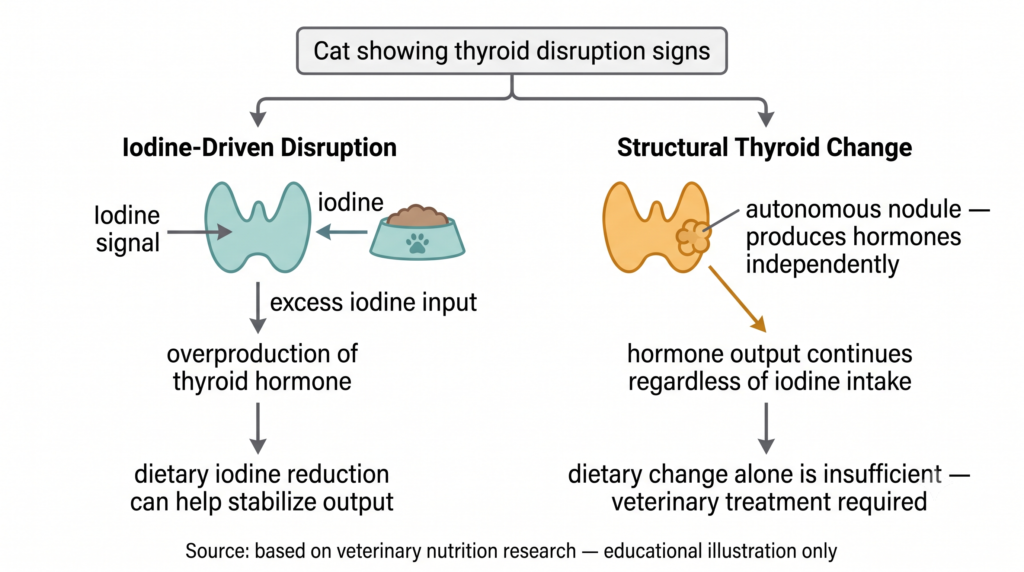
Dietary iodine reduction can lower thyroid hormone levels in some cats when excess iodine intake contributes to the problem. However, whether a diet change is enough depends on how advanced the thyroid disruption has become. Earlier action may allow diet to play a more meaningful role.
Studies on iodine-restricted diets show that TT4 (total thyroxine, the thyroid hormone most often measured in cats) levels can return to the normal range in some cats when they eat the diet exclusively. Research has shown that this response may happen within 8 to 16 weeks in affected cats.
A controlled trial from the University of Bologna, published in the Journal of Feline Medicine and Surgery, found that an iodine-restricted diet could be an option instead of medication for some cats with confirmed hyperthyroidism. This was especially true for indoor-only cats where owners could maintain strict feeding consistency.
These results show that diet changes can help, but they also come with an important condition. The diet must be fed exclusively, without treats, shared meals, or high-iodine supplements that could affect the results.
Diet changes are most likely to help when thyroid disruption mainly comes from iodine imbalance and has not caused structural changes in the thyroid gland. This means the gland is responding to iodine levels rather than producing hormones independently because of formed nodules.
Once structural changes develop, diet management usually becomes an additional support rather than a complete solution. Many owners ask whether changing cat food helps with thyroid problems, and the answer is that it can help in some cases. However, the amount of improvement depends on the cause of the thyroid issue, which only your vet can identify.
The best way to view diet change is this: it is not a cure. It reduces ongoing iodine stress and may create a better environment for the thyroid to stabilize.
Do not assume the thyroid problem has resolved just because your cat gains weight or seems more comfortable. Follow-up testing is still important after a diet change. Your vet can help determine whether dietary management is enough for your cat’s situation.
Should I Change My Cat’s Diet First or Do A Vet Visit?
Choosing between reviewing your cat’s diet and scheduling a vet visit is not an either/or decision. The right first step depends on the timing and urgency of the symptoms you see. When symptoms allow, both actions should happen together.
If symptoms are mild and develop slowly, such as gradual weight changes, small behavior shifts, or slightly less interest in play, you can review the current diet and schedule a vet appointment within one to two weeks. During this time, note the food brand and variety, check the ingredients for marine proteins or kelp, and write down when each symptom first appeared.
Many owners wonder whether I should change cat food for thyroid concerns before seeing the vet. A careful review of the diet and possible reduction of obvious high-iodine sources may be reasonable. However, avoid making major food changes before the appointment.
If symptoms are more moderate, such as steady weight loss over two to four weeks, clear behavior changes, or a worsening coat condition, schedule a vet visit this week. Do not wait another couple of weeks to see if things improve.
If symptoms are sudden or severe, such as neck swelling, very fast weight loss in less than two weeks, extreme behavior changes, or complete loss of appetite, the vet visit becomes the top priority. These signs need professional evaluation before any diet changes. If you are asking what to do if my cat shows thyroid symptoms and the symptoms are severe, contact your vet or an emergency veterinary clinic today.
Before the appointment, gather important details about your cat’s diet. Write down the brand, variety, feeding amount, feeding schedule, recent food changes, and when symptoms started.
If you change the diet before the vet visit, even slightly, record what changed and when it happened. This information can help your vet understand the full picture. The goal is not to choose between diet and veterinary care. It is to use both approaches with the right level of urgency.
Knowing how to make this first decision can make the next step feel easier. Once dietary adjustment becomes part of your plan, the way you change the food matters as much as the food you choose. A sudden switch can create more iodine disruption, which is why the next section focuses on making changes safely.
Symptom Severity and Action Timeline Decision Matrix
| Severity Tier | Specific Observable Signs That Place Your Cat Here | Vet Appointment Timeframe | Dietary Review Appropriate Now? | Specific Dietary Information to Gather Before the Appointment | What NOT to Do Before the Appointment |
|---|---|---|---|---|---|
| Tier 1: Mild and Gradual | Weight loss noticed over 4 or more weeks and progressing slowly. Appetite unchanged or mildly increased. Coat slightly less glossy but not matted. Behavioral changes mild — slightly less playful or slightly more vocal at night. No single sign feels urgent on its own. No visible neck changes. | Within 1 to 2 weeks — a routine scheduled appointment is appropriate. Do not delay beyond 2 weeks even if symptoms seem stable. | Yes — dietary review can and should begin now, running in parallel with scheduling the appointment. | Current food brand, variety name, and format (wet or dry). Primary protein listed first on the ingredient panel. Whether any marine proteins (fish, salmon, tuna, whitefish, cod) appear in the top five ingredients. Whether kelp, seaweed, or fish broth appear anywhere in the ingredient list. How many different brands have been fed in the past 3 months. Whether treats are fish-based. | Do not make an abrupt food switch before the appointment. Do not add supplements. Do not introduce new food components. A gentle reduction of obvious high-iodine sources is reasonable — a complete dietary overhaul is not. |
| Tier 2: Moderate | Consistent weight loss over 2 to 4 weeks that has not stabilized. Appetite noticeably increased or beginning to decrease. Coat visibly unkempt, matted, or greasy. Behavioral changes noticeable to others — restlessness, increased vocalization, reduced interaction. Increased thirst or urination observed. Two or more of the above signs present at the same time. | This week — aim for an appointment within 3 to 5 days. If your vet cannot see you within that window, ask to be placed on a cancellation list or request a telehealth triage call. | Yes — gather dietary information now, but do not change food before the appointment unless a specific high-iodine source is very obvious and a gradual reduction is possible without disrupting the diagnostic baseline. | Everything in Tier 1 above, plus: the full list of all treats, dental chews, and supplements currently being given. Whether any other pets in the household share food with this cat. Whether the cat has access to outdoor hunting or scavenging. The exact timeline — write down when each specific sign was first noticed, even approximately. | Do not start a new food, a new supplement, or a new treat before the appointment. Do not interpret moderate symptoms as a reason to delay — moderate signs can progress. If symptoms worsen before the appointment date, move to Tier 3 action immediately. |
| Tier 3: Acute and Severe | Visible or palpable lump or swelling near the throat or neck area. Rapid weight loss over less than 2 weeks. Complete or near-complete refusal to eat for more than 24 hours. Extreme behavioral change — severe agitation, disorientation, or collapse. Labored or rapid breathing. Any single sign in this row is sufficient to act — you do not need multiple signs present. | Today — contact your vet or an emergency veterinary clinic now. Do not wait for a routine appointment. If your regular vet cannot see your cat same-day, go to the nearest emergency veterinary clinic. | No — dietary review is secondary until your cat has been assessed by a vet. Do not spend time on label reading or food changes before making the call. | Bring whatever food information is immediately available — the current food bag or can, or a photo of the ingredient label taken on your phone. Do not delay contacting the vet in order to gather more complete food information. | Do not change food, add supplements, or attempt any home treatment before the vet has assessed your cat. Do not wait to see if symptoms improve on their own. Do not look for more signs before acting — one sign from this tier is enough. |
Switching to a Thyroid-Safe Diet Takes a Careful Plan
The decision to adjust your cat’s diet is only half of the process. The other half is making the change the right way. A food transition that happens too quickly can upset your cat’s stomach. If you suspect a thyroid problem, it can also cause sudden iodine changes that the thyroid may struggle to handle.
This section explains how to transition to a new food safely, what a realistic improvement timeline looks like, and why staying consistent with the new diet is essential. Once the new food is in place, following the feeding plan closely is not an optional extra. It is the reason the dietary approach has the best chance to work.
The sections below explain the transition process step by step, how long improvement may realistically take, and why even one off-diet meal can matter more than it first appears.
How to Switch My Cat’s Thyroid Diet Safely?
Switching your cat to a thyroid-safer food requires a gradual change. This is not because cats are naturally fussy. A sudden iodine change can add more disruption to the problem you are already trying to reduce. The goal is to reduce iodine swings, not to change everything at once.
Many pet parents feel the idea of switching food feels risky when she is already unwell, and that concern is understandable. A sudden food change can cause digestive upset from a new protein source. It can also create an immediate iodine shift that the thyroid cannot adjust to gradually. Cats respond best when the thyroid sees a consistent nutrient pattern, so a slow transition helps create the stable baseline you are working toward.
A gradual transition over 7 to 14 days is usually recommended. Note the current food before changing anything and keep the old and new food labels for comparison. This information is also helpful for your vet.
Start with 75% old food and 25% new food for days one through three. Move to a 50/50 mix for days four through six. Feed 25% old food and 75% new food for days seven through nine. By days ten through fourteen, your cat should be eating only the new food.
Make food changes slowly unless your vet says otherwise. If digestive upset develops, stay at the current ratio for another two or three days before increasing the new food. Use the same feeding plan for every meal if possible so daily iodine intake stays as consistent as possible.
If your cat’s current food is very high in iodine and the new food contains much less, consider extending the transition to 14 to 21 days. A slower change lowers the chance of a sudden iodine drop, which may create its own disruption. She has already been through enough without a rough food change. Cats are sensitive to changes in texture, temperature, and smell, so a slower transition respects those preferences.
During the transition, avoid adding extra iodine sources. Fish-based treats, tuna toppers, and seaweed supplements can interfere with the process. Keep other pets away from the approved food during meals because access to another cat’s fish-based food can interrupt an otherwise successful transition.
Keep a short log of what she eats and how she responds. Record the food ratio, whether your cat accepted the meal, and any physical or behavior changes you notice. Keep the transition simple enough that everyone in the home can follow it. If a family member or pet sitter also feeds your cat, make sure they understand the plan.
One owner, Linda, noticed that her eleven-year-old Ragdoll had become restless and was leaving food in her bowl more often. While checking food labels, she found that salmon was the first ingredient in the foods she had been rotating for months. She gradually switched her cat to one chicken-based wet food over three weeks. By the end of the second week, her cat was finishing meals more consistently.
Some cats do not accept new foods easily. If that happens, slow the transition even more. You can also add a small amount of low-sodium, unseasoned chicken broth without onion, garlic, or iodized salt to improve the food’s appeal.
If your cat takes medication or already has a confirmed thyroid diagnosis, talk with your vet before changing the diet. Food changes can affect how some medications work and may also influence follow-up test results. Confirm whether a food change should wait until after testing. Your vet may want baseline results while your cat is still eating the current food.
How Long Until Improvement After a Diet Change?
A dietary change does not produce immediate results. The thyroid does not reset instantly after a food change, and your cat’s body may need several weeks before you see measurable improvement. Understanding this timeline helps you avoid judging the results too early.
Research published in peer-reviewed veterinary journals found that cats eating iodine-restricted diets showed measurable reductions in TT4 levels within 8 to 16 weeks of exclusive feeding. This is the earliest meaningful time to evaluate the diet. Do not assume the approach is not working if you see little change after only four weeks.
A food change may need time before the body shows a visible response. Thyroid regulation happens gradually as the gland adjusts to a new iodine level. This process takes time and does not happen overnight.
Behavior changes may appear before hormone changes show up in bloodwork. Many owners notice less nighttime restlessness, calmer behavior, and less vocalization before follow-up test results improve.
Watch for changes after each meal, not just over a week. Keep a short log of what she eats and how she responds. This record can help you see gradual progress that may be easy to miss from day to day.
Weight stabilization is often the first physical sign that the diet is helping. Once weight loss stops, healthy weight gain may follow later, although it usually takes more time.
A carefully chosen diet can reduce the burden on the thyroid over time. However, the process takes longer if the diet is not followed exclusively. Treats, shared food, or accidental food changes can interrupt the iodine balance and delay progress.
The improvement timeline also depends on how long the iodine imbalance existed before the diet changed and whether structural thyroid changes have already developed.
Set realistic expectations. Diet changes slowly correct a problem that often developed slowly over time. Many owners ask how long it takes to see improvement after changing cat food for thyroid. Research suggests that 8 to 16 weeks of strict, exclusive feeding is the most meaningful period before evaluating progress with bloodwork. Follow-up testing at the time recommended by your vet is the best way to confirm whether the diet is working.
Why One Bite of the Wrong Food Breaks the Diet?
A controlled iodine diet works by creating a stable, low daily iodine intake. Even one high-iodine meal can interrupt that balance after the thyroid has adjusted to it. This is not just a precaution. It is one of the main reasons home-managed iodine diets may fail.
After several weeks on a low-iodine diet, the thyroid adjusts to that steady iodine level. A sudden high-iodine meal, such as fish-based treats, a bite of another cat’s tuna food, or seafood table scraps, can disrupt that balance. This may trigger the Wolff-Chaikoff response, a temporary protective reduction in thyroid hormone production after excess iodine intake. Even if the amount seems small, the disruption can still be meaningful.
Research on iodine-restricted diets has identified cross-feeding as a leading reason for diet change response failure in homes with more than one cat. Peer-reviewed veterinary studies found that even small amounts of non-controlled food could prevent the diet from producing its intended stabilizing effect. Even a small amount of the wrong food can matter when the diet is tightly controlled. One bite can introduce enough iodine to disrupt a carefully managed pattern.
Treats are one of the most common sources of accidental iodine exposure. Fish-based treats, dental chews made with fish meal, and flavored medications with fish coatings may all contain meaningful amounts of iodine.
Set out only the approved food so mistakes are less likely. Keep fish-based foods, treats, and toppers away from the feeding area whenever possible. A simple rule can help: if your cat is eating something other than the approved diet, check its iodine content before offering it.
Keep other pets away from the approved food works both ways. If your cat on the controlled diet can eat another pet’s high-iodine food, the dietary plan is no longer fully controlled, even if it happens by accident.
Many owners ask how strict thyroid cat food is. The answer is that it should be as strict as the diet requires to maintain a consistent iodine intake. This level of control is not arbitrary. It is how the dietary approach is designed to work. If your cat eats a prescription iodine-restricted diet, ask your prescribing veterinarian before giving treats, supplements, or any other food items.
The transition protocol tells you how to change; the next section covers what to change to. These are the specific dietary approaches most appropriate when iodine-related thyroid disruption is suspected, including whether a formally prescribed low-iodine cat food is necessary or whether a general dietary reduction is the right starting point.
What to Feed a Cat With Thyroid Issues
Knowing that diet matters is only the first step. The next step is deciding what to put in your cat’s bowl. This section moves from the basic principles to practical feeding choices. It explains natural dietary approaches that support iodine balance, when a prescribed low-iodine diet may be appropriate, and how wet and dry food can affect iodine intake in cats with thyroid concerns.
The focus is on general feeding principles rather than specific brands. That makes this guidance useful no matter where you live or which diet your veterinarian ultimately recommends.
What Are Natural Foods for Thyroid Issues?
A food-based approach to iodine management uses diet to reduce iodine intake instead of medication to suppress thyroid function. It can be a reasonable starting point when thyroid disruption is suspected but not yet confirmed. The foundation is a consistent, predictable protein source, not simply removing one ingredient.
When owners search for natural food for cat thyroid or what foods are good for cat thyroid, the word “natural” refers to food-based iodine management rather than medication. It does not mean raw, organic, or minimally processed. This distinction matters because “natural” labels do not indicate iodine control. The ingredient list, not the marketing claim, tells you more about iodine content.
A practical approach is to choose a single-protein, poultry-based food. Chicken or turkey should be the primary, and ideally the only, animal protein. Avoid added marine proteins, kelp, seaweed, and fish meal. This type of diet provides a more predictable iodine intake than fish-based foods or frequently rotated multi-protein formulas. Veterinary guidance from Cornell University College of Veterinary Medicine notes that dietary factors, including protein sources and their associated mineral balance, may contribute to feline thyroid health. That makes protein selection a clinically relevant decision, not just a nutrition preference.
Whole or minimally processed ingredients are not automatically lower in iodine. A premium fish-based food can still provide a high and variable iodine intake. Check the ingredient list carefully for marine proteins. Salmon, tuna, cod, whitefish, herring, mackerel, sardines, ocean fish, and fish meal are all higher-iodine ingredients, regardless of how the product is marketed. Likewise, kelp, seaweed, spirulina, and dulse are significant iodine sources that are best avoided when iodine management is the goal.
For cats that have eaten fish-based food for a long time, the switch to a poultry-based diet should follow the gradual transition protocol described in H2 2. Many owners ask what foods are good for cat thyroid and expect a specific product name. A better long-term answer is a clear set of criteria: a single- or dual-protein poultry formula, no marine ingredients, no kelp, and consistent feeding without frequent rotation. Understanding these criteria first helps you compare the current food before introducing anything new.
Raw diets are not automatically better for iodine management. Simple raw poultry muscle meat may provide an appropriate iodine level. However, raw diets with large amounts of organ meat, seaweed-based supplements, iodized salt, or pre-mixed seasoning blends may contain iodine levels that are as high as, or even higher than, commercial fish-based foods. If you are considering a raw diet, review the full ingredient and supplement list for iodine content before assuming it is a lower-iodine option. Once your cat receives a formal diagnosis, what foods are good for cat thyroid becomes a more specific clinical question that you should discuss with your veterinarian.
Should I Switch to Low Iodine Cat Food?
A formally restricted low iodine cat food, such as a veterinary therapeutic diet with a controlled iodine range, is a more intensive option than a general poultry-based diet. It is not automatically necessary for every cat with a suspected thyroid concern. Whether it is appropriate depends on the severity of the confirmed condition and your vet’s clinical assessment.
Many owners wonder whether I should change cat food for thyroid before a diagnosis is confirmed. The key distinction is between two levels of dietary management. One is a general reduction approach, which removes obvious high-iodine ingredients and uses a consistent poultry-based diet. The other is a therapeutic approach that uses a prescription diet with a carefully controlled low iodine level, like those used in clinical studies of feline hyperthyroidism. These approaches serve different purposes and are not interchangeable.
Veterinary therapeutic iodine-restricted diets have shown positive results in peer-reviewed studies, including a one-year study published in veterinary internal medicine literature and a controlled trial from the University of Bologna. These studies found that TT4 levels returned to the reference range in many cats with early-stage thyroid dysfunction when they ate the diet exclusively. Research published in the Journal of Feline Medicine and Surgery also found that the therapeutic diet could be a practical alternative to methimazole, an oral medication that blocks the thyroid’s use of iodine to produce hormones, in some cats with confirmed hyperthyroidism. This was especially true for indoor cats that could stay on the diet without interruption.
The choice between a therapeutic low iodine diet and a general iodine reduction plan should always follow veterinary guidance. Therapeutic diets are meant for cats with confirmed and significant thyroid disease. They are not recommended as a precaution for every cat with suspected thyroid concerns.
There is also a practical issue to consider. A therapeutic low iodine diet must be fed exclusively. That means no treats, table scraps, or other foods. This level of feeding consistency can be difficult for some households. It can be especially challenging in homes with multiple cats that share food.
Can food affect a cat’s thyroid? Yes. Can changing cat food help with thyroid problems? Yes, but the amount of benefit depends on what your vet finds during the evaluation. If a therapeutic diet is not yet needed and the goal is simply to lower obvious iodine intake while waiting for a diagnosis, a poultry-based commercial food with no marine proteins or kelp is a reasonable option. Feed it consistently and avoid frequent rotation. Whether to move to a therapeutic diet is a decision to discuss with your veterinarian, not one to make based only on online information.
Does Wet or Dry Food Change Iodine Levels?
For a cat with a suspected thyroid issue, the choice between wet and dry food involves more than iodine alone. It also affects hydration, calorie intake, and how consistently your cat eats the planned diet each day. Both options can work, but each has different advantages and considerations.
Many owners ask whether wet food has less iodine or is dry cat food is high in iodine. The answer is that iodine depends more on the protein source than on the food format. A fish-based wet food and a fish-based dry food are both high in iodine. However, wet and dry foods can differ in moisture, concentration, and mineral delivery, and those differences matter for cats with thyroid concerns. Wet food also supports hydration. This can be helpful because thyroid disease often increases water intake and may occur alongside kidney disease in older cats.
Does wet food have less iodine? The short answer is no. The ingredient list, not the format, determines iodine content. A poultry-based wet food with no marine proteins is often the preferred choice for a cat with thyroid concerns if the cat accepts it. It provides a more controlled iodine intake, supports hydration, and is often easier for an underweight cat to eat in adequate amounts. Dry food is more calorie-dense per gram. However, a cat with thyroid-related weight loss may not eat enough dry food to meet her calorie needs, which can make weight loss worse.
Mixed feeding, using both wet and dry food, makes iodine control more difficult. Each food contributes a different amount of iodine, so it becomes harder to estimate the total daily intake. If you choose a mixed-feeding plan, evaluate both foods for iodine content and consider the combined daily total. Feeding consistency is usually easier to maintain with one food format, especially when more than one person feeds the cat.
Carlos fed his middle-aged Abyssinian a rotating mix of wet and dry foods. Several of those foods listed tuna or whitefish near the top of the ingredient list. During a routine weigh-in, his veterinarian suggested switching to one turkey-based wet food and stopping the rotation. Within a month, Carlos noticed his cat no longer woke him at night and seemed calmer at mealtimes. If your cat has always eaten dry food and refuses wet food, do not force the switch. Choose the dry food your cat will reliably eat and focus on the protein source and iodine content instead.
For cats with a confirmed thyroid condition, discuss the food format with your veterinarian. Hydration needs, calorie goals, and possible medication interactions all affect the best choice.
Diet is one part of managing a suspected thyroid problem at home. The next step is working with your veterinarian. The following section explains which tests to ask about, which questions to bring to the appointment, and how to make the most of your visit.
A Vet’s Input Is Essential for Diagnosis and Timing
Diet is the part you can review and adjust at home. Vet testing helps separate a thyroid problem from a food concern, and dietary changes alone cannot confirm what is causing your cat’s symptoms. Without veterinary testing, you cannot know whether the thyroid is responding or whether another condition is responsible.
This section completes the action plan by explaining what tests vets run for thyroid, what vet test shows cat thyroid problem, and what blood test for cat thyroid is commonly used. It also covers what should i ask vet about cat food, what should I tell vet about cat food, and cat food and thyroid questions for vet so you can prepare for the appointment with confidence. Finally, it explains when to call the vet for cat thyroid symptoms, how soon cat thyroid should be checked, and how to judge the urgency based on your cat’s signs.
Every point focuses only on what to ask and what to expect during the veterinary visit. It does not discuss treatment plans or medication recommendations.
What Vet Test Checks Iodine and Thyroid?
The most common first test for suspected thyroid disease in cats is a blood panel measuring total thyroxine. Knowing the test name helps you ask for it during a routine wellness visit instead of waiting for your vet to suggest it. Bloodwork gives a snapshot of hormone activity, not the full story by itself, but it is the most practical and informative place to start.
TT4, or total thyroxine, is the thyroid hormone most commonly measured in cats. It reflects the total amount of thyroid hormone circulating in the blood. According to VCA Animal Hospitals, vets usually begin by measuring TT4 because it clearly identifies many cats with an overactive thyroid.
If you are wondering what blood test for cat thyroid concerns is most common, TT4 is usually the first choice. You can also ask, “Can we include a T4 or fT4 panel in today’s bloodwork?” Routine wellness testing does not always include these tests, especially for younger adult cats.
fT4, or free T4, measures the unbound and biologically active portion of thyroxine. This is the hormone that is available to act on the body’s tissues. It is more sensitive than TT4 for detecting early or borderline thyroid changes.
VCA Animal Hospitals explains that when TT4 falls within the upper end of the normal range but symptoms continue, a free T4 by equilibrium dialysis is often the next recommended test. This laboratory method separates free hormone from bound hormone for a more accurate reading. That is why a normal TT4 result does not always rule out a thyroid problem. The fT4 result may detect changes that TT4 misses.
TSH, or thyroid-stimulating hormone, is produced by the pituitary gland and signals the thyroid to make more hormone. Measuring TSH adds another layer of diagnostic information. A high TSH with a low T4 suggests an underactive thyroid pattern. A low TSH with a high T4 supports an overactive thyroid pattern.
Together, TT4, fT4, and TSH provide a clearer picture of thyroid function. They show both hormone levels and how the body’s feedback system is working. TT4 and fT4 are the lab values most often used to assess thyroid hormone levels, making them the key thyroid hormone markers in a standard feline endocrine evaluation.
Thyroid scintigraphy is a nuclear imaging test that shows how active the thyroid tissue is. It tracks the uptake of a small amount of radioactive material into the thyroid gland. As the keyword states, scintigraphy can show how active the thyroid tissue is in some cases.
This test is usually available only through specialty centers. It provides detailed information about thyroid structure and thyroid activity, including areas of abnormal tissue function. If you are asking what vet test shows cat thyroid problem most accurately, thyroid scintigraphy is considered the most specific option, although it is not the first test most cats need.
Finally, lab interpretation is just as important as the testing itself. Always review the results with your veterinarian. The same thyroid value may have different meanings depending on your cat’s age, overall health, and the laboratory’s reference ranges. Following veterinary guidance helps ensure the results are interpreted correctly.
What Questions Should I Ask My Vet?
Arriving at your vet appointment with prepared questions leads to a more productive conversation than simply describing a general concern. The questions below help you discuss both diet and thyroid health without needing to know the answers in advance. Their purpose is to help you take an informed role in the discussion instead of waiting for the vet to guide every topic.
Many owners feel they want to ask the vet the right question the first time. A short list makes that much easier. Save the questions on your phone, print them, or write them down before the visit. Bring a photo of the label to the appointment, including the front of the package and the ingredient list, so the vet can review the protein sources and identify any obvious iodine concerns.
Here are the most useful questions to ask during a thyroid-related appointment:
- “Can we include a T4 or fT4 panel in today’s bloodwork, based on the symptoms I have described?” This starts the conversation with the hormone testing that best matches what you have observed.
- “Based on her current food, do you think her iodine intake could be contributing to these signs?” This opens the discussion about diet and shows that you have already reviewed the ingredient list.
- “If we reduce the iodine in her diet, what changes should I expect, and how long might they take?” This helps set realistic expectations and creates a clear timeline for monitoring progress.
- “Is a therapeutic iodine-restricted diet appropriate now, or is a general dietary reduction enough?” This helps separate two different levels of dietary management and avoids moving to a prescription diet before it is needed.
- “What should I feed as a treat or supplement while keeping iodine controlled?” Many owners forget this question, but it is one of the most important. Treats and supplements are common sources of accidental iodine exposure.
- “When should we repeat her thyroid testing after starting the new diet?” This creates a follow-up plan based on bloodwork instead of observation alone.
These questions cover the topics most owners need during cat food and thyroid questions for vet discussions. They also work well as a cat diet question for vet checklist. Finally, ask the vet which lab values they want to track at future visits. This gives every follow-up appointment a clear goal and supports better veterinary guidance over time.
What to Do If My Cat Shows Symptoms of Thyroid Issues?
The right first step when thyroid symptoms appear is to contact your vet. The timing depends on how severe the symptoms are, but the need to make contact does not change.
When she is not acting like herself, and I want to know why, it is worth trusting that instinct. Many owners feel I keep second-guessing whether I am overreacting, but one symptom is enough to make me want a second opinion. A pattern of symptoms makes a vet appointment even more important. The severity of the symptoms determines how quickly you should be seen, not whether you should call.
If symptoms are mild and develop gradually, such as slow weight changes over several weeks, small behavior changes, or slightly lower activity, schedule an appointment within one to two weeks. While you wait, review the ingredient list for high-iodine ingredients, including fish as the main protein, fish meal, kelp, or seaweed. You can also begin a gradual switch to a poultry-based food using the protocol in H2 2. Call sooner if symptoms are getting worse instead of stable, because worsening signs change the timeline from “this week” to “today.”
If symptoms are moderate, such as steady weight loss over two to four weeks, clear behavior changes, or a declining coat condition, book a vet appointment this week. Do not wait longer than a few days. Before the visit, gather the brand and variety of every food your cat eats, portion sizes, feeding schedule, and a timeline of when each symptom began. Write down the food brand, flavor, and can or bag size so you do not have to rely on memory during the appointment.
If symptoms are severe, such as a visible lump in the neck, rapid weight loss within two weeks, extreme behavior changes, or complete refusal to eat, contact your vet or an emergency veterinary clinic today. These signs need immediate medical evaluation. Diet should become a secondary concern until your vet has assessed the situation. Do not start supplements, introduce new foods, or change the diet before the appointment. Making changes before an initial assessment can make the results harder to interpret.
No matter how urgent the appointment is, a few simple steps will help. Note the current food before changing anything. Keep the old and new food labels for comparison. Record when each symptom started, and bring a photo of the label to the appointment. Also, ask whether the current food can be reviewed by your vet before making any dietary changes. In some cases, especially if your cat is taking medication or is about to have bloodwork, your vet may recommend keeping the current diet the same until testing is complete.
The four sections above cover the full action sequence from first decision through vet engagement. The questions below address the specific practical details that come up most frequently at this stage of the journey.
Conclusion
When your cat’s thyroid may be affected by what she eats, the path forward is clearer than it may seem. Review her diet, transition carefully if a change is needed, feed a consistent diet that is low in marine iodine, and involve your vet with the right tests and questions. These steps help make the conversation more productive.
Diet is a meaningful tool, but it works slowly. It also requires consistent feeding and works best alongside professional monitoring rather than replacing it. Whether your goal is reducing iodine intake, supporting a more stable thyroid environment, or preparing for a diagnostic appointment, each step in this article helps move you forward without creating unnecessary disruption.
If you have followed this guide from the beginning, you now understand the full picture. You have learned how to recognize symptoms, understand the biology, adjust the diet, and prepare for the next step. Your next step is your vet.
What to Watch For
Before the appointment: what to observe and record
- Whether your cat is losing weight despite eating the same amount or more.
- Any changes in how much water she drinks or how often she urinates.
- Changes in behavior, including restlessness, nighttime vocalization, reduced interaction, or increased anxiety.
- The condition of her coat, including whether it looks unkempt, matted, or less glossy than usual.
- Any visible or noticeable swelling in the neck area.
- The exact timeline of when you first noticed each symptom.
Before the appointment: what to prepare
- The brand name, variety, and format (wet or dry) of every food your cat eats.
- A photo of the ingredient panel for each food.
- Approximate portion sizes and feeding frequency.
- A record of any recent food changes, including when they happened.
- A list of any treats, supplements, or medications your cat currently receives.
Questions to bring to the appointment
- Whether a T4 or fT4 panel can be included in the bloodwork.
- Whether the protein sources in your cat’s current food are worth reviewing.
- What a realistic improvement timeline looks like after a dietary change.
- When thyroid levels should be retested after a diet or treatment change.
- Which treats or supplements are safe to continue if iodine control becomes the goal.
Frequently Asked Questions
FAQ 1: Can I manage my cat’s thyroid issue with diet alone without medication?
In early-stage iodine-driven thyroid disruption without structural gland changes, dietary iodine reduction has been shown in peer-reviewed veterinary research to normalize thyroid hormone levels in some cats without medication. Whether diet alone is sufficient depends entirely on the individual cat’s test results and the degree of gland involvement — this is a determination that must be made by a veterinarian, not by the owner. Please consult your vet before treating any thyroid concern with diet alone.
FAQ 2: My cat refuses the new food — what should I do?
Food refusal during a diet transition is common and should not be forced. Slow the transition ratio further — staying at 90% old food and 10% new food for several days before advancing — and consider adding a small amount of low-sodium, unseasoned chicken broth to the new food to increase acceptance. If the cat refuses to eat entirely for more than 24 hours, contact your vet, as prolonged food refusal in cats carries its own health risk independent of the thyroid concern.
FAQ 3: How will I know if the diet change is working?
Early positive signs may include weight stabilization, reduced nighttime restlessness, and a calmer daytime demeanor — and these behavioral shifts may appear before blood test values normalize. Objective confirmation requires a follow-up thyroid panel at the interval your vet recommends, typically within the 8 to 16 week window after the diet change is fully implemented and strictly maintained. Your vet is the right person to interpret whether the numbers reflect genuine improvement.
FAQ 4: Should I stop giving treats entirely while managing my cat’s iodine intake?
Treats do not need to be eliminated, but they do need to be iodine-evaluated before continuing. Poultry-based treats with no fish ingredients, no kelp, and no iodized salt are generally compatible with a controlled iodine approach. Fish-based treats, dental chews containing fish meal, and any treat listing seaweed should be paused until their iodine content is confirmed — and if your cat is on a veterinary therapeutic diet, all treats should be approved by your vet before use.
FAQ 5: Can stress or other factors cause the same symptoms as iodine-related thyroid disruption?
Yes — weight loss, behavioral changes, and coat deterioration can have many causes, including stress, dental pain, kidney disease, diabetes, and parasites, and iodine-related thyroid disruption is one possibility on a list your vet will systematically evaluate. Do not assume diet is the cause and delay a proper diagnostic workup — dietary adjustment and veterinary investigation should happen in parallel, not in sequence. Your vet is best placed to determine what is actually driving the symptom picture.
Disclaimer: This article is written for educational purposes only and does not replace professional veterinary advice. All referenced sources were used to inform general educational content they do not constitute veterinary guidance for any individual cat. If you are concerned about your cat’s thyroid health or iodine intake, please consult a licensed veterinarian before making any dietary changes.
References and Sources
The information in this article draws on the following veterinary, institutional, and peer-reviewed sources. All sources were selected for their relevance to feline thyroid health, iodine nutrition, and dietary management in cats. This article is educational in nature and does not constitute veterinary advice.
Veterinary Institutional Sources
Cornell University College of Veterinary Medicine
Feline Health Center — Hyperthyroidism in Cats
Information on contributing dietary and environmental factors in feline thyroid disruption, clinical signs, diagnosis, and treatment options including dietary iodine restriction.
Available at: https://www.vet.cornell.edu/departments-centers-and-institutes/cornell-feline-health-center/health-information/feline-health-topics/hyperthyroidism-cats
Cornell University College of Veterinary Medicine
Internal Medicine Service — Feline Hyperthyroidism
Clinical overview of feline hyperthyroidism including symptom profile, diagnostic approach, and the iodine-restricted diet as a treatment option with strict exclusivity requirements.
Available at: https://www.vet.cornell.edu/hospitals/services/internal-medicine-0/feline-hyperthyroidism
VCA Animal Hospitals
Hyperthyroidism in Cats
Guidance on TT4 as the primary initial diagnostic test, the role of free T4 by equilibrium dialysis as a confirmatory test, and the relationship between untreated hyperthyroidism and kidney disease.
Available at: https://vcahospitals.com/know-your-pet/hyperthyroidism-in-cats
Merck Veterinary Manual
Disorders of the Thyroid Gland in Cats — Cat Owners Version
Revised September 2024. Information on naturally occurring hypothyroidism as extremely rare in cats, iatrogenic hypothyroidism following treatment for hyperthyroidism, and the role of iodine in thyroid hormone synthesis.
Available at: https://www.merckvetmanual.com/cat-owners/hormonal-disorders-of-cats/disorders-of-the-thyroid-gland-in-cats
Professional Veterinary Guidelines
American Animal Hospital Association (AAHA)
2023 AAHA Selected Endocrinopathies of Dogs and Cats Guidelines — Feline Hyperthyroidism Therapy
Identifies four treatment options for feline hyperthyroidism including radioactive iodine, anti-thyroid medication, surgical removal, and iodine-deficient therapeutic diet. States radioactive iodine as the treatment of choice, achieving a cure in more than 95% of cases. Notes that untreated hyperthyroidism will eventually be fatal.
Available at: https://www.aaha.org/resources/2023-aaha-selected-endocrinopathies-of-dogs-and-cats-guidelines/therapy-4/
American Animal Hospital Association (AAHA)
2023 AAHA Selected Endocrinopathies of Dogs and Cats Guidelines — Feline Hypothyroidism
Guidance on feline hypothyroidism including iatrogenic causes following hyperthyroidism treatment.
Available at: https://www.aaha.org/resources/2023-aaha-selected-endocrinopathies-of-dogs-and-cats-guidelines/feline-hypothyroidism/
American Animal Hospital Association (AAHA)
2023 AAHA Selected Endocrinopathies of Dogs and Cats Guidelines — Categorical Approach to Diagnosis Based on Clinical Presentation
Guidance on TT4, fT4, TSH, and T3 suppression testing in the diagnostic sequence for feline hyperthyroidism, including reference laboratory recommendations for monitoring.
Available at: https://www.aaha.org/resources/2023-aaha-selected-endocrinopathies-of-dogs-and-cats-guidelines/categorical-approach-to-diagnosis-based-on-clinical-presentation-4/
American Association of Feline Practitioners (AAFP)
2016 AAFP Guidelines for the Management of Feline Hyperthyroidism
Published in PMC. Notes epidemiological associations between environmental compounds and feline hyperthyroidism, and identifies bilateral thyroid disease as supporting dietary and environmental etiologies. Referenced for the guideline finding that hyperthyroidism affects approximately 10% of cats over age 10.
Available at: https://pmc.ncbi.nlm.nih.gov/articles/PMC11132203/
Peer-Reviewed Research — Iodine and Feline Thyroid Health
Edinboro CH, Scott-Moncrieff JC, Glickman LT
Feline Hyperthyroidism: Potential Relationship with Iodine Supplement Requirements of Commercial Cat Foods
Journal of Feline Medicine and Surgery, 2010 September, Volume 12, Issue 9, Pages 672 to 679
Published in PMC. Foundational research on the association between dietary iodine content and feline hyperthyroidism, and the parallel between feline thyroid disease and iodine-induced thyrotoxicosis in humans.
Available at: https://pmc.ncbi.nlm.nih.gov/articles/PMC11149000/
Scientific Reports (Nature Publishing Group)
Estimating Short and Longer-Term Exposure of Domestic Cats to Dietary Iodine Fluctuation
Published May 2022. Confirms hyperthyroidism as the most common endocrinopathy of domestic cats. Documents proposed risk factors including dietary factors and iodine fluctuation in commercial foods. Notes striking similarities between feline hyperthyroidism and human toxic nodular goiter in iodine-deficient areas.
Available at: https://www.nature.com/articles/s41598-022-13139-8
Also available at: https://pmc.ncbi.nlm.nih.gov/articles/PMC9148307/
van Zuiden B, Santarelli G, Galac S, Kooistra HS, Szatmári V
Cardiac Abnormalities in Feline Hyperthyroidism
Veterinary Sciences, Volume 12, Issue 12, Article 1115. Published November 2025. Utrecht University, Faculty of Veterinary Medicine.
Documents cardiac changes in hyperthyroid cats including hypertrophic cardiomyopathy and heart failure risk, and confirms that cardiac changes caused by hyperthyroidism can be cured with treatment, making thyroid testing in cats with suspected heart disease important.
Available at: https://www.ncbi.nlm.nih.gov/pmc/articles/PMC12737610/
Peer-Reviewed Research — Iodine-Restricted Dietary Treatment
Scott-Moncrieff JC et al. (Purdue University / VCA West Los Angeles Animal Hospital)
Effect of Feeding an Iodine-Restricted Diet in Cats with Spontaneous Hyperthyroidism
Journal of Veterinary Internal Medicine. Retrospective case series of 49 client-owned cats. Examined the effect of exclusive iodine-restricted diet feeding on TT4 concentrations and clinical signs in cats with spontaneous hyperthyroidism.
Available at: https://pmc.ncbi.nlm.nih.gov/articles/PMC4895365/
Fracassi F et al. (University of Bologna)
Iodine-Restricted Food Versus Pharmacological Therapy in the Management of Feline Hyperthyroidism: A Controlled Trial in 34 Cats
Journal of Feline Medicine and Surgery, 2019 July to September. Prospective controlled trial comparing iodine-restricted diet to methimazole in client-owned indoor cats with confirmed hyperthyroidism. Found dietary treatment to be a viable alternative to medication, with compliance with exclusive feeding identified as essential to outcome.
Available at: https://pmc.ncbi.nlm.nih.gov/articles/PMC6794403/
Doerge DR, Sheehan DM
Goitrogenic and Estrogenic Activity of Soy Isoflavones
Environmental Health Perspectives, 2002, Volume 110, Supplement 3, Pages 349 to 353.
Research on the goitrogenic mechanism of soy isoflavones, specifically their inhibition of thyroid peroxidase (TPO), relevant to the soy-as-separate-thyroid-risk section of this article.
Referenced in: https://endocrinevet.blogspot.com/2011/10/does-iodine-deficiency-cause-thyroid.html
Peer-Reviewed Research — Concurrent Conditions
Yu L, Lacorcia L, Johnstone T
Hyperthyroid Cats and Their Kidneys: A Literature Review
Australian Veterinary Journal, 2022 September, Volume 100, Issue 9, Pages 415 to 432.
Comprehensive review of the relationship between hyperthyroidism and chronic kidney disease in cats. Confirms that hyperthyroidism increases renal blood flow and glomerular filtration rate, masking pre-existing kidney disease — and that iatrogenic hypothyroidism from over-treatment can be detrimental to renal function.
Available at: https://pubmed.ncbi.nlm.nih.gov/35711100/
Geddes R, Aguiar J
Feline Comorbidities: Balancing Hyperthyroidism and Concurrent Chronic Kidney Disease
Journal of Feline Medicine and Surgery, 2022 July, Volume 24, Issue 7, Pages 641 to 650.
Review documenting that 10% to 20% of hyperthyroid cats have evidence of pre-existing chronic kidney disease at the time of first thyroid diagnosis, and that increasing evidence suggests hyperthyroidism drives renal injury through tubulointerstitial damage, fibrosis, and glomerular hypertension.
Available at: https://journals.sagepub.com/doi/full/10.1177/1098612X221090390
Peer-Reviewed Research — Treatment Outcomes
Comparison of Survival Times of Cats with Hyperthyroidism Treated with Thyroidectomy or Methimazole
Journal of the American Veterinary Medical Association (JAVMA), Volume 262, Issue 11, November 2024.
Documents median survival time of approximately 2 years for cats treated with methimazole alone, compared to approximately 5.3 years for cats treated with methimazole followed by radioactive iodine — noting that these are observational outcomes influenced by many variables including concurrent disease.
Available at: https://avmajournals.avma.org/view/journals/javma/262/11/javma.24.01.0057.xml
Peterson ME, Broome MR
A Dosing Algorithm for Individualized Radioiodine Treatment of Cats with Hyperthyroidism
Journal of Veterinary Internal Medicine. Prospective consecutive controlled case series covering January 2013 to June 2020. Referenced for context on radioiodine treatment protocols and the instruction that cats on low-iodine diets should resume an iodine-replete diet at least 4 weeks before radioiodine treatment.
Available at: https://pmc.ncbi.nlm.nih.gov/articles/PMC8478068/
Additional Institutional References
PetMD — Editorial Content (Veterinarian Reviewed)
Is There a Special Diet for Hyperthyroidism in Cats?
Reviewed by Dr. Jennifer Coates, DVM. Guidance on iodine-restricted dietary therapy including the requirement for complete exclusivity — no treats, people food, or scavenging — and the role of poultry-based wet food in the dietary management approach.
Available at: https://www.petmd.com/cat/nutrition/there-special-diet-hyperthyroidism-cats
PetMD — Editorial Content (Veterinarian Reviewed)
Hypothyroidism in Cats: What Pet Parents Need to Know
Guidance on iatrogenic hypothyroidism following hyperthyroidism treatment, including reversible and irreversible forms, and the distinction between treatment-induced and naturally occurring hypothyroidism in cats.
Available at: https://www.petmd.com/cat/conditions/endocrine/c_ct_hypothyroidism

Saloni Nagar is the founder and lead content creator of Bark & Meow Tales. As a dedicated cat parent and researcher, she transitioned from personal loss to pet health advocacy, focusing on early warning signs and preventive care. Saloni specializes in translating complex veterinary concepts into actionable guidance for pet parents. Her work is driven by a commitment to helping others interpret subtle feline health signals before they escalate, ensuring that every cat has a voice through informed, compassionate care.